
Research · Market and business research
Commissioning Research: Writing a Brief That Gets Useful Results
What a research brief should contain, why starting from the decision produces more useful research, and how to work with a research supplier from brief to final report.
Most research that disappoints its users goes wrong before any data are collected. The cause is usually a brief that describes a topic instead of a decision, so the supplier designs a study that answers interesting questions but not the one the business needed answered. This article sets out what a research brief should contain, how to write one, and how to work with a research supplier so that the results are used.
Start with the decision
Andreasen (1985) proposed what he called "backward" market research. Instead of starting with the questions to ask, the researcher starts with the decision to be made and works backward. The sequence is: identify the decision; decide what the final report should look like and how its findings would change the decision; work out what analysis would produce that report; and only then design the questionnaire and sample. Andreasen's point was that research planned forward from a topic often produces findings that are accurate but cannot be acted on.
A useful test for any brief is to write down, before commissioning, what the business would do differently under each plausible result. If the answer is "the same thing in every case," the research is not needed for that decision. If different results would lead to different actions, the brief should name those actions and the thresholds between them, for example "if fewer than 30% of current customers would pay the higher price, we will keep the existing plan."
What a brief should contain
A brief is written by the client. The research proposal, written by the supplier in response, sets out the method and cost. A good brief gives the supplier enough information to design the right study and to propose alternatives. It normally covers the following points (Figure 1).
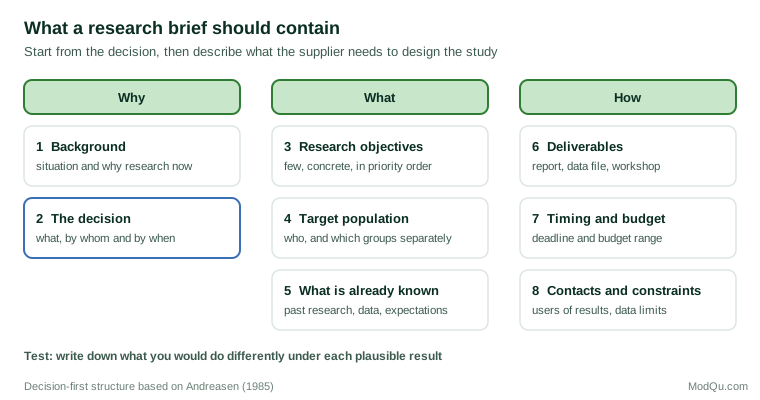
- Background: the business situation, the product or service, the market and what prompted the research now.
- The decision: what will be decided, by whom and by when, and the options under consideration.
- Research objectives: the specific questions the research must answer, stated in priority order. Objectives should be few and concrete. "Understand customer attitudes" is a topic; "measure how many current customers would switch if the price rose by 10%" is an objective.
- Target population: who should be researched, including any groups that must be analysed separately.
- What is already known: previous research, internal data and existing assumptions, so the supplier does not repeat work already done.
- Deliverables: the form of the output, such as a presentation, report, data file or workshop.
- Timing and budget: the date by which results are needed and the budget range. Stating the budget lets suppliers propose the best design for the money rather than guessing.
- Contacts and constraints: who the supplier will work with, who will use the results, and any constraints, such as customer lists that can or cannot be used.
Saying what is already believed
A brief should record the team's current expectations: what they think the research will show and why. This serves two purposes. It helps the supplier design questions that could disprove those expectations, and it gives a record to compare against the results. Without it, people tend to remember afterwards that they had expected whatever the research found, and the research seems to have told them nothing new.
Recording expectations in advance also protects against a quieter problem. When a team examines many results and picks the most favourable, the selected result tends to overstate reality. Smith and Winkler (2006) showed that choosing the alternative with the best estimated value systematically leads to disappointment once the true value is known. Kahneman and Lovallo (1993) described how planners' forecasts are biased toward optimism. A brief that sets the key measures and decision criteria before fieldwork limits these effects, in the same way that pre-registration does in academic research (Nosek et al., 2018). Simmons et al. (2011) showed how flexibility in choosing measures and analyses after the data arrive can produce apparently significant results that are not real.
Working with the supplier
A brief is the start of a conversation. A good supplier will question it, propose a different method or point out that an objective cannot be met within the budget. These challenges are useful and should be invited.
Trust between client and researcher affects whether research is used. Moorman et al. (1992) studied the relationships between users of market research and the researchers who provided it, and found that users' trust in researchers was associated with greater use of the research. Deshpandé and Zaltman (1982) found that managers' use of research depended especially on its technical quality, how actionable and how surprising the findings were, how much managers had interacted with the researchers, and the structure of the organisation. Involving the decision-makers at the briefing stage, and again at the review of interim findings, makes later use more likely.
Use does not always mean an immediate decision. Weiss (1979) distinguished several meanings of research use, including direct use to make a specific decision and conceptual use, in which research gradually changes how people understand a problem. A brief can state which kind of use is intended, so that the supplier knows whether to concentrate on a clear recommendation or on a fuller account of the market.
Checklist before sending the brief
- Is the decision named, with its options and deadline?
- Are the objectives few, concrete and ranked?
- Have expected results and decision thresholds been written down?
- Is existing knowledge summarised?
- Are budget and timing stated?
- Will the people who make the decision see the brief and the results?
A brief that passes these checks gives the supplier what is needed to design a study that answers the right question, and gives the business a clear basis for acting on what the study finds.
References
Andreasen, A. R. (1985). "Backward" market research. Harvard Business Review, 63(3), 176–182.
Deshpandé, R., & Zaltman, G. (1982). Factors affecting the use of market research information: A path analysis. Journal of Marketing Research, 19(1), 14–31. https://doi.org/10.2307/3151527
Kahneman, D., & Lovallo, D. (1993). Timid choices and bold forecasts: A cognitive perspective on risk taking. Management Science, 39(1), 17–31.
Moorman, C., Zaltman, G., & Deshpandé, R. (1992). Relationships between providers and users of market research: The dynamics of trust within and between organizations. Journal of Marketing Research, 29(3), 314–328.
Nosek, B. A., Ebersole, C. R., DeHaven, A. C., & Mellor, D. T. (2018). The preregistration revolution. Proceedings of the National Academy of Sciences, 115(11), 2600–2606. https://doi.org/10.1073/pnas.1708274114
Simmons, J. P., Nelson, L. D., & Simonsohn, U. (2011). False-positive psychology: Undisclosed flexibility in data collection and analysis allows presenting anything as significant. Psychological Science, 22(11), 1359–1366. https://doi.org/10.1177/0956797611417632
Smith, J. E., & Winkler, R. L. (2006). The optimizer's curse: Skepticism and postdecision surprise in decision analysis. Management Science, 52(3), 311–322.
Weiss, C. H. (1979). The many meanings of research utilization. Public Administration Review, 39(5), 426–431. https://doi.org/10.2307/3109916