
Research · Literature and evidence
Citation Practices and Academic Referencing Styles Explained
Why researchers cite sources, how the main referencing styles differ, common citation errors and distortions, how citations are counted and misused as metrics, and practical rules for citing well.
Citations are the visible links between a piece of research and the work it builds on. They tell readers where an idea or a fact came from, allow them to check it, and give credit to the people who produced it. They also do quieter work: they place a study within a field, signal which debates it joins and lend it authority. This article explains why citation matters, how the main referencing styles differ, what goes wrong in practice, how citations came to be counted, and how to cite well.
Why we cite
The most obvious reason to cite is to acknowledge a debt. Using another person's words, data or ideas without acknowledgement is plagiarism, one of the clearest breaches of research integrity. But citation does more than avoid wrongdoing.
It allows verification. A reader who doubts a claim can follow the citation to the original source and check whether it says what the citing author says it does. This is the practical foundation of a cumulative body of knowledge.
It locates the work. Swales (1990) showed that the introductions of research articles follow a typical pattern: the author establishes a research territory by reviewing previous work, identifies a gap in it, and then presents the new study as filling that gap. Citations are the building material of this move. Hyland (1999) found that disciplines differ markedly in how they cite: writers in the humanities and social sciences cite more often, quote more and more often name the cited author in the sentence, while writers in the natural sciences more often place citations in brackets and report findings rather than authors' positions.
It persuades. Gilbert (1977) argued that references are partly tools of persuasion: authors cite well-known work to show that their study is grounded in accepted knowledge and to make their own claims harder to dismiss. Latour (1987) went further, describing how a claim surrounded by many references becomes harder to challenge, because a critic must take on all the cited work as well. Neither author argued that citation is merely rhetorical, but both showed that it is not a neutral record.
The main referencing styles
There are dozens of referencing styles, but most belong to one of two families. Author-date styles put the author's surname and year in the text and list the references alphabetically at the end. Numbered styles put a number in the text and list references in the order first cited. A third family, notes and bibliography, places full or short references in footnotes or endnotes.
The figure below compares the most widely used styles.
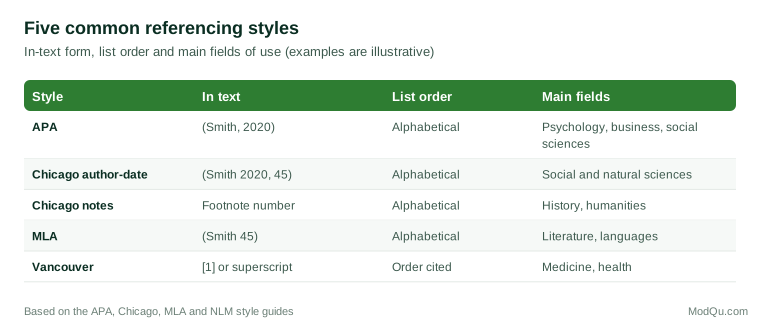
APA style, set out in the Publication manual of the American Psychological Association (American Psychological Association, 2020), is the dominant author-date style in psychology, education, business and much of the social sciences. Its seventh edition recommends including a DOI, written as a full web address, for every work that has one.
Chicago style (University of Chicago Press, 2017) offers two systems: an author-date system similar to APA, and a notes and bibliography system widely used in history and the humanities, where readers expect to see full details of a source at the foot of the page.
MLA style (Modern Language Association of America, 2021) is common in literature and languages. In-text citations give the author and page number rather than the year, reflecting the importance of precise location in a text for close reading.
Vancouver style, the numbered system used by most medical journals, is described in detail in the National Library of Medicine's guide Citing medicine (Patrias, 2007). Numbered styles save space and keep the text uncluttered, which suits fields with many short citations to empirical findings.
Harvard style is a general name for author-date referencing rather than a single fixed standard. Different universities and publishers publish their own versions, so writers using "Harvard" should follow the specific guide required by their institution or publisher.
No style is better than another in principle. What matters is to use one consistently, to follow the version required by the publisher or institution, and to give readers enough information to find every source.
What goes wrong
Citation errors are surprisingly common, and some distort the scientific record.
Quotation errors. A citation may not support the claim it is attached to. Jergas and Baethge (2015) reviewed studies of quotation accuracy in medical journals and estimated that about one in four citations contained an error in how the source was represented, with roughly half of those serious enough that the source did not support, or even contradicted, the claim.
Citing without reading. Simkin and Roychowdhury (2003) analysed how misprints in references propagated through the literature, and estimated from the pattern of repeated errors that only around one in five citers had read the original paper. The rest appear to have copied the reference from another article.
Citation distortion. Greenberg (2009) traced the citation network around a claim in biomedical research and showed how selective citation of supportive studies, the citing of reviews as if they were primary evidence and the gradual transformation of hypotheses into "facts" created an unfounded impression of authority. Critical studies existed but were rarely cited.
Reference rot. Web links decay. Klein et al. (2014) found that about one in five scholarly articles they examined contained references to web content that had disappeared or changed. Persistent identifiers such as DOIs, and archived copies of web pages, reduce this risk.
Coercive and gratuitous citation. Wilhite and Fong (2012) surveyed researchers in economics, sociology, psychology and business and found that a substantial share had been asked by journal editors to add citations to the editor's journal, without any indication that the manuscript was lacking. Such requests inflate journal metrics without adding knowledge.
Patchwriting and plagiarism. Howard (1995) introduced the term patchwriting for copying a source closely while changing a few words, a practice common among inexperienced writers who are still learning to write in their discipline. Pecorari (2003) found patchwriting in the work of postgraduate students writing in a second language, often without any intent to deceive. Both authors argued that the response should be teaching as well as sanctions, but the practice still misrepresents whose words are on the page.
Quoting, paraphrasing and summarising
There are three ways to use a source in the text, and each needs a citation.
Quoting reproduces the author's exact words inside quotation marks. It is best kept for wording that matters in itself: a definition, a striking phrase or a statement whose precise form is being analysed. Most styles ask for a page number with a direct quotation, so that a reader can find the passage.
Paraphrasing restates a specific point from the source in the writer's own words and sentence structure. A good paraphrase shows that the writer has understood the idea, and it fits the flow of the new text better than a quotation would. It still needs a citation, because the idea belongs to the original author.
Summarising condenses the main argument or findings of a whole source, or a large part of it, into a few sentences. Summaries are the usual way of reporting previous studies in a literature review.
Writers who are new to a field often lean too heavily on quotation, or produce paraphrases that stay too close to the original. Both problems are best solved by reading a passage, closing the source, writing the point from memory and then checking the result against the original for accuracy.
Citing data, software and online material
Citation practice has expanded beyond books and articles. Datasets, software and online material now carry much of the evidence on which research depends, and they need to be cited as carefully as publications. Most current style guides, including the APA manual, give formats for datasets, software, websites and social media posts. The core elements are the same as for any source: who created it, when, what it is called, and where it can be found, preferably through a persistent identifier. Citing the exact version of a dataset or program matters, because results can change when the data are revised or the software is updated.
Counting citations
Citations became measurable when Garfield (1955) proposed a citation index for science: a database recording which papers cited which. His original purpose was retrieval, allowing a researcher to follow an idea forward in time from an earlier paper to the later work that used it. The same data soon came to be used to measure influence.
Merton (1968) had already described the Matthew effect in science: well-known researchers receive disproportionate credit for work, while lesser-known researchers receive less than their contribution deserves. Citation counts can amplify this pattern, since frequently cited work is more visible and therefore cited more.
Several metrics followed. The journal impact factor measures the average number of citations to a journal's recent articles. Seglen (1997) showed that citations within any journal are highly skewed, with a small share of articles receiving most of them, so the impact factor says little about any individual article. Hirsch (2005) proposed the h-index: a researcher has an index of h if h of their papers have each been cited at least h times. It is simple and widely used, but it favours long careers and fields that cite heavily.
Bornmann and Daniel (2008) reviewed studies of why authors cite, and found that citations reflect many motives besides intellectual influence, including persuasion, criticism, habit and social ties. Citation counts are therefore a rough measure of attention, not a direct measure of quality. The Leiden Manifesto (Hicks et al., 2015) set out principles for the responsible use of research metrics, including that quantitative measures should support, not replace, expert judgement and that differences between fields must be taken into account.
Citing well
The research on citation practice points to a few practical rules.
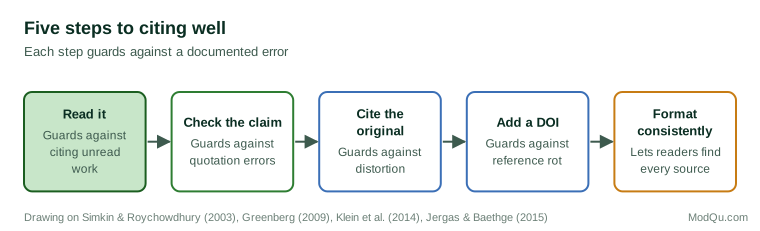
- Read what you cite. Cite a source only after reading the relevant part of it yourself. If you rely on a secondary account, say so.
- Cite the original. Where a review reports a finding, trace it to the primary study when possible, and cite the review for its synthesis rather than for the original result.
- Check that the source supports the claim. Make sure the source says what you say it says, in the context in which it said it.
- Cite fairly. Include work that disagrees with your position where it is relevant. Selective citation creates a misleading picture.
- Use persistent identifiers. Give DOIs where they exist, and archive web pages that may change.
- Use reference management software, but check its output. Tools save time but often import incomplete or incorrect details.
- Follow one style consistently. Use the edition and local version required, and apply it to every entry.
- Write in your own words. Paraphrase by restating an idea in your own structure and language, not by substituting a few words, and use quotation marks for any words taken directly.
Citation in business and applied research
These rules apply equally outside the academic world. A market report, a consultancy paper or a survey summary that states facts without sources asks readers to take its claims on trust. Clear citation lets clients and colleagues check the figures, judge the quality of the evidence behind them and see where the author's own analysis begins. It also protects the author: a statistic traced to a named source can be defended or corrected, while an unsourced figure can only be repeated or doubted.
Conclusion
Citation is the mechanism that turns individual studies into a body of knowledge. It credits others, allows checking, places work within a field and shapes how claims are received. Its value depends on accuracy and fairness: reading what is cited, citing original sources, representing them correctly and including evidence that cuts both ways. Referencing styles differ in form, but all serve the same purpose of letting readers find and verify every source.
References
American Psychological Association. (2020). Publication manual of the American Psychological Association (7th ed.). https://doi.org/10.1037/0000165-000
Bornmann, L., & Daniel, H.-D. (2008). What do citation counts measure? A review of studies on citing behavior. Journal of Documentation, 64(1), 45–80. https://doi.org/10.1108/00220410810844150
Garfield, E. (1955). Citation indexes for science: A new dimension in documentation through association of ideas. Science, 122(3159), 108–111. https://doi.org/10.1126/science.122.3159.108
Gilbert, G. N. (1977). Referencing as persuasion. Social Studies of Science, 7(1), 113–122. https://doi.org/10.1177/030631277700700112
Greenberg, S. A. (2009). How citation distortions create unfounded authority: Analysis of a citation network. BMJ, 339, Article b2680. https://doi.org/10.1136/bmj.b2680
Hicks, D., Wouters, P., Waltman, L., de Rijcke, S., & Rafols, I. (2015). Bibliometrics: The Leiden Manifesto for research metrics. Nature, 520(7548), 429–431. https://doi.org/10.1038/520429a
Hirsch, J. E. (2005). An index to quantify an individual's scientific research output. Proceedings of the National Academy of Sciences, 102(46), 16569–16572. https://doi.org/10.1073/pnas.0507655102
Howard, R. M. (1995). Plagiarisms, authorships, and the academic death penalty. College English, 57(7), 788–806. https://doi.org/10.2307/378403
Hyland, K. (1999). Academic attribution: Citation and the construction of disciplinary knowledge. Applied Linguistics, 20(3), 341–367. https://doi.org/10.1093/applin/20.3.341
Jergas, H., & Baethge, C. (2015). Quotation accuracy in medical journal articles: A systematic review and meta-analysis. PeerJ, 3, Article e1364. https://doi.org/10.7717/peerj.1364
Klein, M., Van de Sompel, H., Sanderson, R., Shankar, H., Balakireva, L., Zhou, K., & Tobin, R. (2014). Scholarly context not found: One in five articles suffers from reference rot. PLoS ONE, 9(12), Article e115253. https://doi.org/10.1371/journal.pone.0115253
Latour, B. (1987). Science in action: How to follow scientists and engineers through society. Harvard University Press.
Merton, R. K. (1968). The Matthew effect in science. Science, 159(3810), 56–63. https://doi.org/10.1126/science.159.3810.56
Modern Language Association of America. (2021). MLA handbook (9th ed.).
Patrias, K. (2007). Citing medicine: The NLM style guide for authors, editors, and publishers (2nd ed.). National Library of Medicine.
Pecorari, D. (2003). Good and original: Plagiarism and patchwriting in academic second-language writing. Journal of Second Language Writing, 12(4), 317–345. https://doi.org/10.1016/j.jslw.2003.08.004
Seglen, P. O. (1997). Why the impact factor of journals should not be used for evaluating research. BMJ, 314(7079), 498–502. https://doi.org/10.1136/bmj.314.7079.497
Simkin, M. V., & Roychowdhury, V. P. (2003). Read before you cite! Complex Systems, 14(3), 269–274.
Swales, J. M. (1990). Genre analysis: English in academic and research settings. Cambridge University Press.
University of Chicago Press. (2017). The Chicago manual of style (17th ed.).
Wilhite, A. W., & Fong, E. A. (2012). Coercive citation in academic publishing. Science, 335(6068), 542–543. https://doi.org/10.1126/science.1212540