
Research · Research design
Building a Conceptual Framework for an Applied Study
What a conceptual framework is, how it differs from a theoretical framework, why applied studies need one, a step-by-step method for building one from theory, prior research and practical knowledge, how to draw and test it, and a worked example from customer research.
Every study rests on ideas about how the world works: which factors matter, how they are related and why. In some studies these ideas are explicit and carefully argued; in others they are implicit, buried in the choice of survey questions or the variables included in an analysis. A conceptual framework makes them explicit. It sets out the key concepts in a study, the relationships expected between them and the reasoning behind those expectations, usually with a diagram. Miles et al. (2014) describe a conceptual framework as a visual or written product that explains the main things to be studied, the key factors, variables or constructs, and the presumed relationships among them. For applied research, which aims to inform a decision or solve a practical problem, the framework is what links the problem to the data. This article explains what a conceptual framework is, why it matters, how to build one and how to use it throughout a study.
What a conceptual framework is, and is not
The term is used in several ways, and it is often confused with related ideas. Ravitch and Riggan (2017) define a conceptual framework as an argument about why the topic of a study matters and why the means proposed to study it are appropriate and rigorous. In this broad sense, the framework includes the researcher's interests, the relevant literature and theory, and the logic connecting them to the research questions and design.
A narrower and more common usage refers to the model of concepts and relationships at the heart of the study. Imenda (2014) distinguishes this from a theoretical framework. A theoretical framework applies a single established theory, such as the theory of planned behaviour or a model of technology acceptance, to the problem at hand. A conceptual framework may draw on several theories, on prior empirical findings and on practical knowledge, and combine them into a model specific to the study. Grant and Osanloo (2014) use the analogy of a blueprint: the theoretical framework is the borrowed design; the conceptual framework is the plan for this particular building.
A conceptual framework is not a literature review, although it draws on one. Nor is it a list of variables. Sutton and Staw (1995) warned that references, data, lists of variables, diagrams and hypotheses are not theory in themselves; what makes a framework useful is the reasoning about why the concepts are related. Whetten (1989) suggested that a theoretical contribution must answer four questions: what factors are involved, how they are related, why they are related, and under what conditions (who, where and when) the relationships hold. The same questions provide a good test for any conceptual framework.
Why applied studies need a framework
Applied studies are often driven by an urgent practical question: why are customers leaving, why is a programme not working, what would make staff more productive? It is tempting to go straight to data collection, asking customers or staff a wide range of questions and hoping that the answer will emerge. Without a framework, this approach has several problems.
It wastes effort. Without a view of what matters, studies collect data on everything, which lengthens surveys and interviews and dilutes attention from the factors that count.
It misses important factors. Without a framework that draws on what is already known, a study may omit variables that prior research shows are important. A study of customer loyalty that does not measure switching costs, for example, may misinterpret why dissatisfied customers stay.
It produces uninterpretable results. Finding that twenty variables are each correlated with an outcome tells a decision-maker little. A framework that specifies how the variables relate, which are causes, which are consequences and which modify relationships, allows results to be interpreted.
It leads to the wrong analysis. Pearl and Mackenzie (2018) show that whether a variable should be controlled for depends on its causal role. Adjusting for a variable that lies on the causal path between a cause and an outcome, or for a common consequence of both, can produce misleading results. Only a framework that specifies these roles allows the correct analysis to be chosen.
Lewin (1951) observed that there is nothing so practical as a good theory, and the point applies directly here. A clear framework makes applied research more efficient, more interpretable and more useful.
Sources for a framework
Maxwell (2013) identifies four main sources from which a conceptual framework is built.
Existing theory. Established theories provide tested ideas about how concepts relate. The theory of planned behaviour (Ajzen, 1991), for example, proposes that behaviour is predicted by intentions, which depend on attitudes, perceived social norms and perceived control. The technology acceptance model (Davis, 1989) proposes that people adopt a technology when they perceive it as useful and easy to use. Parasuraman et al. (1985) proposed a model of service quality based on gaps between customers' expectations and their perceptions of service. Such theories provide a starting point, but they rarely fit an applied problem exactly.
Prior research. Empirical studies of similar problems show which factors have been found to matter, how they have been measured and which relationships have held up. A focused review of this research is essential.
Practical and experiential knowledge. People who work with the problem every day, such as managers, front-line staff and customers, often know things that the literature does not. Interviews or workshops with them can identify factors and mechanisms specific to the setting. Maxwell (2013) also encourages researchers to acknowledge their own experience and assumptions as part of the framework, so that they can be examined rather than left hidden.
Pilot and exploratory research. Preliminary studies can test whether proposed concepts are meaningful to participants and whether expected relationships appear in initial data.
Alvesson and Sandberg (2011) add that frameworks can be strengthened by questioning the assumptions on which existing theories rest, rather than accepting them. An applied framework that challenges a common assumption, for example that satisfaction is the main driver of loyalty, may produce more useful insights than one that simply applies the standard model.
Building a framework step by step
Jabareen (2009) proposed a procedure for building conceptual frameworks from multiple sources. Adapting it to applied research gives a sequence of steps.
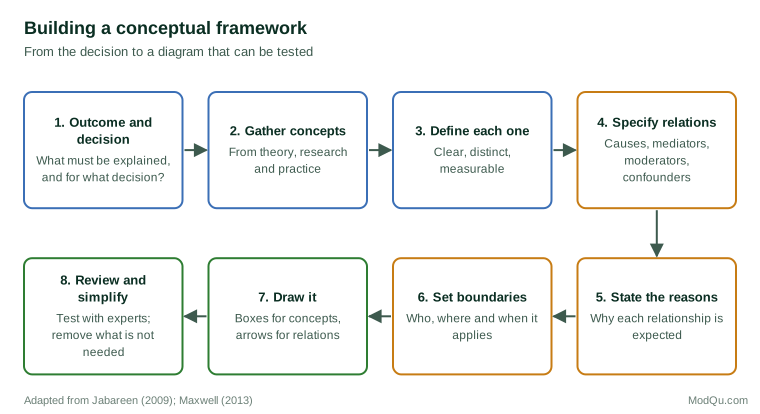
1. Define the outcome and the decision
Start with what the study must explain or predict and the decision it will inform. A framework for a study of customer retention should specify exactly what retention means (renewing a contract, making a repeat purchase within a year) and what decision depends on it (where to invest in service improvements, how to target retention offers). Booth et al. (2016) emphasise that a research problem is defined by its consequences: what will be understood or done differently once the question is answered.
2. Gather candidate concepts
Review theory, prior research and practical knowledge to list the concepts that might explain the outcome. At this stage, the list should be broad. For customer retention, it might include satisfaction, perceived value, trust, switching costs, competitor offers, habit, service failures and life events such as moving house.
3. Define each concept
Each concept needs a clear definition, so that it can later be measured. Bacharach (1989) emphasised that a theory's constructs must be clearly defined and distinct from one another. Overlapping concepts, such as "satisfaction" and "happiness with the service", should be merged or distinguished.
4. Specify relationships
Decide how the concepts relate. Some will be causes of the outcome. Some will be mediators, which lie on the path between a cause and the outcome and explain how the effect occurs. Some will be moderators, which change the strength or direction of a relationship. Baron and Kenny (1986) set out the distinction between mediators and moderators, which is often confused. In a retention framework, satisfaction might affect retention partly through trust (a mediator), and the effect of satisfaction on retention might be weaker when switching costs are high (a moderator). Some variables will be confounders, which affect both a cause and the outcome and must be accounted for in the analysis.
5. State the reasoning
For each relationship, state why it is expected, citing theory, evidence or practical knowledge. Whetten (1989) argued that the explanation of why concepts are related is the core of a theoretical contribution. Weick (1989) described theory construction as a process of disciplined imagination, in which researchers generate many possible explanations and then select among them using explicit criteria.
6. Set boundaries
State where the framework is expected to apply: which customers, which markets, which period. Whetten (1989) emphasised that the conditions under which a theory holds are part of the theory.
7. Draw the framework
A diagram makes the framework concrete and easy to discuss. Boxes represent concepts and arrows represent expected relationships, with arrows pointing to other arrows to indicate moderators. Greenland et al. (1999) developed formal rules for causal diagrams, which allow researchers to determine which variables must be adjusted for to estimate a particular effect. Even informal diagrams help, because they force the researcher to decide where each arrow goes.
8. Review and simplify
Share the framework with colleagues, subject experts and practitioners, and ask whether anything important is missing and whether any element can be removed. A framework with dozens of concepts and arrows is rarely useful; the aim is to capture the most important relationships for the decision at hand.
A worked example
Consider a regional bank that has seen a rise in customers closing their accounts and wants to know why and what to do. A framework might be built as follows (illustrative).
The outcome is account closure within twelve months. The decision is where to invest a retention budget. A review of research on customer retention, interviews with branch staff and an analysis of complaint records suggest several concepts: satisfaction with service, perceived value of fees, trust in the bank, switching costs, competitor offers, and service failures such as errors or long waits.
The framework proposes that service failures reduce satisfaction, which in turn reduces trust; that satisfaction, trust and perceived value each reduce the likelihood of closure; that switching costs weaken the link between dissatisfaction and closure, so that dissatisfied customers with many linked products are less likely to leave; and that competitor offers increase the likelihood of closure. Customer age and tenure are included as factors that may affect both satisfaction and closure.
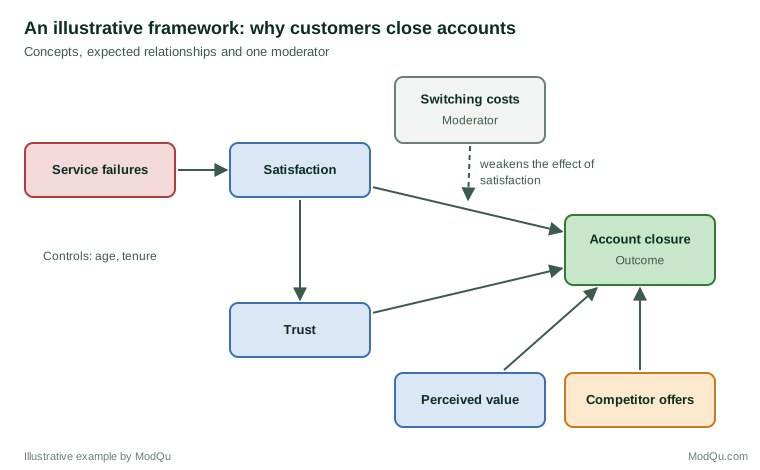
This framework has immediate practical uses. It tells the researcher what to measure in a survey and which records to link. It specifies the analysis: for example, testing whether the effect of satisfaction on closure is weaker for customers with high switching costs. And it shapes the recommendations: if service failures turn out to be the main driver of dissatisfaction, and dissatisfaction the main driver of closure among customers with low switching costs, the retention budget should go into reducing failures and be targeted at those customers.
Testing a framework against data
Once data are collected, the framework becomes a set of expectations that can be checked. Several questions guide this.
Do the expected relationships appear? Each arrow in the framework implies a prediction: that two measures are associated, in a particular direction, possibly only under certain conditions. Testing each prediction shows which parts of the framework are supported.
Are the mediators doing what was expected? If satisfaction is expected to affect closure partly through trust, the analysis can test whether the association between satisfaction and closure weakens once trust is taken into account, using methods appropriate to the design. Mediation claims are causal claims and need careful justification, especially with cross-sectional data.
Do the moderators matter? Testing whether the effect of satisfaction differs between customers with high and low switching costs shows whether the framework's conditions hold.
What is missing? Large amounts of unexplained variation, or patterns that the framework did not anticipate, suggest that an important factor has been left out. Open-ended survey questions and follow-up interviews can help identify it.
Does the framework hold across groups? If the framework fits well for some segments and poorly for others, its boundaries may need to be redrawn.
Bacharach (1989) emphasised that a useful theory must be falsifiable: it must be possible for the data to show that it is wrong. A framework that is drawn so loosely that any result can be accommodated provides no guidance. The value of stating expected relationships clearly in advance is that the data can then confirm, refine or overturn them.
Frameworks in qualitative research
Conceptual frameworks are not only for quantitative studies. In qualitative research, the framework is usually more tentative and is expected to change as data are collected. Miles et al. (2014) recommend starting with a provisional framework, which guides the initial choice of participants, questions and codes, and revising it as the analysis proceeds. Maxwell (2013) describes the framework as one component of an interactive design, in which goals, framework, questions, methods and validity are adjusted in relation to one another throughout the study. Leshem and Trafford (2007) found that doctoral examiners often see a weak or missing conceptual framework as a key weakness of qualitative theses, because without it the analysis has no clear direction.
Frameworks in programme evaluation
In evaluation, the conceptual framework often takes the form of a programme theory or theory of change: an account of how a programme's activities are expected to lead to its intended outcomes. Weiss (1995) argued that making these assumptions explicit allows evaluators to test each link in the chain, so that if a programme fails, it is possible to see where. Funnell and Rogers (2011) describe how to develop and use programme theories, and the related logic model sets out the chain from inputs and activities to outputs, outcomes and impact (W. K. Kellogg Foundation, 2004). These are conceptual frameworks adapted to the task of evaluating interventions.
Using the framework throughout the study
A conceptual framework is not a one-off exercise for a proposal. It should shape every stage of the study.
- Design. The framework determines which concepts must be measured and which comparisons are needed.
- Measurement. Each concept in the framework should map to one or more measures, defined in advance.
- Sampling. The framework shows which groups must be included to test the expected relationships and boundaries.
- Analysis. The framework specifies which relationships to test, which variables to adjust for and which to treat as mediators or moderators.
- Interpretation. Results are interpreted in relation to the framework: which relationships were supported, which were not and what that implies.
- Revision. Findings that contradict the framework are among the most valuable results of a study, because they show where understanding was wrong.
Creswell and Creswell (2018) recommend presenting the framework explicitly in proposals and reports, so that readers can judge whether the design and analysis follow from it.
Common mistakes
Several mistakes recur in conceptual frameworks.
- A list rather than a framework. Naming concepts without specifying their relationships or the reasons for them.
- Everything connected to everything. Diagrams with so many arrows that no clear expectation can be tested.
- Unclear concepts. Concepts that are vague or overlap, making measurement and interpretation difficult.
- Confusing roles. Treating mediators as confounders, or the reverse, which leads to the wrong analysis.
- No link to the decision. A framework that explains an outcome but offers no guidance on what can be changed.
- Fixed in place. Treating the framework as final and ignoring evidence that contradicts it.
Conclusion
A conceptual framework makes explicit the ideas on which a study rests: the concepts that matter, how they are related and why. For applied research, it connects the practical problem to the data, determines what is measured and how it is analysed, and makes results interpretable for decision-makers. Building a framework from theory, prior research and practical knowledge, defining concepts carefully, specifying their relationships and the reasons for them, and drawing the result as a diagram that can be discussed and tested, is one of the most valuable investments a researcher can make before collecting any data.
References
Ajzen, I. (1991). The theory of planned behavior. Organizational Behavior and Human Decision Processes, 50(2), 179–211. https://doi.org/10.1016/0749-5978(91)90020-T
Alvesson, M., & Sandberg, J. (2011). Generating research questions through problematization. Academy of Management Review, 36(2), 247–271. https://doi.org/10.5465/amr.2009.0188
Bacharach, S. B. (1989). Organizational theories: Some criteria for evaluation. Academy of Management Review, 14(4), 496–515. https://doi.org/10.5465/amr.1989.4308374
Baron, R. M., & Kenny, D. A. (1986). The moderator–mediator variable distinction in social psychological research: Conceptual, strategic, and statistical considerations. Journal of Personality and Social Psychology, 51(6), 1173–1182. https://doi.org/10.1037/0022-3514.51.6.1173
Booth, W. C., Colomb, G. G., Williams, J. M., Bizup, J., & FitzGerald, W. T. (2016). The craft of research (4th ed.). University of Chicago Press.
Creswell, J. W., & Creswell, J. D. (2018). Research design: Qualitative, quantitative, and mixed methods approaches (5th ed.). SAGE.
Davis, F. D. (1989). Perceived usefulness, perceived ease of use, and user acceptance of information technology. MIS Quarterly, 13(3), 319–340. https://doi.org/10.2307/249008
Funnell, S. C., & Rogers, P. J. (2011). Purposeful program theory: Effective use of theories of change and logic models. Jossey-Bass.
Grant, C., & Osanloo, A. (2014). Understanding, selecting, and integrating a theoretical framework in dissertation research: Creating the blueprint for your "house". Administrative Issues Journal, 4(2), 12–26. https://doi.org/10.5929/2014.4.2.9
Greenland, S., Pearl, J., & Robins, J. M. (1999). Causal diagrams for epidemiologic research. Epidemiology, 10(1), 37–48. https://doi.org/10.1097/00001648-199901000-00008
Imenda, S. (2014). Is there a conceptual difference between theoretical and conceptual frameworks? Journal of Social Sciences, 38(2), 185–195. https://doi.org/10.1080/09718923.2014.11893249
Jabareen, Y. (2009). Building a conceptual framework: Philosophy, definitions, and procedure. International Journal of Qualitative Methods, 8(4), 49–62. https://doi.org/10.1177/160940690900800406
Leshem, S., & Trafford, V. (2007). Overlooking the conceptual framework. Innovations in Education and Teaching International, 44(1), 93–105. https://doi.org/10.1080/14703290601081407
Lewin, K. (1951). Field theory in social science: Selected theoretical papers (D. Cartwright, Ed.). Harper & Brothers.
Maxwell, J. A. (2013). Qualitative research design: An interactive approach (3rd ed.). SAGE.
Miles, M. B., Huberman, A. M., & Saldaña, J. (2014). Qualitative data analysis: A methods sourcebook (3rd ed.). SAGE.
Parasuraman, A., Zeithaml, V. A., & Berry, L. L. (1985). A conceptual model of service quality and its implications for future research. Journal of Marketing, 49(4), 41–50. https://doi.org/10.1177/002224298504900403
Pearl, J., & Mackenzie, D. (2018). The book of why: The new science of cause and effect. Basic Books.
Ravitch, S. M., & Riggan, M. (2017). Reason & rigor: How conceptual frameworks guide research (2nd ed.). SAGE.
Sutton, R. I., & Staw, B. M. (1995). What theory is not. Administrative Science Quarterly, 40(3), 371–384. https://doi.org/10.2307/2393788
W. K. Kellogg Foundation. (2004). Logic model development guide. W. K. Kellogg Foundation.
Weick, K. E. (1989). Theory construction as disciplined imagination. Academy of Management Review, 14(4), 516–531. https://doi.org/10.5465/amr.1989.4308376
Weiss, C. H. (1995). Nothing as practical as good theory: Exploring theory-based evaluation for comprehensive community initiatives for children and families. In J. P. Connell, A. C. Kubisch, L. B. Schorr, & C. H. Weiss (Eds.), New approaches to evaluating community initiatives: Concepts, methods, and contexts (pp. 65–92). Aspen Institute.
Whetten, D. A. (1989). What constitutes a theoretical contribution? Academy of Management Review, 14(4), 490–495. https://doi.org/10.5465/amr.1989.4308371