
Investigation · Method and the future
Training and Certification Standards for Investigative Knowledge Professionals
Investigators make decisions that affect people's liberty, livelihoods and reputations, yet in many fields anyone can call themselves an investigator. This article explains the competences investigators need, how professional training and certification schemes work, what research shows about building expertise, how to evaluate training, and how organisations can set standards.
Investigators gather evidence, interview people, analyse information and reach findings that can lead to prosecution, dismissal, regulatory penalties or public reports. Errors can ruin lives and allow wrongdoing to continue. Yet investigative work is carried out by a wide range of people, from police detectives and regulatory inspectors to human resources staff, auditors, compliance officers, private investigators and journalists, many with little formal training in investigation. Training and certification standards aim to ensure that people who investigate have the knowledge and skills the work requires. This article explains what those competences are, how training and certification work, and what research says about developing expertise.
What investigators need to know and do
Core investigative doctrine sets out the knowledge and skills that apply across most investigations: understanding the legal framework, planning an investigation, identifying and preserving evidence, interviewing, managing information, testing hypotheses, making decisions and reporting findings (Association of Chief Police Officers [ACPO], 2005). Stelfox (2009) and Tong et al. (2009) describe how these elements combine in practice and emphasise that investigation requires both technical knowledge and judgement.
Specialist areas add their own requirements. Digital forensic examiners need technical knowledge of devices, file systems and tools. Fraud examiners need accounting knowledge. Interviewers of vulnerable witnesses need specific training. Forensic scientists need validated methods and demonstrated proficiency. Professional standards for United States inspectors general require that investigators collectively possess the knowledge, skills and abilities needed for their work, and that they maintain them through continuing training (Council of the Inspectors General on Integrity and Efficiency [CIGIE], 2011).
Levels of competence
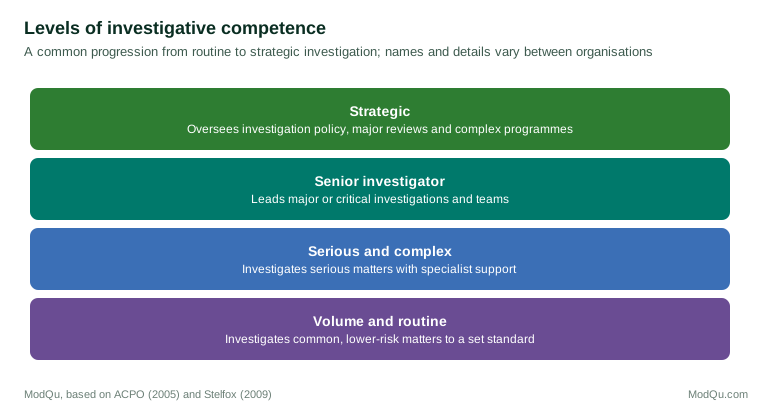
Several professional schemes organise competence into levels. In England and Wales, a professionalising investigation programme for police describes progressive levels, from volume crime through serious and complex investigation to leading major investigations, each requiring training, workplace assessment and supervised experience before accreditation (Stelfox, 2009). The principle generalises: investigators should take on cases matched to their demonstrated competence, with supervision until they are ready for more.
Certification
Certification is the formal recognition, by an independent body, that a person meets defined competence requirements. An international standard sets requirements for bodies that certify persons, including impartiality, a defined scheme of competence requirements, valid assessment methods and procedures for recertification (International Organization for Standardization [ISO], 2012). Certifications exist for fraud examiners, digital forensic examiners, workplace investigators and many other specialisms.
Forensic science has moved towards mandatory standards. The National Research Council (2009) recommended that forensic science practitioners be certified and laboratories accredited, after finding wide variation in training and quality. Laboratory accreditation standards require that personnel be competent, with documented training, supervision and monitoring of performance (ISO, 2017).
Certification has limits. Many certifications test knowledge rather than performance, and holding one does not guarantee good judgement in a real case. Organisations should treat certification as one indicator of competence, alongside supervised experience, performance review and peer assessment.
How expertise develops
Research on expertise suggests that experience alone is not enough. Ericsson et al. (1993) found that expert performance in many fields results from deliberate practice: effortful activity designed to improve specific aspects of performance, with feedback. Kahneman and Klein (2009) concluded that intuitive expertise can be trusted only in environments that are regular enough to be learned and where practitioners receive timely and accurate feedback on their judgements. Investigation often lacks such feedback: investigators rarely learn whether a case they closed was correctly resolved, and outcomes may take years to emerge. Fahsing and Ask (2016) found that experienced detectives generated more hypotheses and considered more investigative actions than novices, but that experience alone did not guarantee better reasoning.
This has practical implications. Training should include realistic cases with known answers, structured feedback, and opportunities to practise skills such as interviewing and hypothesis testing. Supervisors and peer reviewers should give investigators feedback on their decisions. Reviews of closed cases, including those later reopened, can provide the feedback that ordinary practice lacks.
Does training work?
Training should be evaluated, not assumed to work. Kirkpatrick and Kirkpatrick (2006) describe four levels of evaluation: participants' reactions, their learning, changes in their behaviour at work, and results for the organisation. Most training is evaluated only at the first level. Salas et al. (2012) review the science of training and conclude that it is most effective when it is based on a needs analysis, includes practice and feedback, and is supported in the workplace after the course ends.
Investigative interviewing illustrates the point. A national evaluation of a widely used investigative interviewing course in England and Wales found that while officers' knowledge improved, many skills taught on the course were not consistently used in real interviews afterwards, and recommended supervision and ongoing assessment in the workplace (Clarke & Milne, 2001). Training in the cognitive interview has been shown to increase the amount of accurate information obtained (Fisher & Geiselman, 1992), but only when interviewers use the techniques consistently. Debriefs after real cases and exercises also improve performance (Tannenbaum & Cerasoli, 2013).
Ethics and conduct
Competence is not only technical. Investigators hold power over the people they investigate and access to sensitive information, so training and certification schemes should include ethics: impartiality, avoiding conflicts of interest, respecting privacy and confidentiality, treating people with dignity, and reporting honestly even when findings are unwelcome. Many certification bodies require members to follow a code of conduct and can withdraw certification for breaches. Organisations should also set clear expectations about how investigators handle pressure from managers or clients to reach a particular conclusion, and give them a route to raise concerns. An investigator who is skilled but willing to bend findings is more dangerous than one who is inexperienced but honest.
Setting standards in an organisation
Organisations that investigate, whether a police force, a regulator or a company's compliance team, can set standards by:
- Defining competences for each type of investigation they carry out.
- Matching cases to competence, assigning complex or sensitive cases only to qualified investigators.
- Providing foundation and specialist training, with practice and assessment.
- Requiring supervised experience before independent work.
- Recognising certification where relevant, without treating it as sufficient.
- Building in feedback through supervision, peer review and case reviews.
- Requiring continuing development, because law, technology and methods change.
- Evaluating training for its effect on practice, not only on satisfaction.
A short example
The following hypothetical case shows standards in practice. A market research company decides that all staff who investigate panel fraud or misconduct complaints must meet a defined standard. It sets out competences in evidence preservation, interviewing, data analysis, data protection law and report writing. New investigators complete a short course, then handle three cases under supervision, each reviewed against a checklist. Experienced investigators take a certification in fraud examination and attend an annual refresher on interviewing. Every quarter, a peer review panel examines a sample of closed cases and gives feedback. After a year, the company finds fewer complaints about its investigations, faster completion, and more consistent reports.
Conclusion
Investigators need legal knowledge, technical skills and sound judgement. Training and certification schemes define and recognise competence, often in levels matched to the seriousness of cases. Research shows that expertise develops through deliberate practice with feedback, which ordinary investigative work often lacks, and that training changes practice only when it is reinforced in the workplace. Organisations that define competences, match cases to competence, provide practice and feedback, require continuing development and evaluate their training can raise the quality and fairness of their investigations.
References
Association of Chief Police Officers. (2005). Practice advice on core investigative doctrine. National Centre for Policing Excellence.
Clarke, C., & Milne, R. (2001). National evaluation of the PEACE investigative interviewing course (Police Research Award Scheme Report No. PRAS/149). Home Office.
Council of the Inspectors General on Integrity and Efficiency. (2011). Quality standards for investigations.
Ericsson, K. A., Krampe, R. T., & Tesch-Römer, C. (1993). The role of deliberate practice in the acquisition of expert performance. Psychological Review, 100(3), 363–406. https://doi.org/10.1037/0033-295X.100.3.363
Fahsing, I., & Ask, K. (2016). The making of an expert detective: The role of experience in English and Norwegian police officers' investigative decision-making. Psychology, Crime & Law, 22(3), 203–223. https://doi.org/10.1080/1068316X.2015.1077249
Fisher, R. P., & Geiselman, R. E. (1992). Memory-enhancing techniques for investigative interviewing: The cognitive interview. Charles C Thomas.
International Organization for Standardization. (2012). Conformity assessment — General requirements for bodies operating certification of persons (ISO/IEC 17024:2012).
International Organization for Standardization. (2017). General requirements for the competence of testing and calibration laboratories (ISO/IEC 17025:2017).
Kahneman, D., & Klein, G. (2009). Conditions for intuitive expertise: A failure to disagree. American Psychologist, 64(6), 515–526. https://doi.org/10.1037/a0016755
Kirkpatrick, D. L., & Kirkpatrick, J. D. (2006). Evaluating training programs: The four levels (3rd ed.). Berrett-Koehler.
National Research Council. (2009). Strengthening forensic science in the United States: A path forward. National Academies Press. https://doi.org/10.17226/12589
Salas, E., Tannenbaum, S. I., Kraiger, K., & Smith-Jentsch, K. A. (2012). The science of training and development in organizations: What matters in practice. Psychological Science in the Public Interest, 13(2), 74–101. https://doi.org/10.1177/1529100612436661
Stelfox, P. (2009). Criminal investigation: An introduction to principles and practice. Willan.
Tannenbaum, S. I., & Cerasoli, C. P. (2013). Do team and individual debriefs enhance performance? A meta-analysis. Human Factors, 55(1), 231–245. https://doi.org/10.1177/0018720812448394
Tong, S., Bryant, R. P., & Horvath, M. A. H. (2009). Understanding criminal investigation. Wiley-Blackwell. https://doi.org/10.1002/9780470749616