
Investigation · Method and the future
Psychological Support for Investigators Handling Traumatic Cases
Investigators of child abuse, homicide, terrorism, disasters and online harms are repeatedly exposed to distressing material and accounts. This article explains the psychological effects of that exposure, including secondary traumatic stress, vicarious trauma, burnout and post-traumatic stress disorder, the risk and protective factors, what the evidence says about support interventions, and how organisations can protect investigators and the quality of their work.
Some investigations require people to look closely at the worst things humans do. Investigators of child sexual abuse may view thousands of images and videos of children being harmed. Homicide detectives attend scenes, examine post-mortem photographs and listen to recordings of violence. Investigators of terrorism, war crimes and disasters review footage of mass casualties. Fraud and safeguarding investigators hear repeated accounts of exploitation and suffering. Journalists, content moderators and open-source researchers increasingly do similar work. Such exposure can harm the people who do it, and harmed investigators can make poorer decisions. Supporting them is both a duty of care and a condition for reliable investigation. This article explains the psychological effects of traumatic casework, who is most at risk, what the evidence says about support, and how organisations can build effective protection.
Why investigators are affected
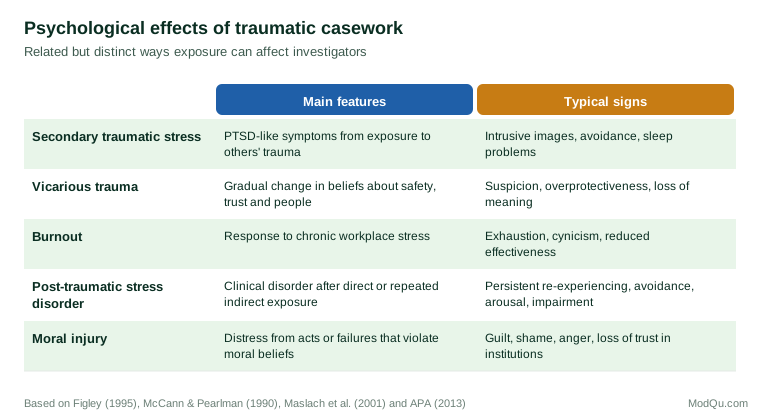
Most people associate psychological trauma with direct experience of danger, such as an assault or accident. But trauma can also result from repeated exposure to other people's suffering. The diagnostic criteria for post-traumatic stress disorder (PTSD) recognise this explicitly: they include repeated or extreme exposure to aversive details of traumatic events, giving as examples first responders collecting human remains and police officers repeatedly exposed to details of child abuse, and they note that this can include exposure through electronic media when it is work-related (American Psychiatric Association, 2013).
Several related concepts describe the effects of indirect exposure. Figley (1995) described secondary traumatic stress, or compassion fatigue, as the natural consequence of caring for and helping traumatised people, with symptoms resembling PTSD such as intrusive images, avoidance and heightened arousal. McCann and Pearlman (1990) described vicarious traumatisation as a gradual change in a helper's inner experience, including their beliefs about safety, trust and the goodness of others, resulting from empathic engagement with traumatised people. Burnout, by contrast, is a response to chronic workplace stress more generally, characterised by exhaustion, cynicism and a reduced sense of effectiveness (Maslach et al., 2001). Some investigators also describe moral injury, distress arising from witnessing or being unable to prevent acts that violate their moral beliefs, for example when a case cannot be prosecuted or a child cannot be found.
Evidence of harm
Research with investigators confirms that these effects are common. Perez et al. (2010) surveyed law enforcement investigators exposed to disturbing media images, mostly in child exploitation cases, and found that greater exposure was associated with higher levels of secondary traumatic stress and burnout. Burns et al. (2008), interviewing members of Canadian police teams investigating internet child exploitation, found that many experienced intrusive images, emotional distress and changes in their relationships, and that they used a range of coping strategies, some helpful and some not. Powell et al. (2014) found that Australian officers who viewed child exploitation material described both immediate distress and longer-term effects, such as heightened protectiveness towards their own children. Craun et al. (2015) found that such work affected investigators' relationships with family and friends, including reluctance to discuss work and increased worry about children. Tehrani (2016), in a study of internet child abuse investigators in the United Kingdom, found that personality traits were associated with levels of secondary trauma.
Policing more broadly carries high rates of trauma-related problems. Brewin et al. (2022), in a large survey of United Kingdom police officers and staff, found high rates of PTSD and complex PTSD, many of them undiagnosed. Violanti et al. (2017), reviewing research on police stressors and health, found associations between police work and a range of physical and mental health problems, and noted that organisational stressors, such as workload and management practices, often matter as much as exposure to traumatic incidents.
The same risks extend beyond policing. Feinstein et al. (2014) found that journalists who frequently viewed violent user-generated images showed higher levels of psychological distress, including PTSD symptoms, than those who viewed them less often. Steiger et al. (2021) reviewed research on commercial content moderators and found evidence of significant psychological harm from repeated exposure to disturbing content, along with weak support in many workplaces.
Why it matters for investigations
Psychological harm affects not only investigators' wellbeing but the quality of their work. Exhaustion, intrusive memories and avoidance can lead investigators to avoid examining material thoroughly, to miss details, or to make hasty decisions to end exposure. Cynicism and changed beliefs can affect how investigators treat victims, witnesses and suspects. High staff turnover in specialist units removes experienced investigators, leaving cases to people with less skill. Supporting investigators is therefore part of maintaining investigative quality.
Risk and protective factors
Not everyone exposed to traumatic material develops lasting problems. Meta-analyses of risk factors for PTSD have found that the severity of the trauma, lack of social support after the event and additional life stress are among the strongest predictors, while factors such as previous trauma and psychiatric history also contribute (Brewin et al., 2000; Ozer et al., 2003). Social support consistently emerges as protective.
For investigators, specific risk factors include the volume and intensity of exposure, particularly to material involving children or extreme violence; identifying with victims, for example when they resemble the investigator's own children; lack of control over workload; inadequate training; poor supervision; and a workplace culture that discourages talking about distress. Karasek (1979) showed that jobs combining high demands with low control over how the work is done produce the greatest strain, a finding relevant to investigators facing heavy caseloads with little say over their work.
Protective factors include adequate training and preparation, control over the pace and manner of exposure, supportive supervisors and colleagues, a sense that the work is meaningful and effective, a life outside work, and access to confidential support.
Stigma and help-seeking
Many investigators are reluctant to seek help. They may fear being seen as weak, being removed from specialist work, or having their fitness for duty questioned. Karaffa and Koch (2016) found that police officers' reluctance to seek mental health services was associated with perceived stigma, and that officers often underestimated how supportive their colleagues would be. Organisations can reduce stigma by making support routine rather than exceptional, ensuring confidentiality, involving leaders who speak openly about mental health, and making clear that seeking help will not by itself lead to removal from a role.
What works: the evidence on interventions
Psychological debriefing. A common response to traumatic incidents has been single-session psychological debriefing, in which those involved are encouraged to talk through the event and their reactions soon afterwards. A Cochrane systematic review found no evidence that single-session individual debriefing prevented PTSD, and some evidence that it might increase symptoms in some people (Rose et al., 2002). National guidance in England advises against offering psychologically focused debriefing for the prevention or treatment of PTSD (National Institute for Health and Care Excellence [NICE], 2018). This does not mean that operational debriefs, which review what happened in a case, are harmful; it means that compulsory emotional debriefing should not be relied on to prevent trauma.
Psychological first aid and early support. Hobfoll et al. (2007), drawing on the evidence on mass trauma, identified five elements of effective immediate and mid-term support: promoting a sense of safety, calming, a sense of self- and community efficacy, connectedness, and hope. These principles inform psychological first aid and peer support programmes.
Peer support and risk assessment. Trauma risk management, developed in the British armed forces and since adopted by some police and emergency services, trains peers to identify colleagues at risk after traumatic events, offer support and refer those who need it to professional help (Greenberg et al., 2008). The approach relies on monitoring rather than compulsory debriefing.
Screening and monitoring. Many specialist units, especially those investigating child exploitation, require regular psychological screening, for example once or twice a year, using standardised measures. The Professional Quality of Life scale, for example, measures compassion satisfaction, burnout and secondary traumatic stress (Stamm, 2010). Screening can identify problems early, but it must be confidential and linked to support, or people will not answer honestly.
Treatment. For those who develop PTSD, effective treatments exist. National guidance recommends trauma-focused psychological therapies, such as trauma-focused cognitive behavioural therapy and eye movement desensitisation and reprocessing, for adults with PTSD (NICE, 2018). Organisations should ensure that investigators can access such treatment quickly and confidentially.
Pressure points in the life of a case
Strain is not evenly spread across an investigation. Certain moments carry particular risk: the first exposure to a new and distressing type of material; cases involving children of the same age as the investigator's own; the death or serious harm of a victim the investigator has come to know; giving evidence in court, where investigators may have to revisit material and face hostile questioning; and periods of intense media or public attention, when investigators may be criticised publicly and cannot respond. The end of a long case can also be difficult, when the structure and purpose it provided suddenly disappear, particularly if the outcome is disappointing. Supervisors who know these pressure points can plan check-ins around them, offer additional support before and after court appearances, and make sure that investigators are not left to absorb public criticism alone. Recognising that strain is predictable at these moments helps normalise it and makes asking for help easier.
Organisational measures
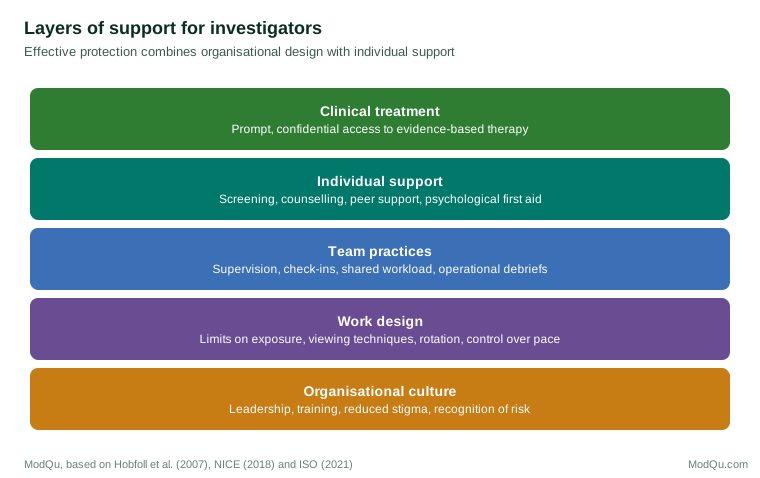
Individual support cannot compensate for poorly designed work. An international standard on psychological health and safety at work requires organisations to identify psychosocial hazards, such as workload, lack of control, exposure to traumatic material and poor support, and to manage them through work design as well as individual support (International Organization for Standardization [ISO], 2021). Guidance on work-related stress emphasises managing demands, control, support, relationships, role clarity and change (Health and Safety Executive, n.d.).
For investigators handling traumatic material, practical measures include:
- Selection and preparation. Explain the nature of the work honestly before people join specialist units, and provide training in what to expect and how to cope.
- Limits on exposure. Set limits on viewing time, schedule breaks, avoid viewing material at the end of the day, and avoid unnecessary repeated viewing.
- Viewing techniques. Use technical measures to reduce impact, such as viewing images in smaller sizes or greyscale, muting audio unless it is needed, and using automated tools such as hash matching to categorise known material without viewing it.
- Control over pace. Give investigators as much control as possible over when and how they view material.
- Rotation. Allow investigators to rotate out of the most intense roles, without penalty to their careers.
- Supervision. Train supervisors to recognise signs of distress, hold regular check-ins and manage workloads.
- Peer support. Train peers to offer support and to refer colleagues to professional help.
- Confidential services. Provide confidential access to counselling and treatment, separate from management.
- Recognition. Acknowledge the value of the work and the cost it carries.
Researchers, interviewers and survey staff
Traumatic material is not confined to criminal and regulatory investigations. Researchers who interview people about violence, abuse, illness or loss, and survey staff who hear disclosures during interviews or read open-text responses, can also be affected. Dickson-Swift et al. (2009), interviewing qualitative researchers who studied sensitive topics, found that many experienced emotional exhaustion, intrusive thoughts and difficulty leaving the work behind, and that they often received little preparation or support from their institutions. Research and survey organisations should therefore apply the same principles as investigative bodies: warn staff in advance when a study is likely to involve distressing content, give them a clear procedure for responding to disclosures, limit the volume of distressing material any one person handles, provide supervision and debriefing in the operational sense, and make confidential support available.
Supporting non-specialist investigators
Not all exposure happens in specialist units. Workplace investigators, human resources staff, auditors and compliance officers may encounter traumatic material unexpectedly, for example when investigating a harassment complaint involving sexual assault, a suicide, or the discovery of illegal images on a work computer. They may have no training or support. Organisations should recognise that any investigation can involve distressing material, brief investigators when it is likely, offer debriefing in the operational sense and access to support, and avoid assigning such cases to people working alone.
The role of leaders
Leaders set the conditions in which investigators work. They decide caseloads, staffing and budgets for support services, and their behaviour signals whether talking about distress is acceptable. Leaders who acknowledge the emotional cost of the work, take part in wellbeing programmes themselves and protect investigators who ask for help do more to reduce stigma than any policy document. Leaders also need to recognise that pressure to clear backlogs can push exposure beyond safe limits, and should treat exposure limits as part of operational planning, not as an optional extra. Where specialist units are small, leaders should plan for cover so that investigators can take leave and rotate without leaving cases unattended.
Life outside work and leaving the role
Traumatic casework can follow investigators home. Craun et al. (2015) found that investigators of crimes against children often avoided discussing their work with family and friends, became more protective of their own children and sometimes felt isolated as a result. Organisations can help by giving families general information about the nature of the work and the signs of strain, without breaching confidentiality, and by encouraging investigators to maintain interests and relationships outside work. Effects can also persist after investigators leave a specialist role or retire. Exit interviews, a final screening and continued access to support for a period after leaving help ensure that problems are not simply carried away unnoticed.
Knowing whether support works
Organisations should evaluate their support arrangements rather than assume they are effective. Useful information includes the results of confidential screening over time, the uptake of support services, sickness absence and turnover in specialist units, and feedback from investigators about whether they know how to obtain help and trust that it is confidential. Changes in work design, such as new exposure limits or viewing tools, can be assessed by comparing these indicators before and after. Results should be reviewed with investigators and used to adjust the programme, in the same way that lessons from investigations themselves are used to improve practice.
A short example
The following hypothetical case shows these measures in practice. A company's internal investigations team, normally focused on fraud, is asked to investigate an allegation that an employee has stored child sexual abuse images on a work laptop. The team leader recognises that this is outside the team's experience. She stops the investigation at the point of preserving the laptop and reports the matter to the police, who take over the examination of the images, so that no one in the team needs to view them. The investigator who first opened a folder and saw several images is offered a confidential conversation with the company's employee assistance service and a check-in from a trained peer a week later. The team leader also arranges for the investigator to work on lower-intensity cases for a few weeks, without any implication of failure.
At the next team meeting, the team holds an operational debrief on how the case was handled, agrees a procedure for future cases involving such material, and adds a short briefing on trauma exposure to its induction training. Three months later, the investigator reports through the confidential screening programme that intrusive images have faded, and the team's procedure is used when a second case arises.
Conclusion
Investigators who handle traumatic cases are at real risk of secondary traumatic stress, vicarious trauma, burnout, PTSD and moral injury, and these harms can affect the quality of their work. Research shows that risk rises with the intensity of exposure and falls with social support, control and preparation. Single-session psychological debriefing does not prevent PTSD and may harm some people, while psychological first aid, peer support, confidential screening and evidence-based treatment are better supported. Above all, organisations must manage psychosocial risk through the design of the work itself: limiting exposure, using technical measures to reduce impact, giving investigators control and rotation, training supervisors and building a culture in which seeking help is normal. Protecting investigators protects the people they serve.
References
American Psychiatric Association. (2013). Diagnostic and statistical manual of mental disorders (5th ed.). https://doi.org/10.1176/appi.books.9780890425596
Brewin, C. R., Andrews, B., & Valentine, J. D. (2000). Meta-analysis of risk factors for posttraumatic stress disorder in trauma-exposed adults. Journal of Consulting and Clinical Psychology, 68(5), 748–766. https://doi.org/10.1037/0022-006X.68.5.748
Brewin, C. R., Miller, J. K., Soffia, M., Peart, A., & Burchell, B. (2022). Posttraumatic stress disorder and complex posttraumatic stress disorder in UK police officers. Psychological Medicine, 52(7), 1287–1295. https://doi.org/10.1017/S0033291720003025
Burns, C. M., Morley, J., Bradshaw, R., & Domene, J. (2008). The emotional impact on and coping strategies employed by police teams investigating internet child exploitation. Traumatology, 14(2), 20–31. https://doi.org/10.1177/1534765608319082
Craun, S. W., Bourke, M. L., & Coulson, F. N. (2015). The impact of internet crimes against children work on relationships with families and friends: An exploratory study. Journal of Family Violence, 30(3), 393–402. https://doi.org/10.1007/s10896-015-9680-3
Dickson-Swift, V., James, E. L., Kippen, S., & Liamputtong, P. (2009). Researching sensitive topics: Qualitative research as emotion work. Qualitative Research, 9(1), 61–79. https://doi.org/10.1177/1468794108098031
Feinstein, A., Audet, B., & Waknine, E. (2014). Witnessing images of extreme violence: A psychological study of journalists in the newsroom. JRSM Open, 5(8). https://doi.org/10.1177/2054270414533323
Figley, C. R. (Ed.). (1995). Compassion fatigue: Coping with secondary traumatic stress disorder in those who treat the traumatized. Brunner/Mazel.
Greenberg, N., Langston, V., & Jones, N. (2008). Trauma risk management (TRiM) in the UK Armed Forces. Journal of the Royal Army Medical Corps, 154(2), 124–127. https://doi.org/10.1136/jramc-154-02-11
Health and Safety Executive. (n.d.). Management standards for work-related stress.
Hobfoll, S. E., Watson, P., Bell, C. C., Bryant, R. A., Brymer, M. J., Friedman, M. J., Friedman, M., Gersons, B. P. R., de Jong, J. T. V. M., Layne, C. M., Maguen, S., Neria, Y., Norwood, A. E., Pynoos, R. S., Reissman, D., Ruzek, J. I., Shalev, A. Y., Solomon, Z., Steinberg, A. M., & Ursano, R. J. (2007). Five essential elements of immediate and mid-term mass trauma intervention: Empirical evidence. Psychiatry, 70(4), 283–315. https://doi.org/10.1521/psyc.2007.70.4.283
International Organization for Standardization. (2021). Occupational health and safety management — Psychological health and safety at work — Guidelines for managing psychosocial risks (ISO 45003:2021).
Karaffa, K. M., & Koch, J. M. (2016). Stigma, pluralistic ignorance, and attitudes toward seeking mental health services among police officers. Criminal Justice and Behavior, 43(6), 759–777. https://doi.org/10.1177/0093854815613103
Karasek, R. A., Jr. (1979). Job demands, job decision latitude, and mental strain: Implications for job redesign. Administrative Science Quarterly, 24(2), 285–308. https://doi.org/10.2307/2392498
Maslach, C., Schaufeli, W. B., & Leiter, M. P. (2001). Job burnout. Annual Review of Psychology, 52, 397–422. https://doi.org/10.1146/annurev.psych.52.1.397
McCann, I. L., & Pearlman, L. A. (1990). Vicarious traumatization: A framework for understanding the psychological effects of working with victims. Journal of Traumatic Stress, 3(1), 131–149. https://doi.org/10.1007/BF00975140
National Institute for Health and Care Excellence. (2018). Post-traumatic stress disorder (NICE Guideline NG116).
Ozer, E. J., Best, S. R., Lipsey, T. L., & Weiss, D. S. (2003). Predictors of posttraumatic stress disorder and symptoms in adults: A meta-analysis. Psychological Bulletin, 129(1), 52–73. https://doi.org/10.1037/0033-2909.129.1.52
Perez, L. M., Jones, J., Englert, D. R., & Sachau, D. (2010). Secondary traumatic stress and burnout among law enforcement investigators exposed to disturbing media images. Journal of Police and Criminal Psychology, 25(2), 113–124. https://doi.org/10.1007/s11896-010-9066-7
Powell, M., Cassematis, P., Benson, M., Smallbone, S., & Wortley, R. (2014). Police officers' perceptions of their reactions to viewing internet child exploitation material. Journal of Police and Criminal Psychology, 30(2), 103–111. https://doi.org/10.1007/s11896-014-9148-z
Rose, S. C., Bisson, J., Churchill, R., & Wessely, S. (2002). Psychological debriefing for preventing post traumatic stress disorder (PTSD). Cochrane Database of Systematic Reviews, (2), Article CD000560. https://doi.org/10.1002/14651858.CD000560
Stamm, B. H. (2010). The concise ProQOL manual (2nd ed.). ProQOL.org.
Steiger, M., Bharucha, T. J., Venkatagiri, S., Riedl, M. J., & Lease, M. (2021). The psychological well-being of content moderators: The emotional labor of commercial moderation and avenues for improving support. In Proceedings of the 2021 CHI Conference on Human Factors in Computing Systems (Article 341). ACM. https://doi.org/10.1145/3411764.3445092
Tehrani, N. (2016). Extraversion, neuroticism and secondary trauma in Internet child abuse investigators. Occupational Medicine, 66(5), 403–407. https://doi.org/10.1093/occmed/kqw004
Violanti, J. M., Charles, L. E., McCanlies, E., Hartley, T. A., Baughman, P., Andrew, M. E., Fekedulegn, D., Ma, C. C., Mnatsakanova, A., & Burchfiel, C. M. (2017). Police stressors and health: A state-of-the-art review. Policing: An International Journal, 40(4), 642–656. https://doi.org/10.1108/PIJPSM-06-2016-0097