
Investigation · Scientific and technical investigation
Scene Examination and Physical Evidence Collection for Reconstructive Knowledge
A scene holds physical traces of what happened there, but only for a limited time and only if it is examined properly. This article explains the principles of scene examination, from securing and recording a scene to searching, collecting and preserving evidence, how traces support reconstruction of events, the scientific and cognitive limits of physical evidence, and how to keep scene work reliable.
Every event leaves traces. A burglar forces a window and leaves tool marks and shoe impressions; an assailant leaves fibres, DNA and blood patterns; a fire leaves burn patterns that reveal where it started; a machine failure leaves fracture surfaces that show how it broke. A scene is where these traces are concentrated. Examined carefully, it can allow investigators to reconstruct what happened, in what order and sometimes by whom. Examined carelessly, it can lose or contaminate the evidence, or produce a reconstruction that looks scientific but is wrong.
Scene examination applies far beyond homicide. Similar principles govern the investigation of workplace accidents, fires, product failures, environmental incidents and even data breaches, where the "scene" is a computer system. This article explains the principles of scene examination and physical evidence collection, how traces support reconstruction, the limits of physical evidence, and the practices that keep scene work reliable.
The principle of exchange
The foundation of scene examination is often expressed as Locard's exchange principle: that every contact leaves a trace. Edmond Locard, who founded one of the first police laboratories in Lyon, wrote about the analysis of dust and other microscopic traces that criminals carry away from and leave at scenes (Locard, 1930). Kirk (1953) expressed the same idea, arguing that physical evidence cannot be wrong, perjure itself or be wholly absent; only its interpretation can err.
Modern forensic science qualifies this optimism. Traces may be transferred, but they can also be lost, degraded, contaminated or transferred indirectly. Inman and Rudin (2001) describe the core principles of criminalistics as transfer, identification, classification, individualisation, association and reconstruction, and stress that each step depends on understanding how traces are produced and how they persist. Roux et al. (2012) argue that forensic science should be understood as the study of traces as remnants of past activity, not only as a set of laboratory techniques, and that scene examination is where that study begins.
Securing and recording the scene
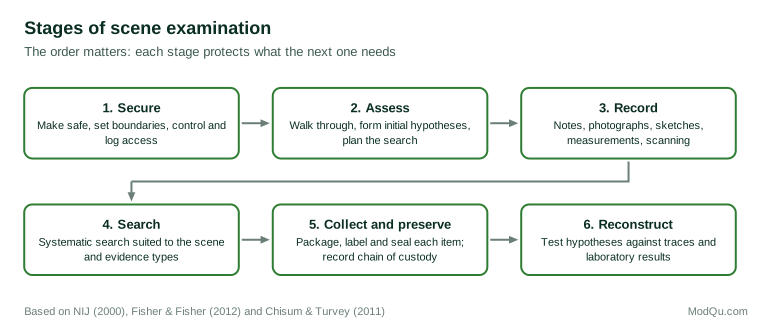
The first duty at any scene is safety: to care for injured people and remove hazards. The second is to protect the evidence. Guidance for law enforcement emphasises establishing boundaries wide enough to include all areas where evidence may be found, controlling access, keeping a log of everyone who enters and leaves, and preventing anything being moved, added or removed (National Institute of Justice [NIJ], 2000). Every person who enters a scene can bring in or carry away traces, so entry should be limited to those who need to be there, wearing protective clothing where appropriate.
Before anything is touched, the scene is recorded. Recording usually combines notes, photographs, video, sketches and measurements, and increasingly three-dimensional laser scanning. The record should show the scene as found, the position of each item before collection, and the relationships between items. Fisher and Fisher (2012) emphasise that recording is not a formality: once the scene is disturbed, the record is the only way to show what it looked like, and errors or omissions cannot be corrected later.
Assessing and searching
An initial walk-through, carried out along a defined path, allows the examiner to understand the scene, identify fragile evidence that needs immediate attention, and plan the search. At this stage examiners begin to form hypotheses about what happened, which help direct the search. They must also guard against fixing on one explanation too soon, because a search guided only by the first hypothesis may miss evidence that points elsewhere.
Searches follow systematic patterns, such as lines, grids, zones or spirals, chosen to suit the scene's size and layout. The aim is to cover the whole area consistently so that absence of evidence can be stated with confidence. Different types of evidence require different methods: alternative light sources for body fluids and fibres, oblique lighting for shoe impressions, chemical treatments for latent fingerprints and blood, and careful sieving or excavation for buried items. Ribaux et al. (2010) argue that scene examination should also be intelligence-led: traces collected at one scene can be linked to others, so examiners should consider what information would help connect the case to a wider pattern of offending.
Types of physical evidence
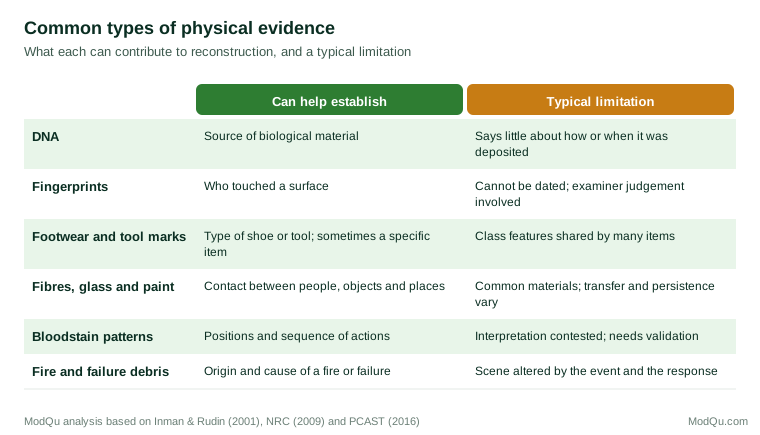
Biological evidence. DNA profiling, first applied forensically in the 1980s (Gill et al., 1985), can identify the source of blood, semen, saliva and other biological material with great discriminating power. Its sensitivity has increased so much that profiles can now be obtained from tiny amounts of DNA left by touch; van Oorschot and Jones (1997) showed that DNA could be recovered from objects that had merely been handled. This sensitivity brings a problem: DNA can be transferred indirectly, for example from one person to another by a handshake and then to an object, so the presence of someone's DNA does not prove that they touched the item or were present. Meakin and Jamieson (2013) reviewed research on DNA transfer and concluded that the presence of DNA should be interpreted with reference to how it might have got there.
Fingerprints. Fingerprints can associate a person with a surface, but they cannot usually be dated, and comparison depends on examiner judgement. The misidentification of Brandon Mayfield, a lawyer in Oregon, as the source of a print connected with the 2004 Madrid train bombings, a conclusion verified by several FBI examiners, showed that experienced examiners could make errors (Office of the Inspector General, 2006).
Impressions and marks. Footwear, tyre and tool marks can indicate the type of item that made them and sometimes, through accidental damage, a specific item.
Trace evidence. Fibres, glass, paint, soil and hair can indicate contact between people, objects and places. Their value depends on how common the material is and on how readily it transfers and persists.
Patterns. Bloodstain patterns, burn patterns and fracture surfaces can indicate positions, movements and sequences of events. Bevel and Gardner (2008) describe how bloodstain pattern analysis is used in reconstruction, but the scientific basis of some pattern interpretations has been questioned (National Research Council [NRC], 2009).
Collection, packaging and chain of custody
Each item must be collected in a way that preserves the information it carries. Biological material is usually dried and packaged in paper to prevent degradation; items for fingerprinting are handled at edges and packaged to avoid friction; fire debris is sealed in airtight containers to retain volatile accelerants. Each package is labelled with a unique reference, a description, the location of recovery, the time and the collector, and sealed so that any later opening is evident.
The chain of custody records every transfer of the item from collection to court: who held it, when, where it was stored and for what purpose it was opened. Gaps or inconsistencies give grounds to challenge whether the item examined in the laboratory is the item recovered from the scene, or whether it was contaminated in between.
Contamination prevention runs through every stage. Examiners wear protective clothing, change gloves between items, use clean tools, and separate items from different people and locations. Elimination samples from examiners and others who entered the scene allow their DNA and fingerprints to be excluded. The investigation of the murder of Meredith Kercher in Italy, in which the conviction of Amanda Knox and Raffaele Sollecito was ultimately annulled, illustrates the consequences of poor practice: independent experts criticised the collection of a bra clasp weeks after the murder and the handling of a knife, and questioned whether low-level DNA results could exclude contamination (Gill, 2016).
Quality standards help. Many forensic bodies seek accreditation of their scene examination work to the international standard for inspection bodies, which requires documented procedures, competent staff, impartiality and records that allow work to be checked (International Organization for Standardization [ISO], 2012).
From traces to reconstruction
Reconstruction uses the traces and their relationships to infer the sequence of events. Chisum and Turvey (2011) describe reconstruction as a scientific process of forming hypotheses about what happened and testing them against the physical evidence, the scene record and laboratory results, rejecting hypotheses that the evidence contradicts. Reconstruction may establish the point of entry, the movements of people within a scene, the positions of a victim and assailant, the order of events, or the origin of a fire.
A useful way to frame reconstruction is through the levels of proposition described by Cook et al. (1998). Evidence may address the source of a trace (whose DNA is this?), the activity that produced it (how did it get here?) or the offence itself (did this person commit the crime?). Laboratory analysis usually answers source questions; scene examination and reconstruction are needed to address activity questions, and these are often what matters to the case. A DNA profile on a door handle may identify its source, but only an understanding of the scene, the timing and the possibility of innocent transfer can say whether it means the person opened that door during the crime.
The value of physical evidence
Physical evidence is often assumed to be decisive, but research suggests a more complex picture. Studies in England and the United States found that forensic evidence was collected at a minority of scenes and contributed to the solution of a relatively small proportion of cases, with its greatest value often lying in confirming suspects identified by other means (Tilley & Ford, 1996; Peterson et al., 2010). At the same time, a large field experiment in the United States found that collecting and analysing DNA at burglary scenes substantially increased the number of suspects identified and arrested compared with conventional investigation alone (Roman et al., 2008). The value of physical evidence therefore depends on the type of crime, the quality of scene work and whether the results are used to generate leads rather than only to confirm them.
Scientific limits
A series of reviews has questioned the scientific basis of some forensic disciplines. The National Research Council (2009) found that, with the exception of nuclear DNA analysis, no forensic method had been rigorously shown to consistently and with a high degree of certainty demonstrate a connection between evidence and a specific individual or source. The President's Council of Advisors on Science and Technology (2016) reviewed feature-comparison methods, such as fingerprints, firearms marks, footwear and bite marks, and found that several lacked adequate empirical evidence of validity and known error rates. Saks and Koehler (2005) argued that forensic identification needed to shift from assumptions of uniqueness and examiner certainty to empirically tested methods with known error rates.
These findings do not mean physical evidence is unreliable, but they mean its weight must be justified. Courts in the United States assess the reliability of expert evidence by asking, among other things, whether a method has been tested and has a known error rate (Daubert v. Merrell Dow Pharmaceuticals, Inc., 1993).
Cognitive bias at the scene and in the laboratory
Examiners are people, and their judgements can be affected by context. Dror and Charlton (2006) found that fingerprint examiners changed their own earlier conclusions about the same prints when told contextual information suggesting a different answer. Kassin et al. (2013) reviewed evidence that knowledge of a suspect, a confession or investigators' expectations can influence the collection and interpretation of forensic evidence, a phenomenon they called forensic confirmation bias. At the scene, a strong early hypothesis can influence what is searched for, what is collected and what is recorded as significant.
Several measures reduce these effects. Linear sequential unmasking requires examiners to analyse and document the evidence before being exposed to reference material or other case information, revealing information only as it is needed (Dror et al., 2015). At scenes, recording observations before interpretation, considering several hypotheses, and having a second examiner review key decisions can reduce the risk that expectations shape the evidence.
Scenes beyond crime
The same principles apply in other investigations. Workplace accident investigators secure and record the scene, preserve equipment, and examine physical damage and positions to reconstruct the sequence of events. Fire investigators trace burn patterns back to an area of origin and test hypotheses about the cause. Engineers examining a structural or product failure study fracture surfaces and deformation. In each case, the scene is altered by the event itself and by the emergency response, so investigators must distinguish traces of the event from traces of rescue, firefighting or clean-up, and must record the scene before it is cleared. Digital incidents follow the same logic. When a computer system is compromised, the affected servers, logs and network records form the scene: they should be isolated and copied before systems are rebuilt, the copies verified with hash values, and every action recorded, because restoring service quickly can destroy the traces needed to understand what happened.
Good practice
The research and guidance point to a set of practices for scene work:
- Protect first. Secure the scene quickly, set wide boundaries, control and log access.
- Record before touching. Photograph, sketch, measure and scan the scene as found.
- Search systematically. Use patterns suited to the scene, and record what was searched and what was not found.
- Prevent contamination. Use protective clothing, change gloves, separate items, and take elimination samples.
- Package and document. Label, seal and log every item, and maintain an unbroken chain of custody.
- Keep hypotheses open. Consider several explanations and record observations separately from interpretations.
- Address activity, not only source. Ask how each trace came to be where it was.
- Use validated methods. Rely on methods with demonstrated validity and known error rates, and state their limitations.
A short example
The following hypothetical case illustrates these practices. A warehouse worker is found injured at the bottom of a mezzanine staircase. The manager suspects a fall caused by the worker's carelessness. The safety investigator, however, treats the area as a scene. She stops work in the area, photographs the staircase, the worker's position as reported by first aiders, and the surrounding floor, and measures the stair dimensions. A systematic search finds a loose stair nosing on the third step from the top, fresh scuff marks on it consistent with a shoe sole, and a small oily residue on the step below. She collects a sample of the residue in a sealed container and retains the nosing as evidence, recording each item.
The investigator considers several hypotheses: a slip on oil, a trip on the loose nosing, a medical event, and the worker's own haste. Laboratory analysis identifies the residue as hydraulic fluid matching a forklift parked nearby, which maintenance records show had a leak reported the previous week. The scuff marks are consistent with the worker's shoe. The worker's account, given after the physical evidence has been recorded, describes the foot slipping and then catching. The reconstruction supports a slip on fluid leading to a trip on the loose nosing. Corrective actions address the forklift maintenance process and stair inspections, not only the worker's behaviour.
Conclusion
A scene holds the physical traces of an event, and careful examination can turn those traces into knowledge of what happened. That depends on securing and recording the scene before it is disturbed, searching systematically, collecting and packaging evidence to prevent loss and contamination, and maintaining a clear chain of custody. Reconstruction must test hypotheses against the evidence and address how traces came to be where they were, not only whose they are. Reviews of forensic science and research on cognitive bias show that physical evidence is powerful but not infallible. Scene examiners who keep hypotheses open, use validated methods, and record their observations and reasoning give reconstruction a firm foundation.
References
Bevel, T., & Gardner, R. M. (2008). Bloodstain pattern analysis with an introduction to crime scene reconstruction (3rd ed.). CRC Press.
Chisum, W. J., & Turvey, B. E. (2011). Crime reconstruction (2nd ed.). Academic Press.
Cook, R., Evett, I. W., Jackson, G., Jones, P. J., & Lambert, J. A. (1998). A hierarchy of propositions: Deciding which level to address in casework. Science & Justice, 38(4), 231–239. https://doi.org/10.1016/S1355-0306(98)72117-3
Daubert v. Merrell Dow Pharmaceuticals, Inc., 509 U.S. 579 (1993).
Dror, I. E., & Charlton, D. (2006). Why experts make errors. Journal of Forensic Identification, 56(4), 600–616.
Dror, I. E., Thompson, W. C., Meissner, C. A., Kornfield, I., Krane, D., Saks, M., & Risinger, M. (2015). Context management toolbox: A linear sequential unmasking (LSU) approach for minimizing cognitive bias in forensic decision making. Journal of Forensic Sciences, 60(4), 1111–1112. https://doi.org/10.1111/1556-4029.12805
Fisher, B. A. J., & Fisher, D. R. (2012). Techniques of crime scene investigation (8th ed.). CRC Press.
Gill, P. (2016). Analysis and implications of the miscarriages of justice of Amanda Knox and Raffaele Sollecito. Forensic Science International: Genetics, 23, 9–18. https://doi.org/10.1016/j.fsigen.2016.02.015
Gill, P., Jeffreys, A. J., & Werrett, D. J. (1985). Forensic application of DNA 'fingerprints'. Nature, 318(6046), 577–579. https://doi.org/10.1038/318577a0
Inman, K., & Rudin, N. (2001). Principles and practice of criminalistics: The profession of forensic science. CRC Press.
International Organization for Standardization. (2012). Conformity assessment — Requirements for the operation of various types of bodies performing inspection (ISO/IEC 17020:2012).
Kassin, S. M., Dror, I. E., & Kukucka, J. (2013). The forensic confirmation bias: Problems, perspectives, and proposed solutions. Journal of Applied Research in Memory and Cognition, 2(1), 42–52. https://doi.org/10.1016/j.jarmac.2013.01.001
Kirk, P. L. (1953). Crime investigation: Physical evidence and the police laboratory. Interscience.
Locard, E. (1930). The analysis of dust traces. Part I. American Journal of Police Science, 1(3), 276–298. https://doi.org/10.2307/1147154
Meakin, G., & Jamieson, A. (2013). DNA transfer: Review and implications for casework. Forensic Science International: Genetics, 7(4), 434–443. https://doi.org/10.1016/j.fsigen.2013.03.013
National Institute of Justice. (2000). Crime scene investigation: A guide for law enforcement. U.S. Department of Justice.
National Research Council. (2009). Strengthening forensic science in the United States: A path forward. National Academies Press. https://doi.org/10.17226/12589
Office of the Inspector General. (2006). A review of the FBI's handling of the Brandon Mayfield case. U.S. Department of Justice.
Peterson, J. L., Sommers, I., Baskin, D., & Johnson, D. (2010). The role and impact of forensic evidence in the criminal justice process. National Institute of Justice.
President's Council of Advisors on Science and Technology. (2016). Forensic science in criminal courts: Ensuring scientific validity of feature-comparison methods. Executive Office of the President.
Ribaux, O., Baylon, A., Roux, C., Delémont, O., Lock, E., Zingg, C., & Margot, P. (2010). Intelligence-led crime scene processing. Part I: Forensic intelligence. Forensic Science International, 195(1–3), 10–16. https://doi.org/10.1016/j.forsciint.2009.10.027
Roman, J. K., Reid, S., Reid, J., Chalfin, A., Adams, W., & Knight, C. (2008). The DNA field experiment: Cost-effectiveness analysis of the use of DNA in the investigation of high-volume crimes. Urban Institute.
Roux, C., Crispino, F., & Ribaux, O. (2012). From forensics to forensic science. Current Issues in Criminal Justice, 24(1), 7–24. https://doi.org/10.1080/10345329.2012.12035941
Saks, M. J., & Koehler, J. J. (2005). The coming paradigm shift in forensic identification science. Science, 309(5736), 892–895. https://doi.org/10.1126/science.1111565
Tilley, N., & Ford, A. (1996). Forensic science and crime investigation (Crime Detection and Prevention Series Paper 73). Home Office.
van Oorschot, R. A. H., & Jones, M. K. (1997). DNA fingerprints from fingerprints. Nature, 387(6635), 767. https://doi.org/10.1038/42838