
Investigation · Law, ethics and regulation
Regulatory Investigations: How Authorities Investigate Businesses
Financial, environmental, safety, data protection and other regulators investigate businesses suspected of breaking the rules. This article explains how regulatory investigations begin, the powers regulators use, the stages they follow, how they decide outcomes, and how businesses should respond.
Most businesses are subject to regulators: financial conduct authorities, environmental agencies, health and safety inspectors, data protection authorities, competition authorities and many others. When a regulator suspects that a business has broken the rules, it may open an investigation. Regulatory investigations differ from criminal investigations by police, although they can lead to criminal charges, and from private investigations, because regulators have legal powers that private investigators lack. Understanding how they work helps businesses comply, respond effectively and learn from the findings.
How investigations begin
Regulators learn of possible breaches from complaints, whistleblowers, the business's own reports, routine inspections and data returns, other agencies, media reports and their own analysis of market data. Because they cannot investigate everything, they set priorities. Sparrow (2000) argues that effective regulators organise their work around identifying and solving important problems, rather than responding case by case. In the United Kingdom, a government review recommended that regulators base inspections and enforcement on assessments of risk, concentrating effort where harm is most likely (Hampton, 2005).
Some investigations begin with a business reporting its own problem. In some regimes reporting is mandatory: data protection law, for example, requires many personal data breaches to be reported to the authority. In others, voluntary reporting and cooperation may reduce the eventual penalty.
Powers
Regulators' powers are set by statute and vary widely. Common powers include requiring the production of documents and information, compelling individuals to answer questions, entering premises, sometimes with a warrant, and appointing investigators. In the United Kingdom, for example, the Financial Services and Markets Act 2000 gives the financial regulator powers to require information and documents and to appoint investigators with power to compel attendance and answers. These powers are subject to safeguards, such as protection for legally privileged documents and limits on the use of compelled answers in criminal proceedings.
Stages
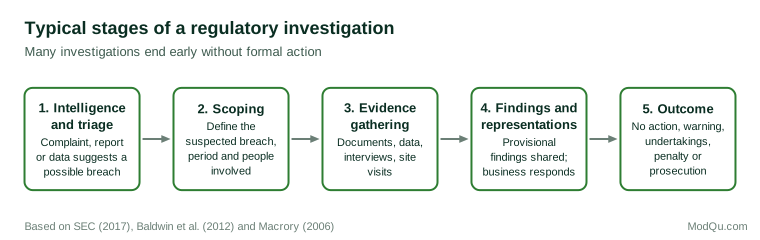
Investigations usually move from triage and scoping to evidence gathering, often taking months or years. The United States Securities and Exchange Commission's enforcement manual, for example, describes how staff open matters, issue requests and subpoenas for documents, take testimony and, before recommending action, typically give the business or individual a chance to make a written submission explaining why charges should not be brought (U.S. Securities and Exchange Commission [SEC], 2017).
Choosing an outcome
Regulators can choose from a range of outcomes. Ayres and Braithwaite (1992) proposed that regulators should begin with persuasion and escalate to warnings, penalties and ultimately licence removal or prosecution only when a business does not respond. Macrory (2006) recommended that sanctions aim to change behaviour, eliminate any financial gain from non-compliance, be proportionate and restore the harm caused. Baldwin et al. (2012) describe how regulators combine deterrence with persuasion, and how the choice depends on the seriousness of the breach and the business's attitude. Hodges (2015) argues that sanctions work best when they support ethical cultures in businesses rather than relying on deterrence alone.
Outcomes can be large. In 2015, the United States Environmental Protection Agency issued a notice of violation to Volkswagen for installing software that detected emissions tests and switched on full emissions controls only during testing (U.S. Environmental Protection Agency [EPA], 2015). The case led to criminal and civil penalties and settlements of many billions of dollars. In 2020, the United Kingdom's Information Commissioner's Office fined British Airways £20 million after an investigation found that weaknesses in its security had allowed attackers to obtain the personal and payment card details of hundreds of thousands of customers (Information Commissioner's Office [ICO], 2020).
Fairness and accountability
Because regulators combine the roles of investigator and decision-maker, fairness is a central concern. Good practice and, in many systems, law require that the business be told the case against it, see the key evidence, have an opportunity to respond before a decision is made, and be able to appeal to an independent tribunal or court. Some regulators separate the staff who investigate from those who decide, so that the decision is not made by the people who built the case. Regulators are also accountable for how they use their powers, through courts, parliamentary scrutiny and published annual reports. Publishing enforcement decisions serves two purposes: it holds the regulator to account for consistency, and it shows other businesses what conduct the regulator will not accept.
Responding as a business
Businesses facing an investigation are generally advised to preserve all relevant documents immediately, take legal advice, cooperate within their legal rights, provide accurate and complete information, and investigate the issue themselves so that they understand what happened. Regulators often take account of cooperation, self-reporting and remediation when deciding outcomes. Obstructing an investigation, destroying documents or giving misleading information is usually a separate offence and can turn a minor matter into a serious one. Above all, a business should treat the investigation as an opportunity to find and correct the underlying problem, because the regulator will assess not only what went wrong but whether it has been put right.
Conclusion
Regulatory investigations use statutory powers to establish whether businesses have broken the rules, and they follow a sequence from intelligence and scoping through evidence gathering to findings and outcomes. Regulators choose among responses ranging from advice to prosecution, guided by the seriousness of the breach and the business's response. Businesses that preserve evidence, cooperate, investigate themselves and fix problems are best placed to limit the consequences.
References
Ayres, I., & Braithwaite, J. (1992). Responsive regulation: Transcending the deregulation debate. Oxford University Press.
Baldwin, R., Cave, M., & Lodge, M. (2012). Understanding regulation: Theory, strategy, and practice (2nd ed.). Oxford University Press.
Financial Services and Markets Act 2000, c. 8 (UK).
Hampton, P. (2005). Reducing administrative burdens: Effective inspection and enforcement. HM Treasury.
Hodges, C. (2015). Law and corporate behaviour: Integrating theories of regulation, enforcement, compliance and ethics. Hart Publishing.
Information Commissioner's Office. (2020, October 16). Penalty notice: British Airways plc.
Macrory, R. B. (2006). Regulatory justice: Making sanctions effective. Cabinet Office.
Sparrow, M. K. (2000). The regulatory craft: Controlling risks, solving problems, and managing compliance. Brookings Institution Press.
U.S. Environmental Protection Agency. (2015, September 18). Notice of violation [Letter to Volkswagen AG, Audi AG and Volkswagen Group of America].
U.S. Securities and Exchange Commission, Division of Enforcement. (2017). Enforcement manual.