
Investigation · Journalism and public investigation
Landmark Investigations That Changed Public Knowledge
A small number of investigations have changed what the public knows, and what societies do, about health, power, war and privacy. This article reviews landmark investigations from the 1880s to the present, the methods they used, and what they teach about how investigation creates public knowledge.
Some investigations do more than expose a single wrong. They change what a society knows about itself, and in doing so change laws, institutions and behaviour for generations. This article looks at a selection of landmark investigations, chosen to show a range of subjects, methods and periods. Each shows how careful inquiry, often against strong resistance, turned hidden facts into public knowledge.
Going inside: Nellie Bly and the asylum
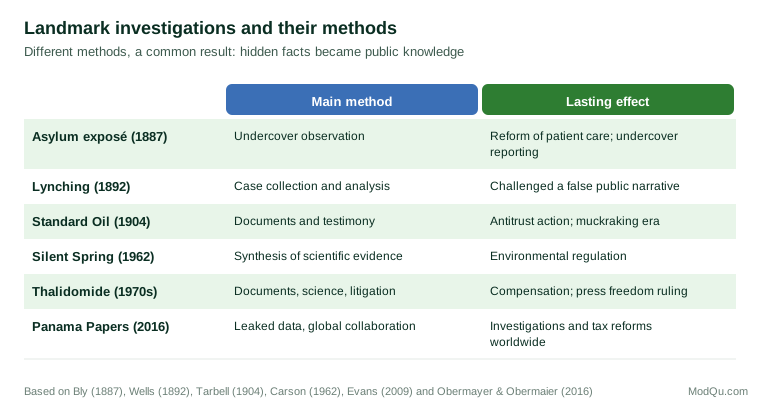
In 1887, the reporter Nellie Bly feigned insanity to have herself committed to the Women's Lunatic Asylum on Blackwell's Island in New York. After ten days she was released at her newspaper's request and published an account of brutal treatment, spoiled food, freezing conditions and the committal of women who showed no sign of mental illness (Bly, 1887). Her reporting led to a grand jury investigation and increased funding for the care of patients. It established undercover reporting as a method for documenting conditions that institutions would never willingly reveal, and it raised ethical questions about deception that investigators still debate.
Counting the dead: Ida B. Wells and lynching
In 1892, the journalist Ida B. Wells published Southern Horrors, an investigation of lynching in the American South (Wells, 1892). Wells collected and analysed cases, including from white-owned newspapers, and showed that the common justification for lynching, that it punished sexual assaults on white women, was false in most cases; many victims had been accused of other offences or of none at all. Her systematic documentation challenged a dominant public narrative with evidence, and her later statistical work became an early example of what would now be called data journalism. Her reporting made her a target of violence and forced her to leave Memphis.
Documenting a monopoly: Ida Tarbell and Standard Oil
Ida Tarbell's The History of the Standard Oil Company, first published as a series in McClure's Magazine, documented how John D. Rockefeller's company had used secret railway rebates, price manipulation and intimidation to dominate the oil industry (Tarbell, 1904). Tarbell relied mainly on documents: court testimony, legislative investigations and company records. Her work contributed to public pressure that led to the antitrust case in which the United States Supreme Court ordered Standard Oil to be broken up in 1911. Feldstein (2006) identifies Tarbell's era, the "muckraking" period, as the first great cycle of American investigative journalism. In the same period, Upton Sinclair's novel The Jungle, based on weeks of investigation in Chicago's meatpacking plants, described unsanitary conditions that contributed to the passage of federal food safety laws in 1906 (Sinclair, 1906).
Science for the public: Rachel Carson
Rachel Carson's Silent Spring brought together scientific evidence about the effects of synthetic pesticides, especially DDT, on birds, wildlife and potentially human health (Carson, 1962). Carson was a scientist rather than a reporter, but her method was investigative: she gathered and synthesised research that was scattered across specialist journals, consulted experts and presented the findings in language the public could understand. The chemical industry attacked her work, but a presidential science advisory committee largely supported her conclusions. The book is widely credited with helping to start the modern environmental movement and with contributing to the later ban on DDT for agricultural use in the United States.
War and secrecy: My Lai and the Pentagon Papers
In 1969, the freelance reporter Seymour Hersh revealed that American soldiers had killed hundreds of unarmed civilians in the Vietnamese village of My Lai the previous year, and that the army had charged an officer in secret. Hersh traced and interviewed soldiers who had been present, building a detailed account from their testimony (Hersh, 1970). In 1971, The New York Times began publishing the Pentagon Papers, a secret government study of American decision-making in Vietnam leaked by the analyst Daniel Ellsberg. When the government sought to stop publication, the Supreme Court ruled that it had not met the heavy burden needed to justify prior restraint (New York Times Co. v. United States, 1971). Together these investigations changed public understanding of the war and established important protections for publishing leaked information.
Thalidomide and the right to report
Thalidomide, a sedative sold from the late 1950s and given to pregnant women for morning sickness, caused severe birth defects in thousands of children. In the United Kingdom, The Sunday Times, under its editor Harold Evans, investigated the drug's development and marketing and the compensation offered to affected families. When the newspaper was prevented by court injunction from publishing an article while litigation was pending, it took the case to the European Court of Human Rights, which held that the injunction violated freedom of expression (Sunday Times v. United Kingdom, 1979). Evans (2009) describes how the campaign helped families obtain far greater compensation and how the case strengthened the right of the press to report on matters before the courts.
Watergate
Between 1972 and 1974, The Washington Post's Bob Woodward and Carl Bernstein, with other news organisations, traced the connections between a burglary at the Democratic National Committee's offices and President Richard Nixon's re-election campaign and White House (Bernstein & Woodward, 1974). Their reporting combined patient interviews with many sources, financial records and the guidance of a confidential senior source. Congressional and judicial investigations followed, and Nixon resigned in 1974. Watergate became the defining example of investigative journalism for a generation and encouraged news organisations to invest in investigative teams.
Institutions and abuse: the Boston Globe
In 2002, the Boston Globe's Spotlight team published evidence that the Catholic Archdiocese of Boston had for decades moved priests accused of sexually abusing children between parishes rather than removing them or reporting them (Boston Globe Investigative Staff, 2002). The team analysed church directories to identify priests repeatedly placed on sick leave or reassigned, interviewed survivors, and went to court to unseal documents. The reporting prompted similar investigations in many countries and led to major changes in how the church and other institutions respond to allegations of abuse.
Data, leaks and collaboration
Recent landmark investigations have often been built on large leaks of data and on collaboration. In 2013, reporting based on documents provided by Edward Snowden revealed the scale of mass surveillance by the United States National Security Agency and its allies, leading to legal challenges and reforms (Greenwald, 2014). In 2016, the Panama Papers investigation, coordinated by the International Consortium of Investigative Journalists, analysed 11.5 million documents from a law firm and exposed how politicians, officials and others used offshore companies (Obermayer & Obermaier, 2016). In 2018, The Observer and The New York Times reported that the political consultancy Cambridge Analytica had obtained data from tens of millions of Facebook profiles without users' consent (Cadwalladr & Graham-Harrison, 2018), prompting regulatory investigations and a wider debate about data protection. In 2017, reporting by Jodi Kantor and Megan Twohey of The New York Times on allegations against the film producer Harvey Weinstein helped prompt a worldwide movement against sexual harassment (Kantor & Twohey, 2019).
Investigations that failed
The landmarks are easier to appreciate alongside investigations that went wrong, because failures show which methods matter most. In 2004, the CBS programme 60 Minutes Wednesday broadcast a report based on documents said to show that President George W. Bush had received favourable treatment during his National Guard service. The documents' authenticity was quickly challenged, and an independent review found that the network had failed to authenticate them or to follow its own standards, under pressure to broadcast quickly (Thornburgh & Boccardi, 2005). Several senior staff lost their jobs.
In 2014, Rolling Stone magazine published an account of an alleged sexual assault at the University of Virginia, based largely on the account of a single student. The story unravelled when other journalists found inconsistencies, and the magazine retracted it. A review by Columbia University's journalism school found that the reporter and editors had not contacted people who could have confirmed or contradicted key details, partly out of a wish to protect the student, and that the failures were avoidable (Coronel et al., 2015). The retraction harmed the people falsely implicated, and it also made it harder for genuine victims to be believed.
Both failures came from the same place: a compelling story that the journalists believed, and a decision to skip steps that would have tested it. The landmark investigations, by contrast, treated their own conclusions as hypotheses until documents and independent sources confirmed them.
What the landmarks teach
Several lessons run through these cases. First, documents matter: from Tarbell's court records to the Panama Papers database, documentary evidence allowed claims to withstand powerful denials. Second, persistence matters: most of these investigations took months or years, and many faced legal and personal threats. Third, the effect of an investigation depends on others acting on it. Protess et al. (1991) found that investigative reports changed policy mainly when officials, legislators and courts took up the findings. Finally, Ettema and Glasser (1998) argue that investigative journalism makes moral claims as well as factual ones: the landmark investigations succeeded because they showed, with evidence, that something was wrong and that someone was responsible.
Conclusion
Landmark investigations show how inquiry by reporters, writers and scientists has changed public knowledge about mental health care, racial violence, corporate power, the environment, war, medicine, religious institutions and privacy. They used a wide range of methods, from undercover observation to the analysis of millions of leaked records, but they shared a commitment to evidence and a willingness to challenge the powerful. Their lasting value lies both in what they revealed and in the methods and legal protections they established for those who came after.
References
Bernstein, C., & Woodward, B. (1974). All the president's men. Simon & Schuster.
Bly, N. (1887). Ten days in a mad-house. Ian L. Munro.
Boston Globe Investigative Staff. (2002). Betrayal: The crisis in the Catholic Church. Little, Brown.
Cadwalladr, C., & Graham-Harrison, E. (2018, March 17). Revealed: 50 million Facebook profiles harvested for Cambridge Analytica in major data breach. The Guardian.
Carson, R. (1962). Silent spring. Houghton Mifflin.
Coronel, S., Coll, S., & Kravitz, D. (2015, April 5). Rolling Stone and UVA: The Columbia University Graduate School of Journalism report. Rolling Stone.
Ettema, J. S., & Glasser, T. L. (1998). Custodians of conscience: Investigative journalism and public virtue. Columbia University Press.
Evans, H. (2009). My paper chase: True stories of vanished times. Little, Brown.
Feldstein, M. (2006). A muckraking model: Investigative reporting cycles in American history. Harvard International Journal of Press/Politics, 11(2), 105–120. https://doi.org/10.1177/1081180X06286780
Greenwald, G. (2014). No place to hide: Edward Snowden, the NSA, and the U.S. surveillance state. Metropolitan Books.
Hersh, S. M. (1970). My Lai 4: A report on the massacre and its aftermath. Random House.
Kantor, J., & Twohey, M. (2019). She said: Breaking the sexual harassment story that helped ignite a movement. Penguin Press.
New York Times Co. v. United States, 403 U.S. 713 (1971).
Obermayer, B., & Obermaier, F. (2016). The Panama Papers: Breaking the story of how the rich and powerful hide their money. Oneworld.
Protess, D. L., Cook, F. L., Doppelt, J. C., Ettema, J. S., Gordon, M. T., Leff, D. R., & Miller, P. (1991). The journalism of outrage: Investigative reporting and agenda building in America. Guilford Press.
Sinclair, U. (1906). The jungle. Doubleday, Page.
Sunday Times v. United Kingdom (No. 1), no. 6538/74, 2 E.H.R.R. 245 (Eur. Ct. H.R. 1979).
Tarbell, I. M. (1904). The history of the Standard Oil Company. McClure, Phillips.
Thornburgh, D., & Boccardi, L. D. (2005). Report of the independent review panel on the September 8, 2004 60 Minutes Wednesday segment "For the Record" concerning President Bush's Texas Air National Guard service. CBS News.
Wells, I. B. (1892). Southern horrors: Lynch law in all its phases. New York Age Print.