
Investigation · Method and the future
Cold Case Investigations: Applying Modern Epistemology to Stagnant Knowledge Pools
A cold case is an investigation that has stopped producing new knowledge. This article explains why cases go cold, how reviewers re-examine what was known and how it was known, what new science and fresh perspectives can add, and the risks of reopening old evidence and memories.
A cold case is an unsolved investigation in which active work has stopped because the available leads have been exhausted. Many involve homicides or serious sexual offences, but the idea applies to any investigation, including a long-unexplained fraud loss or an unresolved safety incident. The word "stagnant" fits: the file holds a body of knowledge that has stopped growing. Reviving it requires more than looking again. It requires asking what was known, how it was known, which beliefs rest on weak foundations, and what new methods might add. This is a question of epistemology, the study of how we know what we claim to know. This article explains why cases go cold and how modern review applies these questions in practice.
Why cases go cold
Cases go cold for several reasons. Sometimes the evidence needed to identify an offender did not exist or could not be analysed with the science of the time. Sometimes it existed but was not recognised, collected or followed up. Sometimes witnesses were afraid to speak. And sometimes the investigation fixed on the wrong explanation early and stopped looking for others.
Rossmo (2009) identifies cognitive bias, organisational pressure and probability errors as recurring causes of investigative failure. Confirmation bias, the tendency to seek and interpret evidence in ways that support an existing belief, is pervasive in human reasoning (Nickerson, 1998), and Kassin et al. (2013) show how it can affect even forensic analysis once examiners know what the investigation expects. Fahsing and Ask (2013) found that experienced detectives were aware of the danger of early "tipping points" in an investigation, after which alternatives receive less attention. A case can go cold because the original team was confident in an account that was wrong.
Re-examining what was known
A cold case review therefore begins not with new leads but with the existing file. The reviewer's task is to separate the facts that were established from the assumptions that were made, and to record the source of each belief. Schum (1994) emphasises that every inference rests on a chain of reasoning from evidence to conclusion, and that each link can be examined for its strength. In a cold case, many links may never have been tested.
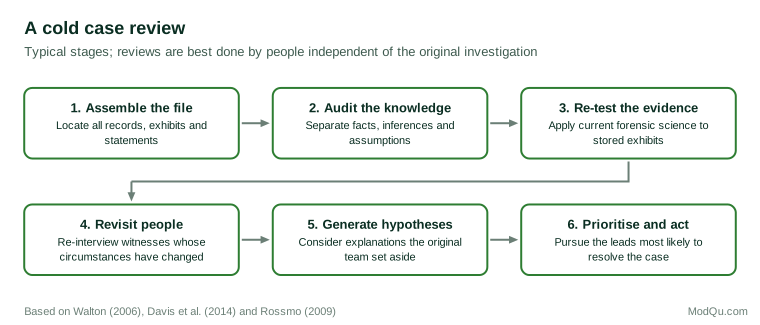
Practical guides recommend that reviews be carried out by investigators who were not involved in the original case, so that they are less attached to its conclusions (Walton, 2006). Reviewers can use structured techniques, such as listing every plausible hypothesis and assessing each item of evidence against all of them, to bring set-aside explanations back into view (Heuer & Pherson, 2015). Each assumption is labelled with its source and tested where possible: a time of death based on a single witness, for example, may be checked against phone or transaction records that were never obtained.
What makes cold cases solvable
Not all cold cases are equally promising. Davis et al. (2014), studying cold case units in the United States, found that successful outcomes were associated with the availability of physical evidence that could be re-examined, particularly biological evidence, and with the presence of witnesses or suspects identified in the original investigation. Cases with no surviving physical evidence and no named persons were much less likely to be solved. Reviewers therefore prioritise cases where stored exhibits exist and where new science or changed circumstances could add information.
New science
DNA profiling transformed cold case work. Since its first forensic application in the 1980s (Gill et al., 1985), increasingly sensitive methods have allowed profiles to be obtained from smaller and older samples, and national databases have allowed old crime scene profiles to be matched against people sampled later.
Investigative genetic genealogy has gone further. Investigators upload a crime scene profile to a consumer genealogy database that permits law enforcement use, identify distant relatives, and build family trees to narrow down a suspect, whose identity is then confirmed by conventional DNA comparison. The method led to the identification of the "Golden State Killer" in 2018 (Phillips, 2018), and Greytak et al. (2019) describe its use in many other cold cases. Erlich et al. (2018) estimated that most Americans of European descent could be identified this way through a relative. The technique raises privacy questions for relatives who never consented, and policies now restrict it in many jurisdictions to serious offences.
Science can also exonerate. Garrett (2011) analysed the first 250 people exonerated by DNA testing in the United States and found that eyewitness misidentification, flawed forensic evidence, false confessions and unreliable informants were common causes of their wrongful convictions. A cold case review should be open to the possibility that the original conclusion was wrong, not only incomplete.
People and memory
Time changes witnesses. Relationships end, loyalties fade and fear diminishes, so a person who said nothing in the past may now be willing to speak. But time also degrades and distorts memory. Loftus (2005) showed that memories can be altered by information encountered after the event, such as media coverage, conversations or earlier interviews. Wixted and Wells (2017) concluded that a witness's confidence is a useful indicator of accuracy only for an initial identification made under fair conditions; confidence expressed years later, after repeated exposure to the suspect's face, says little. Reviewers should therefore record what each witness said originally, what they may have learned since, and how any new account differs, and should seek corroboration rather than rely on a revived memory alone.
Victims' families
Cold cases affect families for decades. A review can renew hope, but it can also reopen grief, especially if it ends without a result. Reviewers should agree in advance how and when families will be told about the review, what they can expect, and who will be their contact. Families often hold information of their own, such as letters, photographs or knowledge of people around the victim, and should be asked what they know. Honest communication about the limits of what a review can achieve protects both the family and the integrity of the investigation.
Managing the knowledge
A cold case file is often a mix of paper records, old databases, exhibits stored in different places and the memories of retired officers. Before new work begins, the reviewer should create an index of every item, its location and its condition, and should establish the chain of custody for each exhibit, because a defence lawyer will examine it closely if the case comes to trial. Gaps should be recorded honestly. Innes (2003) describes investigation as the progressive construction of an account from fragments of information; in a cold case, that account must be rebuilt from what survives, and the record of how it was rebuilt becomes part of the evidence.
A short example
The following hypothetical case illustrates the approach. A 1998 assault remained unsolved after the main suspect, the victim's former partner, was cleared. A review team audits the file and finds that the suspect was considered the obvious answer from the first day, so a neighbour's report of an unknown man nearby was never followed up. The stored clothing is re-tested with current methods, producing a DNA profile that matches no one on the national database. The team then re-interviews the neighbour, now willing to give more detail, and obtains authorisation for a genealogy search. The search points to a family, one of whose members lived nearby in 1998. A direct DNA comparison confirms the match, and the team documents each step so that the new finding, and the earlier failure, can be scrutinised.
Conclusion
Cold cases are investigations whose knowledge has stopped growing. Reviving them depends on re-examining not only the evidence but the reasoning built on it, identifying which beliefs were established and which were assumed. New forensic science, especially DNA analysis and genetic genealogy, can add information that did not exist before, and changed circumstances can make witnesses willing to speak. But old memories are fragile, and original conclusions may be wrong as well as incomplete. Independent reviewers who audit the file, apply current science, consider set-aside hypotheses and document their work carefully give stagnant cases the best chance of resolution.
References
Davis, R. C., Jensen, C. J., Burgette, L., & Burnett, K. (2014). Working smarter on cold cases: Identifying factors associated with successful cold case investigations. Journal of Forensic Sciences, 59(2), 375–382. https://doi.org/10.1111/1556-4029.12384
Erlich, Y., Shor, T., Pe'er, I., & Carmi, S. (2018). Identity inference of genomic data using long-range familial searches. Science, 362(6415), 690–694. https://doi.org/10.1126/science.aau4832
Fahsing, I., & Ask, K. (2013). Decision making and decisional tipping points in homicide investigations: An interview study of British and Norwegian detectives. Journal of Investigative Psychology and Offender Profiling, 10(2), 155–165. https://doi.org/10.1002/jip.1384
Garrett, B. L. (2011). Convicting the innocent: Where criminal prosecutions go wrong. Harvard University Press.
Gill, P., Jeffreys, A. J., & Werrett, D. J. (1985). Forensic application of DNA 'fingerprints'. Nature, 318(6046), 577–579. https://doi.org/10.1038/318577a0
Greytak, E. M., Moore, C., & Armentrout, S. L. (2019). Genetic genealogy for cold case and active investigations. Forensic Science International, 299, 103–113. https://doi.org/10.1016/j.forsciint.2019.03.039
Heuer, R. J., Jr., & Pherson, R. H. (2015). Structured analytic techniques for intelligence analysis (2nd ed.). CQ Press.
Innes, M. (2003). Investigating murder: Detective work and the police response to criminal homicide. Oxford University Press.
Kassin, S. M., Dror, I. E., & Kukucka, J. (2013). The forensic confirmation bias: Problems, perspectives, and proposed solutions. Journal of Applied Research in Memory and Cognition, 2(1), 42–52. https://doi.org/10.1016/j.jarmac.2013.01.001
Loftus, E. F. (2005). Planting misinformation in the human mind: A 30-year investigation of the malleability of memory. Learning & Memory, 12(4), 361–366. https://doi.org/10.1101/lm.94705
Nickerson, R. S. (1998). Confirmation bias: A ubiquitous phenomenon in many guises. Review of General Psychology, 2(2), 175–220. https://doi.org/10.1037/1089-2680.2.2.175
Phillips, C. (2018). The Golden State Killer investigation and the nascent field of forensic genealogy. Forensic Science International: Genetics, 36, 186–188. https://doi.org/10.1016/j.fsigen.2018.07.010
Rossmo, D. K. (2009). Criminal investigative failures. CRC Press.
Schum, D. A. (1994). The evidential foundations of probabilistic reasoning. Wiley.
Walton, R. H. (Ed.). (2006). Cold case homicides: Practical investigative techniques. CRC Press.
Wixted, J. T., & Wells, G. L. (2017). The relationship between eyewitness confidence and identification accuracy: A new synthesis. Psychological Science in the Public Interest, 18(1), 10–65. https://doi.org/10.1177/1529100616686966