
Investigation · Business and corporate investigation
Brand Protection and Counterfeit Investigation
Counterfeit goods cost legitimate businesses revenue and reputation, and some put buyers at real risk. This article explains how counterfeiting works, how brand owners and investigators find and trace fakes, and the legal routes used to stop them.
A handbag sold at a market stall for a fraction of the usual price, a phone charger bought online that overheats, a box of medicines that contains no active ingredient: counterfeits range from the obviously fake to the dangerously convincing. For the businesses whose names and designs are copied, counterfeiting means lost sales, damage to reputation and, in some sectors, liability concerns when customers are harmed by products they believed to be genuine. For governments, counterfeiting is linked to tax evasion, organised crime and threats to public health and safety.
Brand protection is the set of activities a business uses to prevent, detect and respond to counterfeiting and related abuses of its brand. Investigation is at its centre: finding out who is making and selling fakes, how the goods reach buyers, and what evidence will support action against them. This article explains the scale and nature of counterfeiting, the investigative methods used against it, the legal tools available and the limits of enforcement.
The scale of the problem
Counterfeiting is difficult to measure, because it is hidden and because seizures reflect enforcement effort as much as underlying activity. The most widely cited estimates come from the Organisation for Economic Co-operation and Development and the European Union Intellectual Property Office, which used customs seizure data to estimate that counterfeit and pirated goods accounted for up to 3.3 per cent of world trade in 2016 (Organisation for Economic Co-operation and Development [OECD] & European Union Intellectual Property Office [EUIPO], 2019). The goods most affected included footwear, clothing, leather goods, electrical equipment, watches, toys and pharmaceuticals.
Counterfeit medicines are a particular concern. A study by the World Health Organization (2017) estimated that around one in ten medical products in low- and middle-income countries was substandard or falsified, with serious consequences for patients who receive ineffective or harmful treatment.
How counterfeiting works
What counts as a counterfeit
A counterfeit is a product that bears, without authorisation, a trademark identical to or indistinguishable from a registered trademark, so that it is presented as the genuine article. Counterfeiting is distinct from other forms of imitation. A "lookalike" product may copy the general appearance of a brand without using its trademark; a "grey market" product is a genuine product sold outside the channels or territories the brand owner intended; and a "pirated" product infringes copyright, as with unauthorised copies of software, music or films. Each requires a different legal response, and an early task in any investigation is to establish which kind of problem is involved.
Spink et al. (2013) distinguish types of counterfeit products and counterfeiters, from opportunists who make occasional fakes to organised groups that run large manufacturing and distribution operations. The type of counterfeiter shapes the investigation: a single online seller may be dealt with by a takedown notice and a warning letter, while an organised network may require coordinated action with law enforcement in several countries.
Demand
Some buyers are deceived into buying fakes; others buy them knowingly. Grossman and Shapiro (1988) distinguished deceptive counterfeiting, where buyers believe they are buying the genuine product, from non-deceptive counterfeiting of status goods, where buyers know the product is fake but value the brand's image at a lower price. Research on consumer behaviour finds that knowing purchases are influenced by price, attitudes towards brands and the perceived risk of the product (Eisend & Schuchert-Güler, 2006; Bian & Moutinho, 2011). Deceptive counterfeiting is most common in categories where buyers cannot easily judge quality, such as medicines, automotive parts, electronics and cosmetics, and these are also the categories in which counterfeits are most likely to cause harm.
Supply and distribution
Counterfeit supply chains often resemble legitimate ones. Goods are manufactured, sometimes in factories that also make genuine products, then shipped in containers, by post or by courier, and sold through wholesalers, retailers, markets and, increasingly, online marketplaces and social media. Staake et al. (2009), reviewing research on counterfeit trade, describe how globalisation, low-cost manufacturing and the growth of e-commerce have lowered the barriers to entry. Small parcels shipped directly to consumers are particularly hard for customs authorities to intercept. Assessments by European law enforcement and intellectual property agencies have linked some counterfeit operations to organised crime groups that are also involved in other offences (Europol & EUIPO, 2022).
Investigating counterfeits
Detection
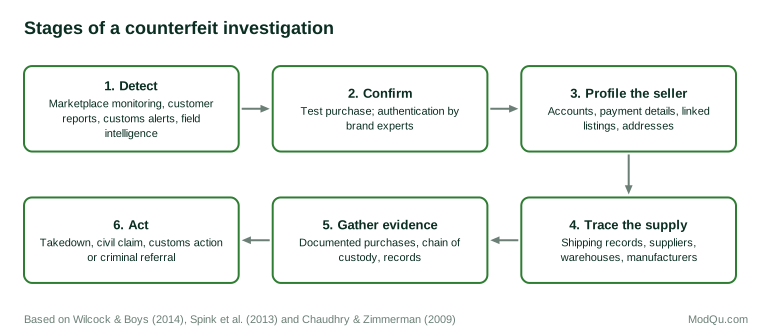
Brand owners learn about counterfeits from many sources: customers who complain about faulty products, distributors who notice unfamiliar competition, customs authorities that detain suspicious shipments, sales staff who see fakes in markets, and specialist monitoring of online marketplaces and social media. Online monitoring is now the largest source for many brands. Automated tools search marketplaces for listings that use the brand's name or images, are priced well below the genuine product, or come from sellers in locations associated with counterfeiting. As with any automated screening, the results are leads that need confirmation. Field intelligence remains important too: investigators who visit markets, trade fairs and wholesale districts can see which products are on offer, how they are priced and who is supplying them, and can identify patterns that online monitoring alone would miss.
Confirmation and test purchases
The usual way to confirm that a product is counterfeit is to buy it. A test purchase, made by an investigator using a documented process, provides both the product for examination and evidence of the sale: the listing, the communications with the seller, the payment record, the packaging and the shipping details. Each step is recorded so that the evidence can be presented in court if needed, with a clear chain of custody from purchase to examination.
The product is then examined by people who know the genuine article. Brand owners often train specialists to identify fakes by features such as materials, stitching, labels, serial numbers and packaging. Many brands also build covert security features into genuine products, such as special inks, microtext, holograms or digital codes, which make authentication faster and more reliable. Li (2013) reviews technologies used to authenticate products in the supply chain, including radio-frequency identification and track-and-trace systems, and international standards set out how authentication solutions should be selected and evaluated (International Organization for Standardization [ISO], 2020).
Profiling sellers and tracing supply
A single seller is rarely the whole story. Investigators look for links between seller accounts, using shared contact details, payment accounts, images, product descriptions, return addresses and shipping patterns. Clusters of accounts often turn out to be operated by the same people. Payment providers, marketplaces and shipping companies may hold records that identify the people behind the accounts, and these can be obtained by cooperation or through court orders.
Tracing supply then means working back from the sellers towards wholesalers, warehouses and manufacturers. Shipping records, customs data, company registries and field inquiries in manufacturing regions all play a part. This work often requires investigators on the ground in the countries where the goods are made, working within local law and often alongside local authorities. Wilcock and Boys (2014) argue that effective anti-counterfeiting requires an integrated approach that links these investigations to supply chain security, legal action and customer education, rather than treating each seizure as an isolated event.
Reading the signs online
Research has examined how counterfeit sellers can be distinguished from legitimate ones online. Wilson and Fenoff (2014), comparing websites selling counterfeit and genuine products, identified features that differed between them, including pricing, contact information, domain registration details and payment options. Such features help investigators prioritise among large numbers of sites and listings, although none is conclusive on its own. Investigators also study the language of listings: sellers of fakes often use phrases such as "replica", "inspired by" or "mirror quality", deliberately misspell brand names to avoid automated detection, or show genuine product images while shipping something different.
Leaks from the legitimate supply chain
Not all counterfeits are made by outsiders. Some originate in the brand owner's own supply chain, when contract manufacturers produce extra units beyond the agreed order and sell them through unofficial channels, when rejected goods that should have been destroyed are sold on, or when genuine components and packaging are diverted to counterfeiters. Stevenson and Busby (2015), studying counterfeiting strategies, describe how counterfeiters exploit weaknesses in supply chains, including the use of authorised suppliers, and argue that supply chains should be designed to resist these strategies. Investigations that find unusually high-quality fakes, or fakes that use genuine components, should therefore examine the brand's own suppliers, production records and disposal processes, not only external sources.
Evidence standards
Because counterfeit investigations may lead to civil or criminal proceedings, evidence must be gathered lawfully and recorded carefully. Test purchases should be made in ways that do not entrap sellers into offences they would not otherwise commit. Investigators must observe data protection and privacy law when collecting information about individuals, and should avoid methods such as pretexting that may be unlawful in some jurisdictions. Evidence from online sources should be captured with dates, times and URLs, using methods that preserve its integrity.
Legal tools
The international framework
The Agreement on Trade-Related Aspects of Intellectual Property Rights (TRIPS Agreement, 1994) requires members of the World Trade Organization to provide civil remedies against trademark infringement, border measures to stop counterfeit goods and criminal procedures for wilful trademark counterfeiting on a commercial scale. National laws build on this framework. In the United States, the Lanham Act (1946) provides civil remedies for trademark infringement and counterfeiting; in the United Kingdom, the Trade Marks Act 1994 provides civil remedies and makes the unauthorised use of a trademark on goods, with a view to gain, a criminal offence.
Customs
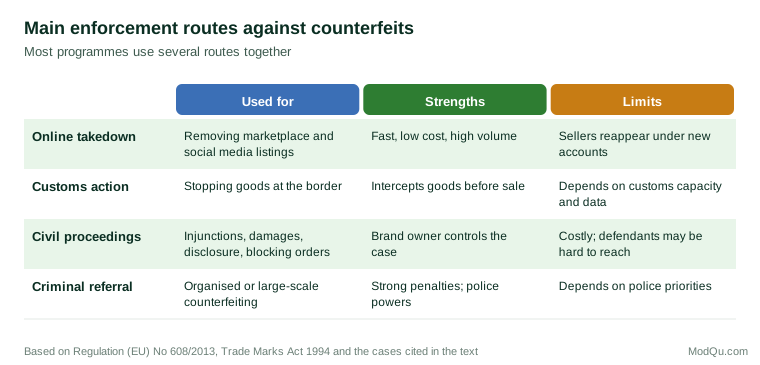
Customs authorities can detain goods suspected of infringing intellectual property rights. In the European Union, brand owners can lodge an application asking customs to watch for infringing goods, and customs authorities can detain suspect shipments and notify the brand owner, who then confirms whether the goods are genuine (Regulation (EU) No 608/2013, 2013). Brand owners improve the effectiveness of customs action by training officers to recognise their products and by sharing intelligence about suspect shippers and routes. Customs authorities publish statistics on seizures, which give a partial picture of the trade (U.S. Customs and Border Protection, 2023).
Online marketplaces and intermediaries
The growth of online sales has raised questions about the responsibility of marketplaces. In Tiffany (NJ) Inc. v. eBay Inc. (2010), a United States appeals court held that eBay was not liable for contributory trademark infringement merely because it knew in general that counterfeits were sold on its site; liability required specific knowledge of particular infringing listings that it failed to remove. In L'Oréal SA v eBay International AG (2011), the Court of Justice of the European Union held that an online marketplace could lose the protection available to hosting services if it played an active role in promoting the offers or became aware of facts from which a diligent operator should have realised that offers were unlawful and failed to act.
These cases established the basis of today's notice-and-takedown systems, in which brand owners report infringing listings and marketplaces remove them. The European Union's Digital Services Act (Regulation (EU) 2022/2065, 2022) has since added obligations for online platforms, including requirements to process notices promptly, to give priority to notices from trusted flaggers, and, for online marketplaces, to collect and verify information about traders.
Courts can also order internet service providers to block access to websites selling counterfeits. In Cartier International AG v British Sky Broadcasting Ltd (2016), the Court of Appeal of England and Wales upheld orders requiring internet service providers to block websites selling counterfeit goods, extending a remedy previously used against copyright piracy.
Civil and criminal proceedings
Civil proceedings allow brand owners to obtain injunctions, damages, delivery up and destruction of goods, and orders requiring disclosure of information about suppliers and customers. Criminal proceedings, brought by police or trading standards authorities, are generally reserved for larger or organised operations, and depend on the priorities of public agencies. Brand owners often assist by providing evidence and expert testimony on whether goods are genuine.
The limits of enforcement
Counterfeit enforcement faces persistent difficulties. Online sellers can open new accounts faster than old ones are removed. Manufacturers may be in countries where enforcement is weak or slow. Seizures and takedowns can be counted easily, but whether they reduce the overall volume of fakes is much harder to show. Heinonen et al. (2012), studying victims of online counterfeit purchases, found that many did not report the incident, which means that the information reaching brand owners and authorities is incomplete.
Chaudhry and Zimmerman (2009) argue that counterfeiting persists because it is profitable, the risk of serious penalties is low in many places, and demand remains strong. Enforcement alone cannot change all of these conditions. Effective programmes therefore combine investigation and enforcement with measures that make counterfeiting harder and less profitable: secure supply chains that prevent genuine components and overruns from leaking into the counterfeit trade, authentication features that let buyers and officials check products, control of distribution channels, and customer education that explains how to recognise genuine products and why it matters.
A short example
The following hypothetical case illustrates a typical investigation. A manufacturer of power tools receives several warranty claims for batteries that have failed and, in one case, caught fire. Examination shows that the batteries are counterfeit: the cells are of lower capacity, the protective circuitry is missing and the labels contain small printing errors.
The brand protection team asks the customers where they bought the batteries. Most bought them from listings on a large marketplace. Monitoring finds over two hundred listings for the same battery at about half the usual price. Test purchases from ten sellers confirm that eight are selling the same counterfeit. Analysis of the listings shows that the eight seller accounts share images, product descriptions and, in several cases, a return address at the same warehouse.
The company files takedown notices for the listings, which are removed within days, and supplies the marketplace with evidence linking the accounts. It then brings civil proceedings and obtains an order requiring the marketplace and the payment provider to disclose the account holders' details. These point to a trading company that imports batteries in bulk. Customs data and shipping records identify the exporter. With this evidence, the company lodges an application for customs action, briefs customs officers on the counterfeit's features, and refers the importer to trading standards because the batteries are unsafe. The company also issues a safety notice to customers explaining how to identify genuine batteries.
Building a brand protection programme
Organisations that manage counterfeiting effectively tend to share several practices:
- Register and maintain rights. Trademarks, designs and patents must be registered in the countries where products are made and sold, since enforcement depends on them.
- Know the genuine product. Maintain authentication guides and train people inside and outside the business to use them.
- Monitor systematically. Watch online marketplaces, social media, customs alerts and customer reports, and record what is found.
- Prioritise by harm. Concentrate investigative effort on fakes that endanger health or safety and on the largest sources of supply.
- Trace upstream. Use each case to learn about the network behind it, rather than dealing only with individual listings.
- Gather evidence carefully. Document purchases, maintain chain of custody and respect privacy and investigative law.
- Work with others. Cooperate with marketplaces, customs, police, industry associations and other brand owners.
- Measure what matters. Track not only takedowns and seizures, but also complaints, warranty claims and the price and availability of fakes over time.
Conclusion
Counterfeiting exploits the trust that customers place in brands. Investigating it requires a combination of product knowledge, online and field investigation, careful evidence handling and knowledge of intellectual property law across several jurisdictions. Because counterfeiters adapt quickly and enforcement reaches only part of the trade, the most effective approach treats each case as a source of intelligence about the wider network, and combines investigation with measures that protect the supply chain and help customers tell the genuine from the fake.
References
Agreement on Trade-Related Aspects of Intellectual Property Rights, Apr. 15, 1994, Marrakesh Agreement Establishing the World Trade Organization, Annex 1C, 1869 U.N.T.S. 299.
Bian, X., & Moutinho, L. (2011). The role of brand image, product involvement, and knowledge in explaining consumer purchase behaviour of counterfeits: Direct and indirect effects. European Journal of Marketing, 45(1/2), 191–216. https://doi.org/10.1108/03090561111095658
Cartier International AG v British Sky Broadcasting Ltd [2016] EWCA Civ 658.
Chaudhry, P. E., & Zimmerman, A. (2009). The economics of counterfeit trade: Governments, consumers, pirates and intellectual property rights. Springer.
Eisend, M., & Schuchert-Güler, P. (2006). Explaining counterfeit purchases: A review and preview. Academy of Marketing Science Review, 2006(12), 1–25.
Europol, & European Union Intellectual Property Office. (2022). Intellectual property crime threat assessment 2022. Publications Office of the European Union.
Grossman, G. M., & Shapiro, C. (1988). Foreign counterfeiting of status goods. The Quarterly Journal of Economics, 103(1), 79–100. https://doi.org/10.2307/1882643
Heinonen, J. A., Holt, T. J., & Wilson, J. M. (2012). Product counterfeits in the online environment: An empirical assessment of victimization and reporting characteristics. International Criminal Justice Review, 22(4), 353–371. https://doi.org/10.1177/1057567712465755
International Organization for Standardization. (2020). Security and resilience — Authenticity, integrity and trust for products and documents — Guidelines for the selection and performance evaluation of authentication solutions for material goods (ISO Standard No. 22383:2020).
Lanham Act, 15 U.S.C. § 1051 et seq. (1946).
Li, L. (2013). Technology designed to combat fakes in the global supply chain. Business Horizons, 56(2), 167–177. https://doi.org/10.1016/j.bushor.2012.11.010
L'Oréal SA v eBay International AG (C-324/09) EU:C:2011:474.
Organisation for Economic Co-operation and Development, & European Union Intellectual Property Office. (2019). Trends in trade in counterfeit and pirated goods. OECD Publishing. https://doi.org/10.1787/g2g9f533-en
Regulation (EU) No 608/2013 of the European Parliament and of the Council of 12 June 2013 concerning customs enforcement of intellectual property rights. (2013). Official Journal of the European Union, L 181, 15–34.
Regulation (EU) 2022/2065 of the European Parliament and of the Council of 19 October 2022 on a Single Market for Digital Services (Digital Services Act). (2022). Official Journal of the European Union, L 277, 1–102.
Spink, J., Moyer, D. C., Park, H., & Heinonen, J. A. (2013). Defining the types of counterfeiters, counterfeiting, and offender organizations. Crime Science, 2, Article 8. https://doi.org/10.1186/2193-7680-2-8
Staake, T., Thiesse, F., & Fleisch, E. (2009). The emergence of counterfeit trade: A literature review. European Journal of Marketing, 43(3/4), 320–349. https://doi.org/10.1108/03090560910935451
Stevenson, M., & Busby, J. (2015). An exploratory analysis of counterfeiting strategies: Towards counterfeit-resilient supply chains. International Journal of Operations & Production Management, 35(1), 110–144. https://doi.org/10.1108/IJOPM-04-2012-0174
Tiffany (NJ) Inc. v. eBay Inc., 600 F.3d 93 (2d Cir. 2010).
Trade Marks Act 1994, c. 26 (UK).
U.S. Customs and Border Protection. (2023). Intellectual property rights seizure statistics: Fiscal year 2022.
Wilcock, A. E., & Boys, K. A. (2014). Reduce product counterfeiting: An integrated approach. Business Horizons, 57(2), 279–288. https://doi.org/10.1016/j.bushor.2013.12.001
Wilson, J. M., & Fenoff, R. (2014). Distinguishing counterfeit from authentic product retailers in the virtual marketplace. International Criminal Justice Review, 24(1), 39–58. https://doi.org/10.1177/1057567714527390
World Health Organization. (2017). A study on the public health and socioeconomic impact of substandard and falsified medical products.