
Investigation · Method and the future
After-Action and Lessons-Learned Reviews Following Major Investigations
Major investigations generate lessons about what worked, what failed and why, but those lessons are often lost when the case closes. This article explains after-action and lessons-learned reviews, the evidence that structured debriefs improve performance, the biases that distort reviews of past cases, landmark reviews that changed practice, and how to turn lessons into lasting change.
When a major investigation ends, whether in a conviction, a disciplinary finding, a published report or an unresolved file, the people involved know things they did not know at the start. They know which lines of enquiry were productive and which wasted time, where information was lost, where decisions were delayed, and what they would do differently. Unless this knowledge is captured and acted on, it disperses as the team moves on. After-action and lessons-learned reviews are structured ways of capturing it. This article explains how they work, what research says about their effectiveness, the pitfalls that undermine them, and how to make sure lessons lead to change.
Origins and purpose
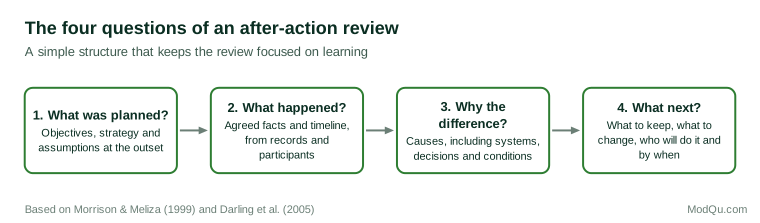
The after-action review was developed by the United States Army in the 1970s as a way for units to learn from training exercises and operations. Morrison and Meliza (1999) describe its foundations: a discussion, led by a facilitator and involving the participants themselves, that asks what was supposed to happen, what actually happened, why there was a difference, and what should be sustained or improved. The aim is learning, not blame. Darling et al. (2005) describe how organisations outside the military adopted the method, and argue that it works best when it is used continuously, linked to future action, and focused on specific, testable lessons.
Lessons-learned reviews of investigations serve several purposes: improving future investigations, identifying systemic problems in procedures, training or technology, recognising good practice, and providing accountability to the public and the people affected.
Does it work?
Research supports structured debriefing. Tannenbaum and Cerasoli (2013), in a meta-analysis of studies of team and individual debriefs, found that debriefs improved performance by about 20 to 25 per cent on average, and that well-structured, facilitated debriefs were more effective than unstructured ones. Keiser and Arthur (2021), in a later meta-analysis of after-action reviews, also found substantial positive effects and identified factors that make them more effective, such as structure and the involvement of a facilitator. Ellis and Davidi (2005) found that soldiers who reviewed both successful and failed events learned more than those who reviewed only failures, because analysing success helped them understand which actions led to good outcomes.
Pitfalls
Reviews of past events are vulnerable to several well-known biases.
Hindsight bias. Once people know how events turned out, they overestimate how predictable the outcome was. Fischhoff (1975) showed that people told the outcome of an event judged it to have been more likely beforehand than people not told. In reviews, this makes decisions that turned out badly look obviously wrong, even when they were reasonable on the information available.
Outcome bias. Baron and Hershey (1988) found that people judged the quality of a decision partly by its outcome, rating the same decision as worse when it led to a bad result. Reviews must judge decisions by what was known and reasonable at the time.
Blame. If reviews are used to find someone to blame, people become defensive and withhold information. Dekker (2014) argues that treating "human error" as the cause of failure stops learning, because it ignores the conditions that made errors likely. Reason (1997) distinguished between the active failures of individuals and the latent conditions in organisations that set them up to fail. Edmondson (1999) found that teams learn more when members feel psychologically safe to admit mistakes and raise concerns.
Lessons recorded but not learned. Many organisations produce lessons-learned documents that are filed and forgotten. The Columbia Accident Investigation Board (2003) found that organisational problems identified after the loss of the space shuttle Challenger in 1986 had re-emerged at NASA and contributed to the loss of Columbia in 2003. Argyris and Schön (1978) distinguished between single-loop learning, which corrects specific errors, and double-loop learning, which questions underlying assumptions; organisations that only fix specific errors tend to repeat deeper failures.
Landmark reviews of investigations
Some reviews of major investigations have changed practice nationally.
The review of the "Yorkshire Ripper" investigation found that the incident room's paper systems had been overwhelmed and that the offender had been interviewed several times without the connections being made. It led to computerised systems and standard procedures for major incident rooms in the United Kingdom (Byford, 1981).
The inquiry into the police investigation of the racist murder of Stephen Lawrence in London in 1993 found that the investigation had been marred by incompetence, institutional racism and a failure of leadership, and made 70 recommendations, which led to changes in police practice, the law on double jeopardy and the handling of racist incidents (Macpherson, 1999).
The Hillsborough Independent Panel, reviewing documents relating to the 1989 football stadium disaster in which 96 people died, found that police statements had been altered to remove criticism and that the blame placed on fans was unfounded, leading to new inquests and investigations (Hillsborough Independent Panel, 2012).
In the United States, reviews of wrongful convictions have identified recurring causes, such as eyewitness misidentification, invalid forensic evidence and false confessions, and have prompted reforms in identification procedures and interrogation practice (Garrett, 2011). Rossmo (2009) collected analyses of investigative failures to identify recurring causes, including cognitive bias, probability errors and organisational pressures.
These reviews show that lessons from investigations can drive lasting change, but often only after serious harm, long delays and sustained public pressure.
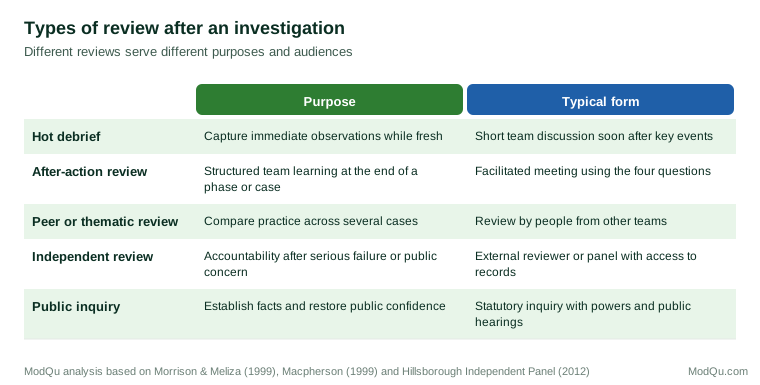
Types of review
Who should take part
A review is only as good as the perspectives it includes. Investigators know what they did and why, but analysts, administrators, lawyers, forensic specialists and the managers who allocated resources often see problems the investigators missed. Where appropriate, people outside the organisation can add essential views: partner agencies, the families of victims and, in some cases, the people who were investigated. Their accounts of how the investigation felt from the outside, for example how quickly they were told what was happening, frequently reveal lessons that internal participants would not raise. Senior leaders should take part or at least receive the findings directly, because many of the most important lessons concern resources, priorities and culture, which only they can change. At the same time, reviews must allow junior staff to speak freely, which may require separate sessions or anonymous input.
Recording and sharing lessons
Lessons must be written down in a form others can use. A good lesson states the context, what happened, why it mattered, and the specific change recommended, rather than a general observation such as "communication should be improved". Milton (2010) argues that a lesson is learned only when it has led to a change in procedure, training or behaviour, and that organisations need a process to move lessons from identification to action, with someone responsible for each step. Lessons should be stored where future investigators will find them, such as in the procedures and checklists they use, not only in a separate library. Senge (1990) describes organisations that learn continuously as ones in which people regularly examine their assumptions and share what they learn across boundaries, rather than keeping knowledge within teams.
Reviewing unresolved investigations
Investigations that end without a clear answer also deserve review, and arguably need it most. When a case remains unresolved, a review can identify whether the problem was a lack of evidence, a missed opportunity, an untested hypothesis or a limit of the available methods. It can also record what would be needed to resolve the case if new information emerges, which makes any later cold case review faster. Reviewing unresolved cases guards against the tendency to learn only from dramatic successes and failures.
Making lessons stick
Experience and research suggest several practices:
- Plan the review from the start. Decide at the outset of a major investigation when and how it will be reviewed, so that records needed for the review are kept.
- Review successes as well as failures. Understanding why things went well is as valuable as understanding failures (Ellis & Davidi, 2005).
- Use a facilitator. An independent facilitator keeps the discussion structured and fair.
- Establish facts first. Agree a timeline from records before discussing causes.
- Judge decisions by what was known at the time. Counter hindsight and outcome bias explicitly.
- Look for systems, not scapegoats. Ask what conditions made errors likely.
- Turn lessons into actions. Each lesson should lead to a specific change with an owner and a deadline.
- Share lessons. Distribute anonymised lessons to other teams and incorporate them into training and procedures.
- Check later. Review whether changes were made and whether they worked.
A short example
The following hypothetical case illustrates a lessons-learned review. A research company completes a six-month investigation into a large-scale fraud by panel respondents. The investigation succeeded but took longer than expected. A facilitator from another department leads an after-action review with the investigation team, the data analysts and the payments manager.
The team first agrees a timeline from the case management system. It then identifies that three weeks were lost because the analysts and investigators used different identifiers for respondents, so matches had to be rebuilt by hand; that a decision to delay freezing payments, criticised at the time, was reasonable given the evidence then available; and that early involvement of the payments team, which had happened by chance, had been crucial to stopping losses. The review produces four actions: a common respondent identifier across systems, a standing procedure for early contact with the payments team, a checklist for freezing decisions, and a short training session for new investigators. Six months later, a follow-up confirms that the identifier and procedure are in place and that a second, smaller investigation took half the time.
Conclusion
After-action and lessons-learned reviews capture what investigators learn so that future investigations are better. Research shows that structured debriefs improve performance, and landmark reviews of failed investigations have transformed practice. Reviews are undermined by hindsight and outcome bias, by blame, and by lessons that are recorded but not acted on. Investigators who plan reviews from the start, examine successes as well as failures, judge decisions fairly, look for systemic causes, and turn lessons into owned actions that are checked later can make each investigation improve the next.
References
Argyris, C., & Schön, D. A. (1978). Organizational learning: A theory of action perspective. Addison-Wesley.
Baron, J., & Hershey, J. C. (1988). Outcome bias in decision evaluation. Journal of Personality and Social Psychology, 54(4), 569–579. https://doi.org/10.1037/0022-3514.54.4.569
Byford, L. (1981). The Yorkshire Ripper case: Review of the police investigation of the case. Home Office.
Columbia Accident Investigation Board. (2003). Report (Vol. 1). National Aeronautics and Space Administration.
Darling, M., Parry, C., & Moore, J. (2005). Learning in the thick of it. Harvard Business Review, 83(7), 84–92.
Dekker, S. (2014). The field guide to understanding 'human error' (3rd ed.). Ashgate.
Edmondson, A. (1999). Psychological safety and learning behavior in work teams. Administrative Science Quarterly, 44(2), 350–383. https://doi.org/10.2307/2666999
Ellis, S., & Davidi, I. (2005). After-event reviews: Drawing lessons from successful and failed experience. Journal of Applied Psychology, 90(5), 857–871. https://doi.org/10.1037/0021-9010.90.5.857
Fischhoff, B. (1975). Hindsight ≠ foresight: The effect of outcome knowledge on judgment under uncertainty. Journal of Experimental Psychology: Human Perception and Performance, 1(3), 288–299. https://doi.org/10.1037/0096-1523.1.3.288
Garrett, B. L. (2011). Convicting the innocent: Where criminal prosecutions go wrong. Harvard University Press.
Hillsborough Independent Panel. (2012). Hillsborough: The report of the Hillsborough Independent Panel (HC 581). The Stationery Office.
Keiser, N. L., & Arthur, W., Jr. (2021). A meta-analysis of the effectiveness of the after-action review (or debrief) and factors that influence its effectiveness. Journal of Applied Psychology, 106(7), 1007–1032. https://doi.org/10.1037/apl0000821
Macpherson, W. (1999). The Stephen Lawrence inquiry: Report of an inquiry by Sir William Macpherson of Cluny (Cm 4262-I). The Stationery Office.
Milton, N. (2010). The lessons learned handbook: Practical approaches to learning from experience. Chandos.
Morrison, J. E., & Meliza, L. L. (1999). Foundations of the after action review process (Special Report 42). U.S. Army Research Institute for the Behavioral and Social Sciences.
Reason, J. (1997). Managing the risks of organizational accidents. Ashgate.
Rossmo, D. K. (2009). Criminal investigative failures. CRC Press.
Senge, P. M. (1990). The fifth discipline: The art and practice of the learning organization. Doubleday.
Tannenbaum, S. I., & Cerasoli, C. P. (2013). Do team and individual debriefs enhance performance? A meta-analysis. Human Factors, 55(1), 231–245. https://doi.org/10.1177/0018720812448394