
Intelligence · Organisational intelligence
"Writing Intelligence Products: Briefs, Estimates and Reports"
The value of intelligence depends on how well it is written. This article explains the main types of intelligence product, the standards that good products meet, and practical rules for writing briefs, estimates and reports that busy readers can understand and act on.
Analysis that is never read, or read and misunderstood, has no value. The written intelligence product is where the work of collection and analysis meets the decision-maker, and many good analyses fail at this last step. Products are too long, bury their conclusions, hedge every statement or leave readers unsure how confident the analyst is. Good intelligence writing is a skill in its own right, with conventions developed over decades in government and adapted by business intelligence teams.
Types of product
Lowenthal (2022) describes the range of products produced by national intelligence agencies, from daily current intelligence to long-range estimates. Business intelligence functions produce similar types under different names. Figure 1 summarises four common forms.
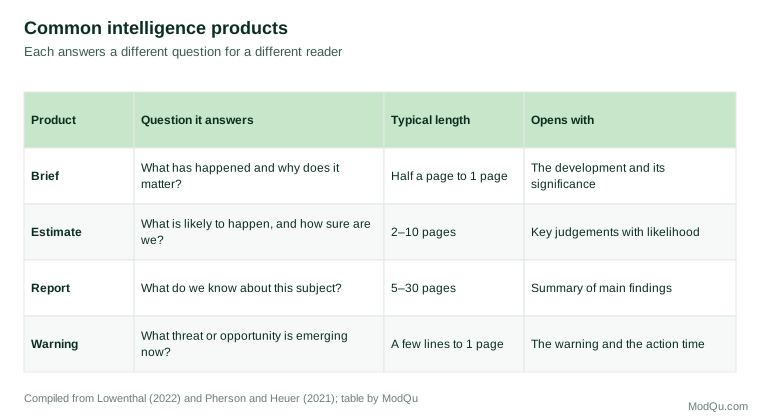
A brief reports a recent development and explains its significance. An estimate judges what is likely to happen and how confident the analyst is. A report sets out what is known about a subject in more depth. A warning alerts decision-makers to an emerging threat or opportunity that may require action. Each calls for a different structure, but all share the same principles.
Standards for good products
American intelligence analytic standards set out what good products must do (Office of the Director of National Intelligence, 2015). They require analysts to describe the quality and credibility of sources, express and explain uncertainty, distinguish clearly between underlying information and the analyst's judgements, consider alternative explanations, be relevant to the user, use clear and logical argument, and explain any change in judgement from previous products.
These standards apply equally to business. A product that does not say how reliable its sources are, how confident the analyst is, or what has changed since the last product leaves readers unable to weigh it.
Lead with the answer
The most important rule is to put the main conclusion first. Minto (2009), in a guide originally written for management consultants, set out the pyramid principle: start with the single main point, then give the supporting arguments, then the detail beneath each. Readers who stop after the first paragraph still have the essential message. Readers who want more can read further. This is the opposite of academic writing, which typically builds towards its conclusion.
For an estimate, the opening should be a set of key judgements: the main conclusions, each with an expression of likelihood and confidence. For a brief, it should be the development and why it matters. For a warning, it should be the threat and how soon action may be needed.
Express uncertainty clearly
Intelligence judgements are almost always uncertain, and readers need to know how uncertain. Kent (1964) found that words such as "probable" or "likely" were interpreted very differently by different readers, and proposed tying them to numerical ranges. Wallsten et al. (1986) confirmed in experiments that people assign widely varying probabilities to the same words. Friedman and Zeckhauser (2012) argue that clear statements of uncertainty make intelligence more useful, not less. Dhami and Mandel (2021) review the research and conclude that numerical probabilities, or words linked explicitly to numbers, reduce misunderstanding.
Scientific bodies face the same problem. Guidance for the authors of Intergovernmental Panel on Climate Change reports sets out calibrated likelihood terms and asks authors to assess confidence separately, based on the amount of evidence and the degree of agreement (Mastrandrea et al., 2010). A good product therefore uses a fixed scale of likelihood terms, defines them, and distinguishes likelihood (how probable an outcome is) from confidence (how solid the evidence and reasoning are).
Separate facts from judgements
Readers must be able to tell what is reported from what is inferred. Phrases such as "According to the company's annual report…" or "Two distributors told us…" signal sourced information. Phrases such as "We judge that…" or "This suggests…" signal analysis. Mixing the two without signals leaves readers unable to evaluate the argument.
Write plainly
Orwell (1946) warned that vague, inflated language conceals meaning and invites lazy thinking. Orwell's rules remain useful: prefer short words to long ones, cut words that add nothing, use the active voice, and avoid jargon where an everyday word will do. Williams and Bizup (2017) show how clarity depends on putting the main actors in subjects and their actions in verbs. "We estimate that the competitor will cut prices" is clearer than "An estimation of probable competitor price reduction has been made."
Know the reader
Davis (2006) stresses that analysts must understand what their readers already know, what they need and how they prefer to receive information. A chief executive reading on a phone between meetings needs a different product from a planning team preparing a detailed proposal. Asking readers what works for them, and adjusting, is part of the job.
Common weaknesses
Reviews of intelligence products reveal recurring weaknesses:
- The answer is buried. The conclusion appears on page four, after background the reader already knows.
- Everything is hedged. Words such as "may", "could" and "possibly" appear in every sentence, so the reader cannot tell which judgements are firm.
- Too much description, too little analysis. The product summarises events but does not say what they mean.
- No alternatives. Only one explanation is offered, and the reader cannot see whether others were considered.
- Sources are vague. "Reports indicate" tells the reader nothing about reliability.
- Length is set by effort, not need. A long product signals hard work but costs the reader time.
An illustration
An analyst at a logistics company drafts a two-page report on a rival's plans to open a new hub. It begins with the rival's history, describes its recent announcements, and ends with "It is possible that this could affect our business in the region." The manager returns it with three questions: What is the main point? How likely is it? What should we do? The revised version opens: "We judge it likely (60–80%) that the rival will open a hub near our largest depot within 18 months, which would put about a fifth of our regional contracts at risk. Our confidence is moderate: the evidence comes from planning applications and job advertisements, but the rival has not confirmed its plans." The rest of the page sets out the evidence, an alternative interpretation and two options. The operations director reads it in two minutes and asks for a meeting.
A checklist
Before releasing any product, check:
- Is the main conclusion in the first two sentences?
- Does each judgement state likelihood and confidence?
- Are sources described and their reliability indicated?
- Are facts and judgements clearly distinguished?
- Are alternatives considered, and the reasons for rejecting them given?
- Does it say what has changed since the last product?
- Can any word, sentence or paragraph be cut without loss?
- Would the intended reader understand it on a first quick read?
Conclusion
Writing is where intelligence becomes useful or useless. Good products lead with the answer, express uncertainty in clear and consistent terms, separate facts from judgements, cite their sources and use plain language suited to the reader. These are learnable skills. Teams that practise them, review each other's drafts and ask readers for feedback produce intelligence that is read, understood and acted on.
References
Davis, J. (2006). Intelligence analysts and policymakers: Benefits and dangers of tensions in the relationship. Intelligence and National Security, 21(6), 999–1021. https://doi.org/10.1080/02684520601046325
Dhami, M. K., & Mandel, D. R. (2021). Words or numbers? Communicating probability in intelligence analysis. American Psychologist, 76(3), 549–560. https://doi.org/10.1037/amp0000637
Friedman, J. A., & Zeckhauser, R. (2012). Assessing uncertainty in intelligence. Intelligence and National Security, 27(6), 824–847. https://doi.org/10.1080/02684527.2012.708275
Kent, S. (1964). Words of estimative probability. Studies in Intelligence, 8(4), 49–65.
Lowenthal, M. M. (2022). Intelligence: From secrets to policy (9th ed.). CQ Press.
Mastrandrea, M. D., Field, C. B., Stocker, T. F., Edenhofer, O., Ebi, K. L., Frame, D. J., Held, H., Kriegler, E., Mach, K. J., Matschoss, P. R., Plattner, G.-K., Yohe, G. W., & Zwiers, F. W. (2010). Guidance note for lead authors of the IPCC Fifth Assessment Report on consistent treatment of uncertainties. Intergovernmental Panel on Climate Change.
Minto, B. (2009). The pyramid principle: Logic in writing and thinking (3rd ed.). Pearson Education.
Office of the Director of National Intelligence. (2015). Intelligence Community Directive 203: Analytic standards.
Orwell, G. (1946). Politics and the English language. Horizon, 13(76), 252–265.
Pherson, R. H., & Heuer, R. J., Jr. (2021). Structured analytic techniques for intelligence analysis (3rd ed.). CQ Press.
Wallsten, T. S., Budescu, D. V., Rapoport, A., Zwick, R., & Forsyth, B. (1986). Measuring the vague meanings of probability terms. Journal of Experimental Psychology: General, 115(4), 348–365. https://doi.org/10.1037/0096-3445.115.4.348
Williams, J. M., & Bizup, J. (2017). Style: Lessons in clarity and grace (12th ed.). Pearson.