
Intelligence · Organisational intelligence
Training and Professional Development Pathways for Intelligence Knowledge Workers
Intelligence analysts need a mix of subject knowledge, analytic method and communication skill. This short article outlines how training and professional development can be organised into a pathway from new analyst to expert.
Intelligence work demands an unusual mix of abilities. Analysts need deep knowledge of their subject, whether a market, a region or a technology. They need methods for weighing evidence, testing hypotheses and expressing uncertainty. And they need to write and brief clearly for busy decision-makers. Few people arrive with all three, so organisations must develop them.
Training and education
Marrin (2009), reviewing how American intelligence analysts were prepared, distinguished training, which teaches specific skills and procedures for the job, from education, which develops broader understanding and the ability to think critically. Both are needed. Training alone produces analysts who can follow procedures but struggle with new problems; education alone produces analysts who understand ideas but lack practical skills. Moore (2011) argues that intelligence work is fundamentally about sensemaking, building understanding of complex and ambiguous situations, and that development should strengthen this capacity rather than only teaching techniques.
A development pathway
A practical pathway has four stages.
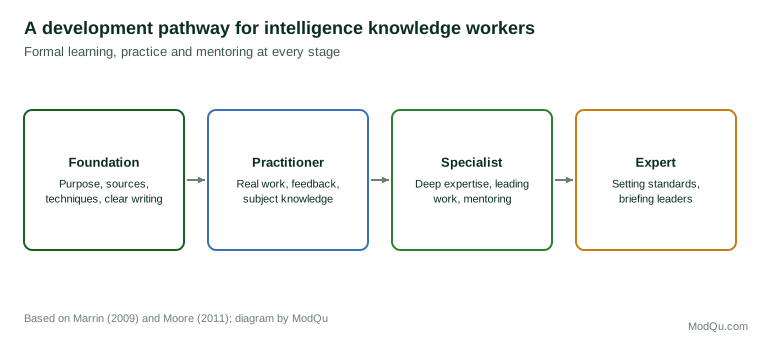
Foundation. New analysts learn the basics: the purpose of intelligence, the needs of consumers, source evaluation, structured analytic techniques, probability language and clear writing. Pherson and Heuer (2021) provide a widely used set of techniques for this stage.
Practitioner. Analysts apply these skills to real work under supervision, receive regular feedback on their products and begin to build subject expertise.
Specialist. Analysts develop deep knowledge of a subject, lead pieces of work, mentor newer colleagues and learn more advanced methods such as forecasting and scenario analysis.
Expert. Senior analysts set standards, review others' work, brief senior leaders and contribute to the organisation's methods and knowledge.
Learning from experience
Most development happens through work itself. Kolb (1984) described learning as a cycle of experience, reflection, forming general ideas and testing them in practice. Organisations can support this cycle with regular product reviews, after-action reviews and records of forecasts compared with outcomes, so that analysts see how their judgements performed.
Learning is also social. Wenger (1998) showed that people learn their craft by taking part in communities of practice, groups who share a domain and learn from each other over time. Pairing new analysts with mentors, holding regular methods discussions and encouraging contact with analysts in other teams all help.
Assessing progress
Progress is best judged by the quality of work, not by courses completed. Useful evidence includes samples of products reviewed against agreed standards, feedback from consumers, the accuracy of recorded forecasts and the analyst's contribution to colleagues' work. Short annual conversations about this evidence help analysts see where they stand and what to develop next.
An illustration
A small market intelligence team in a manufacturing company hires two graduates. In their first three months they complete a short course in analytic techniques and writing, and each is paired with a senior analyst. They draft weekly competitor notes, which their mentors review line by line. By the end of the first year, both lead small projects, record their forecasts and present findings to product managers. In the second year, one specialises in a key competitor and the other in raw material markets. The team's records show steady improvement in forecast accuracy and in consumer feedback, and the graduates now help train the next intake.
Practical steps
- Write down the skills expected at each stage, so analysts and managers share a picture of progress.
- Combine short courses with assignments that apply what was taught.
- Give every analyst a mentor and regular feedback on products.
- Protect time for building subject knowledge, not only for producing reports.
- Rotate analysts between subjects or teams to broaden their perspective.
Conclusion
Intelligence knowledge workers develop through a combination of training, education, practice and community. None of these is enough on its own: courses without practice fade quickly, and practice without reflection or feedback repeats the same mistakes. A clear pathway, from foundation to expert, helps organisations build capability deliberately rather than leaving it to chance.
References
Kolb, D. A. (1984). Experiential learning: Experience as the source of learning and development. Prentice Hall.
Marrin, S. (2009). Training and educating U.S. intelligence analysts. International Journal of Intelligence and CounterIntelligence, 22(1), 131–146. https://doi.org/10.1080/08850600802486986
Moore, D. T. (2011). Sensemaking: A structure for an intelligence revolution. National Defense Intelligence College Press.
Pherson, R. H., & Heuer, R. J., Jr. (2021). Structured analytic techniques for intelligence analysis (3rd ed.). CQ Press.
Wenger, E. (1998). Communities of practice: Learning, meaning, and identity. Cambridge University Press. https://doi.org/10.1017/CBO9780511803932