
Intelligence · Organisational intelligence
Intelligence Support to Decision Making Under Time Pressure
Many important decisions are made in hours or minutes, not weeks. This article explains how time pressure changes the way people decide, and how intelligence teams can prepare in advance and deliver support that is fast, focused and honest about uncertainty.
Textbook descriptions of intelligence often assume plenty of time: a question is set, analysts gather evidence, consider alternatives and deliver a considered assessment. Many real decisions do not allow this. A crisis breaks overnight, a competitor makes an unexpected offer for a key supplier, a cyber attack is under way, or a negotiation reaches its final hour. Decision-makers must act in hours or minutes, and intelligence must help them within that window or not at all.
This article explains how time pressure changes decision making and how intelligence teams can support decisions when time is short.
How time pressure changes decisions
Research shows that people adapt their decision strategies when time is short. Payne et al. (1988) found that under time pressure people switch from strategies that weigh all attributes of all options to simpler strategies that focus on the most important attributes. Ordóñez and Benson (1997) found similar shifts in risky decisions. The contributors to Svenson and Maule (1993) document a range of effects: people consider fewer options, rely more on familiar information, filter out what seems peripheral and may become more cautious or, in some cases, more reckless.
These changes are not necessarily bad. Gigerenzer and Gaissmaier (2011) argue that simple rules of thumb, or heuristics, often perform as well as complex analysis, especially in uncertain environments, because they ignore noise. Kahneman (2011) emphasises the other side: fast, intuitive thinking is prone to systematic errors such as overconfidence and anchoring on the first piece of information received.
Recognition-primed decisions
Klein's research on experienced decision-makers offers the most useful model for intelligence support under time pressure. Klein et al. (1986) studied fireground commanders and found that they rarely compared options. Instead, they recognised the situation as a familiar type, which suggested a plausible course of action, and then mentally simulated that action to check whether it would work. If it seemed likely to work, they acted; if not, they adjusted it or moved to the next option. Klein (1998) called this recognition-primed decision making and found it in many fields, from military command to intensive care nursing.
Kahneman and Klein (2009) later agreed on when such intuition can be trusted: when the environment is regular enough to be learned, and when the decision-maker has had extensive practice with clear feedback. Where these conditions are absent, intuition may feel just as confident but be far less reliable.
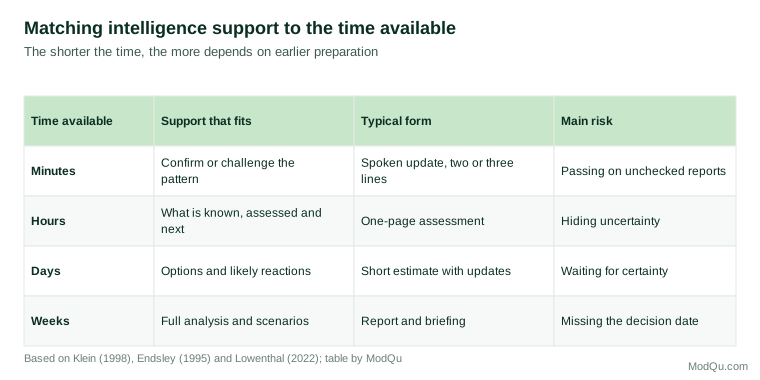
For intelligence teams, this has two implications. First, decision-makers under pressure will look for a recognisable pattern; intelligence can help by confirming or challenging the pattern they think they see. Second, intelligence is most valuable when it identifies what is unusual about this situation compared with the familiar type, because that is where intuition is most likely to fail.
Situation awareness
Endsley (1995) defined situation awareness as perceiving the relevant elements of the environment, understanding what they mean and projecting what they will do next. Under time pressure, decision-makers need all three levels quickly. Intelligence support should therefore answer three questions in order: what is happening, what does it mean, and what is likely to happen next?
Preparing before the crisis
The most important intelligence work for a time-pressured decision is usually done before the crisis begins. Grabo (2002), writing about strategic warning, stresses that warning depends on indicators identified and monitored long before events occur. When an emergency arrives, there is no time to build expertise from scratch.
Preparation includes:
- Baseline knowledge. Keep up-to-date profiles of key competitors, partners, markets and threats, so that analysts can answer basic questions immediately.
- Scenarios and indicators. Think through the most likely and most damaging crises in advance, and list the signs that would show each is developing.
- Templates. Agree short formats for crisis products, so that no time is spent deciding how to present information.
- Contacts and channels. Know who will need intelligence, how to reach them and who has authority to act.
- Rehearsal. Exercises let teams practise producing fast assessments and give decision-makers experience in using them.
Delivering support when time is short
When time is short, the form of intelligence matters as much as the content.
Lead with the answer. Minto (2009) recommends starting with the main conclusion and supporting it with key points. Under pressure, the first sentence may be the only one read.
Separate what is known from what is assessed. State plainly what has been confirmed, what is reported but unconfirmed, and what is judgement. Under pressure, early reports are often wrong.
Give a probability and a confidence level. Decision-makers need to know how sure the team is, even if the honest answer is "not very".
Say what would change the assessment. Name the next piece of information that would most change the picture, and when it might arrive.
Update quickly and visibly. Issue short updates as the situation develops, marking clearly what has changed since the last one.
Davis (2006) stresses the importance of trust between analysts and decision-makers. In a crisis there is no time to build it; it must already exist. Lowenthal (2022) notes that the analysts who are trusted in crises are usually those who have proved themselves in calmer times.
Working with the decision-maker
Under time pressure, the relationship between analyst and decision-maker becomes closer and more conversational. Written products give way to short briefings, calls and messages. This brings risks as well as benefits. Analysts may be drawn into advocating a course of action rather than describing the situation, and decision-makers may ask leading questions that invite the answer they hope for. A simple discipline helps: the analyst describes the situation and the likely consequences of the options under discussion, and the decision-maker chooses. Keeping a short written log of what was said and when also helps the team review its performance afterwards.
Common mistakes
- Waiting for certainty. An assessment delivered after the decision is worthless. A clear provisional judgement with stated uncertainty is better.
- Flooding the decision-maker. Passing on every report increases pressure and confusion. Select and summarise.
- Hiding uncertainty. Presenting early reports as confirmed can lead to costly errors.
- Neglecting preparation. Teams that have not prepared baselines and templates lose valuable hours.
A business illustration
Late on a Friday, a logistics company learns that a fire has closed a major port used by several of its key customers. The chief executive must decide within hours whether to reroute shipments, at considerable cost. The intelligence team has prepared for port disruption as one of its scenarios. Within forty minutes it delivers a one-page assessment: what is confirmed about the fire, which shipments are affected, the likely duration of closure based on similar incidents, alternative routes and their capacity, and the main uncertainties. It gives a probability that the port will remain closed for more than a week and names the official announcement that would change the estimate. The chief executive reroutes the most time-sensitive shipments and holds the rest pending the update. The team issues three short updates over the weekend, each marking what has changed.
Conclusion
Time pressure changes how people decide: they consider fewer options, rely on recognition and intuition, and are more exposed to certain errors. Intelligence can help by confirming or challenging the patterns decision-makers see, highlighting what is unusual, and stating clearly what is known, what is assessed and how confident the team is. Most of the value, however, comes from preparation: the baselines, scenarios, templates and trust built before the crisis begins.
References
Davis, J. (2006). Intelligence analysts and policymakers: Benefits and dangers of tensions in the relationship. Intelligence and National Security, 21(6), 999–1021. https://doi.org/10.1080/02684520601046325
Endsley, M. R. (1995). Toward a theory of situation awareness in dynamic systems. Human Factors, 37(1), 32–64. https://doi.org/10.1518/001872095779049543
Gigerenzer, G., & Gaissmaier, W. (2011). Heuristic decision making. Annual Review of Psychology, 62, 451–482. https://doi.org/10.1146/annurev-psych-120709-145346
Grabo, C. M. (2002). Anticipating surprise: Analysis for strategic warning. Joint Military Intelligence College.
Kahneman, D., & Klein, G. (2009). Conditions for intuitive expertise: A failure to disagree. American Psychologist, 64(6), 515–526. https://doi.org/10.1037/a0016755
Kahneman, D. (2011). Thinking, fast and slow. Farrar, Straus and Giroux.
Klein, G. (1998). Sources of power: How people make decisions. MIT Press.
Klein, G. A., Calderwood, R., & Clinton-Cirocco, A. (1986). Rapid decision making on the fire ground. Proceedings of the Human Factors Society Annual Meeting, 30(6), 576–580. https://doi.org/10.1177/154193128603000616
Lowenthal, M. M. (2022). Intelligence: From secrets to policy (9th ed.). CQ Press.
Minto, B. (2009). The pyramid principle: Logic in writing and thinking (3rd ed.). Pearson Education.
Ordóñez, L., & Benson, L., III. (1997). Decisions under time pressure: How time constraint affects risky decision making. Organizational Behavior and Human Decision Processes, 71(2), 121–140. https://doi.org/10.1006/obhd.1997.2717
Payne, J. W., Bettman, J. R., & Johnson, E. J. (1988). Adaptive strategy selection in decision making. Journal of Experimental Psychology: Learning, Memory, and Cognition, 14(3), 534–552. https://doi.org/10.1037/0278-7393.14.3.534
Svenson, O., & Maule, A. J. (Eds.). (1993). Time pressure and stress in human judgment and decision making. Plenum Press. https://doi.org/10.1007/978-1-4757-6846-6