
Intelligence · Organisational intelligence
The Use of Wikis and Collaborative Editing for Living Intelligence Knowledge Bases
Intelligence knowledge goes out of date quickly, and much of it sits in finished reports that are never revised. Wikis and other collaborative editing tools offer a way to keep a living knowledge base that many people update together. This article explains how wikis work, what research says about the quality and sustainability of collaborative knowledge, how intelligence organisations have used them, and how to make a wiki-based knowledge base succeed.
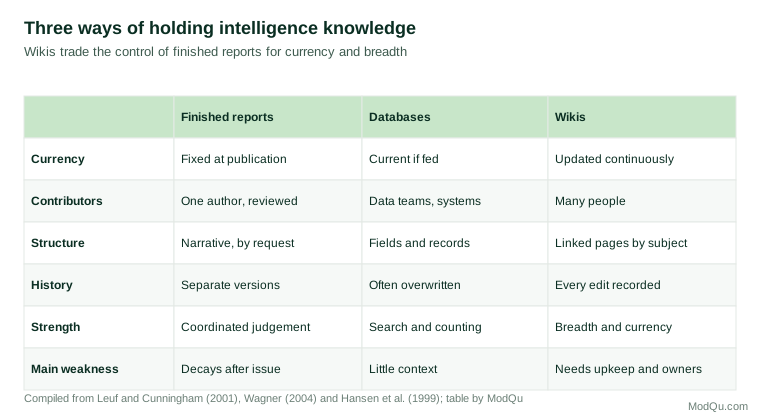
Intelligence organisations produce large volumes of knowledge, but much of it is locked in finished products. A report on a competitor, a market or a threat is written, approved, distributed and filed. Six months later the situation has changed, but the report has not. The next analyst who needs the information must either find and correct the old report or start again. Knowledge that should accumulate instead fragments into a pile of documents, each accurate on the day it was written and increasingly misleading afterwards.
A living knowledge base takes a different approach. Instead of issuing a new document each time, the organisation maintains a single, continuously updated page for each subject: each competitor, product line, country, threat actor or technology. Many people contribute to it, every change is recorded, and readers always see the current version. The most common tool for this is the wiki: a set of web pages that any authorised user can edit through a browser.
This article explains how wikis work, what research says about the quality and sustainability of collaboratively edited knowledge, how intelligence organisations have used wikis, and what makes a wiki-based knowledge base succeed or fail.
What a wiki is
The first wiki was created in 1995 by the software developer Ward Cunningham, who wanted a quick way for programmers to share and refine design patterns. Leuf and Cunningham (2001) describe the core ideas: anyone can edit any page; pages link easily to one another; every change is saved in a page history, so mistakes can be reversed; and the structure of the site grows from use rather than being designed in advance. The name comes from a Hawaiian word for "quick".
Wagner (2004) describes wikis as a technology for conversational knowledge management, in which knowledge is created and refined through many small contributions and discussions rather than through formal publication. This makes wikis well suited to knowledge that changes often and is spread across many people.
Three features matter most for intelligence work:
- Version history. Every edit is recorded with its author and time, so readers can see how a page has changed and restore an earlier version if needed.
- Discussion pages. Each content page usually has a linked discussion page where contributors debate changes, raise doubts and agree wording.
- Links and categories. Pages link to related subjects, so that knowledge is connected rather than isolated.
Why intelligence knowledge suits a living format
Intelligence knowledge has several features that make a living format attractive.
It goes out of date. Facts about organisations, people, markets and threats change constantly. A static report starts to decay as soon as it is published.
It is spread across many people. No single analyst knows everything about a subject. Sales staff, engineers, regional managers and analysts each hold pieces. Davenport and Prusak (1998) note that much valuable organisational knowledge is held by individuals who are never asked to share it.
It builds on itself. New information is most useful when added to what is already known. Nonaka and Takeuchi (1995) describe knowledge creation as a spiral in which individual insights are shared, combined and absorbed into practice; a wiki provides a place where that combination can happen visibly.
It is hard to transfer. Szulanski (1996) found that knowledge and best practice often fail to move within firms, not because people are unwilling, but because recipients lack context and there is no easy channel. A shared, linked page that anyone can read reduces these barriers.
The weaknesses of traditional intelligence knowledge management are well documented. Zegart (2007) showed how information relevant to the attacks of 11 September 2001 was held in different American agencies but never brought together. The Markle Foundation Task Force on National Security in the Information Age (2003) called for a trusted information network in which knowledge could be shared horizontally between agencies rather than only up and down chains of command. Treverton (2003) argued that intelligence needed to move from producing finished products for distant customers towards continuous, networked sense-making.
Wikis in intelligence: Intellipedia
The best-known use of wikis in intelligence is Intellipedia, a set of wikis launched across the American intelligence community in 2006. It was inspired in part by an essay by a Central Intelligence Agency analyst, Calvin Andrus, who argued that the intelligence community should become a "complex adaptive system" in which analysts could share and update knowledge continuously, using tools such as wikis and blogs (Andrus, 2005). Andrus argued that the formal production process was too slow for a fast-changing world, and that self-organising collaboration among many analysts would respond better to new information.
Intellipedia allowed analysts from different agencies to contribute to shared pages at different classification levels. It showed that collaborative editing could work inside intelligence organisations, but also that it did not replace formal products. Finished, coordinated assessments remained the main output to policymakers, while the wiki served as a shared working space and reference. This division of labour is a useful model for businesses: the wiki holds the living base of knowledge, and formal products draw on it for particular decisions.
Wikis in business
Businesses adopted wikis widely in the 2000s. McAfee (2006) described the rise of what McAfee called "Enterprise 2.0": the use of wikis, blogs and similar tools inside companies to let knowledge emerge from collaboration rather than being imposed by formal systems. McAfee argued that such tools work best when they are easy to use, when contributions are visible and when the organisation's structure emerges from use.
Majchrzak et al. (2006), in a survey of corporate wiki users, found that wikis were used mainly for project work, documentation and knowledge sharing, and that users reported benefits such as improved work processes, better collaboration and new opportunities. Contributors were more likely to persist when the wiki was used for tasks that were novel and required knowledge from several people.
Hansen et al. (1999) distinguished two broad knowledge management strategies. A codification strategy stores knowledge in documents and databases so that it can be reused by many people. A personalisation strategy relies on connecting people who hold knowledge. Wikis sit between the two: they codify knowledge, but they also show who contributed it, which helps readers find the people behind the page.
Does collaborative editing produce reliable knowledge?
A natural worry is that knowledge written by many people, any of whom can edit, will be unreliable. Research on Wikipedia, the largest wiki, offers useful evidence.
Giles (2005), reporting a study for the journal Nature, compared science articles in Wikipedia and the Encyclopaedia Britannica. Experts found serious errors at similar low rates in both, though Wikipedia articles contained somewhat more minor errors and omissions. The study was disputed, but it suggested that collaborative editing can produce knowledge of reasonable quality. Mesgari et al. (2015), reviewing a large body of research on Wikipedia content, found that quality varies greatly between articles: heavily edited, frequently viewed articles tend to be accurate and comprehensive, while neglected articles can be poor.
How quality arises has also been studied. Kittur and Kraut (2008) found that adding more editors improved article quality only when the editors coordinated, either through a few contributors doing most of the writing or through discussion. Simply adding more people without coordination did not help. Stvilia et al. (2008) found that Wikipedia's community had developed explicit quality standards, review processes and roles for maintaining quality, which shows that open editing does not mean the absence of governance. Viégas et al. (2004), using a visualisation of page histories, found that vandalism was usually repaired very quickly, often within minutes, because many people watched popular pages.
Conflict is also part of collaborative editing. Kittur et al. (2007) found that an increasing share of Wikipedia activity was devoted to discussion, coordination and resolving disputes rather than writing content directly. For intelligence teams, this is a reminder that a living knowledge base needs time and effort to maintain, and that disagreements should be visible and resolved, not hidden.
Sustainability: why wikis decline
Many corporate wikis start with enthusiasm and fade within a year or two. Pages go out of date, contributors drift away and readers lose trust. Halfaker et al. (2013) found that even Wikipedia's community of active editors declined after 2007, partly because tools and rules introduced to fight vandalism made it harder for newcomers to contribute and more likely that their edits would be reversed. Tools designed to protect quality had the side effect of discouraging new contributors.
Benkler (2006) argues that collaborative production depends on motivations other than pay, such as interest, reputation and a sense of contributing to a shared purpose, and on the ability to make small contributions easily. When contributions become difficult or unrewarded, participation falls.
Several lessons follow for organisations:
- A wiki needs a reason to exist that matters to contributors, such as being the place where answers are actually found.
- Contributions must be easy, and newcomers' edits should be welcomed and corrected gently rather than reversed without explanation.
- Contributors need recognition, for example through visible credit or acknowledgement by managers.
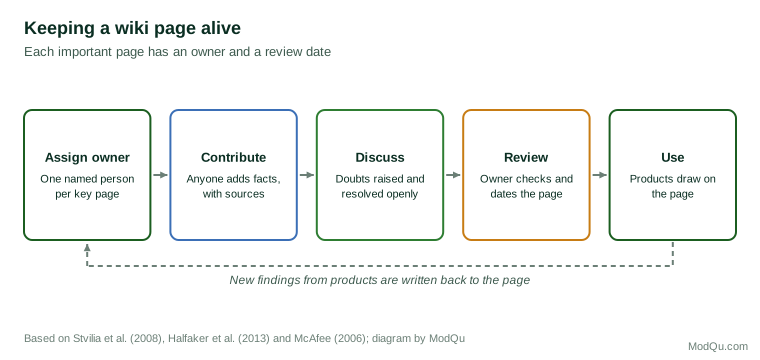
- Someone must be responsible for each important page, so that it is reviewed and kept current.
Culture and tacit knowledge
A wiki captures explicit knowledge: what can be written down. Much expert knowledge is tacit: hard to express in words. Polanyi (1966) observed that "we can know more than we can tell". An experienced analyst may sense that a competitor is preparing a move without being able to list the reasons. Alavi and Leidner (2001) note that knowledge management systems work best when they support, rather than replace, the social processes through which tacit knowledge is shared.
A wiki can help by linking pages to the people who wrote them, by recording the reasoning behind judgements on discussion pages and by acting as a focus for communities of practice: groups of people who share an interest and learn from each other through regular interaction (Wenger, 1998). Kerbel and Olcott (2010) argue that intelligence is best understood as a shared process of making sense with users rather than a product delivered to them; a living knowledge base that users can read and comment on supports that process.
Culture matters too. People will contribute only if they feel safe doing so. Edmondson (1999) showed that teams with high psychological safety are more willing to admit mistakes and share uncertain ideas. In a wiki, that means analysts must feel able to post preliminary information, correct colleagues' work and flag doubts without fear of embarrassment.
Designing a living intelligence knowledge base
The following practices help a wiki-based intelligence knowledge base succeed.
- Start with a clear scope. Decide what the knowledge base covers: for example, one page for each key competitor, market, product category and regulatory issue. A focused start is better than an empty site covering everything.
- Use a standard page structure. Give each type of page a template, such as overview, key facts, recent developments, assessment, key uncertainties, indicators to watch, sources and contacts. Templates make pages easier to write and to read.
- Assign page owners. Each important page should have a named owner responsible for its accuracy and currency. Others may edit, but the owner reviews.
- Show when the page was last reviewed. Display a "last reviewed" date and the reviewer's name prominently, so readers can judge how current the page is.
- Separate facts from assessments. Mark clearly which statements are sourced facts and which are judgements, and attach confidence levels to judgements.
- Cite sources. Every significant fact should link to its source, so readers can check it and so that knowledge can be defended.
- Use discussion pages. Encourage contributors to raise doubts and disagreements on discussion pages, and to record how they were resolved.
- Link to formal products. When a formal assessment is produced, link it from the relevant pages and update the pages with its findings. Equally, draw on the pages when writing formal products.
- Control access sensibly. Restrict sensitive pages to those who need them, but avoid locking down so much that the knowledge base becomes useless. Record who can see what.
- Make it part of the work. Encourage managers to point people to the wiki for answers, and to recognise good contributions in performance reviews.
Questions to ask before launching
Before setting up a wiki, an intelligence team can test whether it is ready by asking:
- Which questions do colleagues ask us repeatedly, and could a page answer them?
- Who outside the team holds knowledge we want, and would they contribute?
- Who will own each key page, and how much time will that take each month?
- What will we do with pages that nobody maintains?
- Which information is too sensitive to place on a shared site, and where will it go instead?
- How will we know, after a year, whether the wiki has been worth the effort?
Clear answers to these questions are a better predictor of success than the choice of software. Most wiki tools offer the core features described above; what differs between successful and failed knowledge bases is ownership, purpose and habit.
Security and legal considerations
A living knowledge base concentrates valuable knowledge in one place, which makes it a target. Access controls, logging of who reads and edits pages, and regular review of permissions are essential. Personal data about individuals, such as competitors' employees or customers, must be handled in line with data protection law, including limits on retention. Version histories mean that deleted information may still be recoverable, which should be considered when removing data that should not have been posted. Sources must also be protected: a page that names a confidential source or describes how sensitive information was obtained should be restricted or rewritten.
Measuring success
It is easy to count pages and edits, but these measure activity rather than value. More useful measures include:
- the share of important pages reviewed within their scheduled period;
- the number of active contributors, and how many are new;
- how often pages are used when writing formal products;
- feedback from readers on whether they found what they needed;
- the time taken to answer common questions compared with before.
Regular review of these measures helps identify pages that are neglected and contributors who need support.
Common mistakes
- Launching without content. Users who find empty pages do not return. Populate key pages before launch.
- Expecting it to run itself. Without owners and review dates, pages go stale and trust collapses.
- Over-policing. Reversing newcomers' edits without explanation drives contributors away.
- Treating the wiki as a dumping ground. Long pasted reports without structure make pages unreadable. Summarise and link.
- Replacing conversation. A wiki supports, but does not replace, the discussions through which tacit knowledge is shared.
- Ignoring security. A single site holding all competitive knowledge must be protected accordingly.
A business illustration
A mid-sized industrial equipment manufacturer has an intelligence team of four people serving sales, product and executive teams across several countries. Its knowledge about competitors is spread across hundreds of slide decks and reports, many years old. Sales staff in different regions repeatedly ask the same questions.
The team sets up a wiki with one page for each of its twelve main competitors and each of its six key markets. Each page follows a template and has a named owner from the intelligence team. Before launch, the team populates every page with current information, sources and an assessment. It invites regional sales managers to add field observations directly to the "recent developments" section and to raise questions on the discussion pages.
After a slow start, the wiki becomes the first place staff look for competitor information. Sales managers add observations from customer meetings, and the intelligence team reviews them weekly, checking and integrating them into the assessments. Each page shows its last review date, and pages not reviewed for three months are flagged. When the board requests an assessment of a competitor's likely entry into a new market, the team draws most of the background from the wiki in a day, rather than a week. After two years, the team finds that contributions from outside the intelligence team account for a significant share of new information, and that the quality of field reporting has improved because contributors can see how their observations are used.
Conclusion
Wikis and collaborative editing offer intelligence organisations a way to keep knowledge current, connected and shared, rather than locked in reports that decay after publication. Research on Wikipedia and corporate wikis shows that collaborative knowledge can be reliable, but only when contributors coordinate, quality standards exist and someone takes responsibility for maintaining important pages. It also shows that participation can decline if contributing becomes difficult or unrewarded. A living intelligence knowledge base succeeds when it has a clear scope, standard templates, named owners, visible review dates, cited sources, a culture that welcomes contributions and close links to the formal products through which intelligence reaches decision-makers.
References
Alavi, M., & Leidner, D. E. (2001). Review: Knowledge management and knowledge management systems: Conceptual foundations and research issues. MIS Quarterly, 25(1), 107–136. https://doi.org/10.2307/3250961
Andrus, D. C. (2005). The wiki and the blog: Toward a complex adaptive intelligence community. Studies in Intelligence, 49(3), 63–70.
Benkler, Y. (2006). The wealth of networks: How social production transforms markets and freedom. Yale University Press.
Davenport, T. H., & Prusak, L. (1998). Working knowledge: How organizations manage what they know. Harvard Business School Press.
Edmondson, A. (1999). Psychological safety and learning behavior in work teams. Administrative Science Quarterly, 44(2), 350–383. https://doi.org/10.2307/2666999
Giles, J. (2005). Internet encyclopaedias go head to head. Nature, 438(7070), 900–901. https://doi.org/10.1038/438900a
Halfaker, A., Geiger, R. S., Morgan, J. T., & Riedl, J. (2013). The rise and decline of an open collaboration system: How Wikipedia's reaction to popularity is causing its decline. American Behavioral Scientist, 57(5), 664–688. https://doi.org/10.1177/0002764212469365
Hansen, M. T., Nohria, N., & Tierney, T. (1999). What's your strategy for managing knowledge? Harvard Business Review, 77(2), 106–116.
Kerbel, J., & Olcott, A. (2010). Synthesizing with clients, not analyzing for customers. Studies in Intelligence, 54(4), 11–27.
Kittur, A., & Kraut, R. E. (2008). Harnessing the wisdom of crowds in Wikipedia: Quality through coordination. In Proceedings of the 2008 ACM Conference on Computer Supported Cooperative Work (pp. 37–46). ACM. https://doi.org/10.1145/1460563.1460572
Kittur, A., Suh, B., Pendleton, B. A., & Chi, E. H. (2007). He says, she says: Conflict and coordination in Wikipedia. In Proceedings of the SIGCHI Conference on Human Factors in Computing Systems (pp. 453–462). ACM. https://doi.org/10.1145/1240624.1240698
Leuf, B., & Cunningham, W. (2001). The wiki way: Quick collaboration on the web. Addison-Wesley.
Majchrzak, A., Wagner, C., & Yates, D. (2006). Corporate wiki users: Results of a survey. In Proceedings of the 2006 International Symposium on Wikis (pp. 99–104). ACM. https://doi.org/10.1145/1149453.1149472
Markle Foundation Task Force on National Security in the Information Age. (2003). Creating a trusted information network for homeland security. Markle Foundation.
McAfee, A. P. (2006). Enterprise 2.0: The dawn of emergent collaboration. MIT Sloan Management Review, 47(3), 21–28.
Mesgari, M., Okoli, C., Mehdi, M., Nielsen, F. Å., & Lanamäki, A. (2015). "The sum of all human knowledge": A systematic review of scholarly research on the content of Wikipedia. Journal of the Association for Information Science and Technology, 66(2), 219–245. https://doi.org/10.1002/asi.23172
Nonaka, I., & Takeuchi, H. (1995). The knowledge-creating company: How Japanese companies create the dynamics of innovation. Oxford University Press.
Polanyi, M. (1966). The tacit dimension. Doubleday.
Stvilia, B., Twidale, M. B., Smith, L. C., & Gasser, L. (2008). Information quality work organization in Wikipedia. Journal of the American Society for Information Science and Technology, 59(6), 983–1001. https://doi.org/10.1002/asi.20813
Szulanski, G. (1996). Exploring internal stickiness: Impediments to the transfer of best practice within the firm. Strategic Management Journal, 17(S2), 27–43. https://doi.org/10.1002/smj.4250171105
Treverton, G. F. (2003). Reshaping national intelligence for an age of information. Cambridge University Press.
Viégas, F. B., Wattenberg, M., & Dave, K. (2004). Studying cooperation and conflict between authors with history flow visualizations. In Proceedings of the SIGCHI Conference on Human Factors in Computing Systems (pp. 575–582). ACM. https://doi.org/10.1145/985692.985765
Wagner, C. (2004). Wiki: A technology for conversational knowledge management and group collaboration. Communications of the Association for Information Systems, 13, 265–289. https://doi.org/10.17705/1CAIS.01319
Wenger, E. (1998). Communities of practice: Learning, meaning, and identity. Cambridge University Press. https://doi.org/10.1017/CBO9780511803932
Zegart, A. B. (2007). Spying blind: The CIA, the FBI, and the origins of 9/11. Princeton University Press.