
Intelligence · Analysis and tradecraft
The Role of Intuition in Expert Intelligence Analysis and Knowledge Synthesis
Experienced analysts often sense the answer before they can explain it. This article explains what intuition is, when research shows it can be trusted, where it fails, how it compares with statistical methods and how to combine it with structured analysis.
Experienced analysts often know something is wrong before they can say why. A report does not ring true; a pattern of activity feels unusual; a forecast seems too optimistic. This sense, which arrives quickly and without conscious reasoning, is intuition. Intelligence organisations depend on it, since it allows experts to notice what matters among large volumes of information. Yet intuition can also mislead, sometimes badly. Research over the past half-century has clarified when intuition deserves trust and when it does not. This article summarises that research and explains how analysts can combine intuition with structured methods to produce better knowledge.
What intuition is
Dane and Pratt (2007) define intuitions as judgements that arise through rapid, non-conscious and holistic associations, often accompanied by a feeling of certainty. They are different from guesses, which have no basis, and from insights, which follow a period of conscious work on a problem.
Psychologists often describe thinking in terms of two kinds of process. Evans and Stanovich (2013) distinguish Type 1 processes, which are fast, automatic and do not depend on working memory, from Type 2 processes, which are slow, deliberate and effortful. Intuition belongs to Type 1. Analysis, such as weighing evidence against several hypotheses, belongs to Type 2. Both are always at work; the question is how they interact.
Herbert Simon offered the most influential explanation of expert intuition. Simon argued that intuition is a form of recognition: "The situation has provided a cue; this cue has given the expert access to information stored in memory, and the information provides the answer. Intuition is nothing more and nothing less than recognition" (Simon, 1992, p. 155). On this view, intuition is not mysterious. It is the product of experience, stored as patterns that can be matched quickly to new situations.
Evidence from chess and firefighting
Chase and Simon (1973) provided early evidence for this view. They showed chess masters and weaker players positions from real games for a few seconds and asked them to reconstruct them. Masters recalled far more pieces correctly. But when the pieces were placed randomly, masters did no better than novices. Their advantage lay in recognising meaningful patterns, or "chunks", built up through years of play, not in a better general memory.
Gary Klein studied experts in real settings. Klein et al. (1986) interviewed commanders of fire crews about difficult incidents and found that in most cases they did not compare options at all. They recognised the situation as a type they had seen before, which suggested a plausible course of action, and then mentally simulated it to check that it would work. If it would, they acted; if not, they adjusted it or tried the next option. Klein (1998) developed this into the recognition-primed decision model, and found similar patterns among military commanders, nurses and other professionals working under time pressure.
Klein and colleagues also studied sensemaking, the process by which people fit data into a frame that explains them and revise the frame when the data do not fit (Klein et al., 2006). Intelligence analysis is largely sensemaking: analysts are constantly fitting new reports into an understanding of a situation. Intuition guides which frame is chosen first.
When intuition can be trusted
Kahneman and Klein (2009) set out to resolve the apparent conflict between Klein's findings, which emphasised the power of expert intuition, and Kahneman's research on heuristics and biases, which emphasised its failures (Tversky & Kahneman, 1974). They concluded that both were right, in different conditions. Intuition is likely to be skilled when two conditions are met:
- The environment is sufficiently regular. There must be stable relationships between cues and outcomes that can be learned. Chess, firefighting and weather forecasting meet this condition.
- The person has had adequate opportunity to learn those regularities, through prolonged practice with rapid and clear feedback.
When either condition is missing, intuitions may feel just as confident but be no more accurate than chance. Confidence, they warned, is not a reliable guide to accuracy.
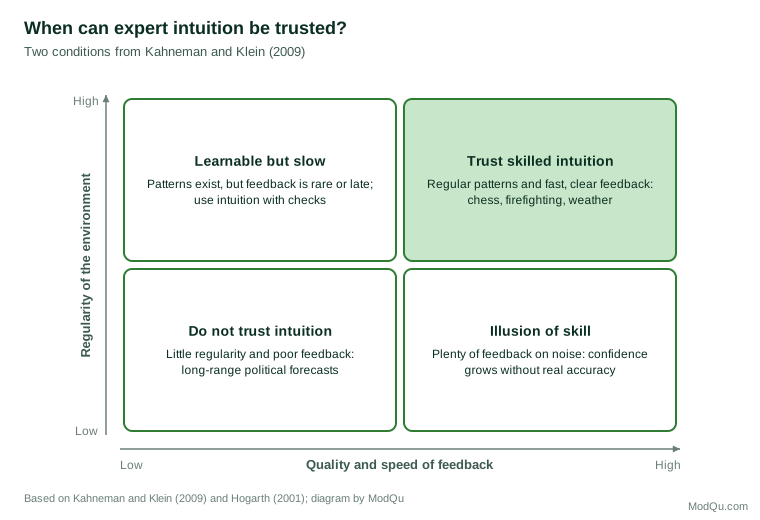
Hogarth (2001) described the same idea in terms of kind and wicked learning environments. In a kind environment, feedback is accurate and timely, so experience teaches the right lessons. In a wicked environment, feedback is missing, delayed or misleading, so experience can teach the wrong lessons and intuition becomes confidently wrong.
Shanteau (1992) compared expert performance across many professions and identified task characteristics that distinguish domains where experts do well from those where they do not.
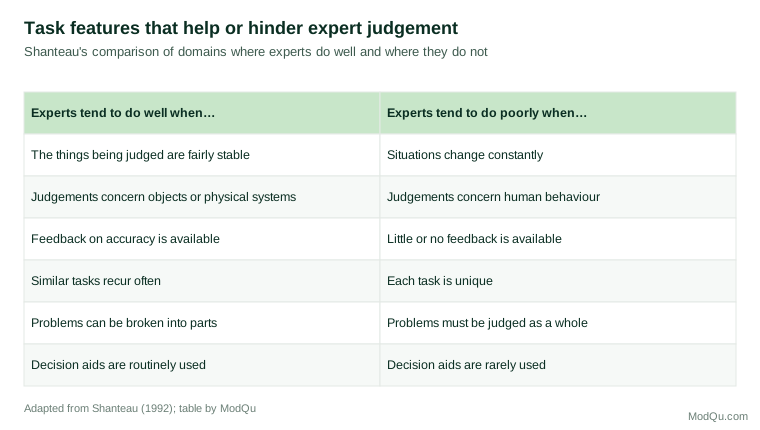
Many intelligence problems have the features in the right-hand column. They concern human behaviour, situations change, each case is in some ways unique and feedback on judgements is slow or absent. A strategic analyst may make only a handful of major forecasts in a career, and learn the outcome years later, if at all. This does not mean intuition is useless in intelligence, but it does mean it should be checked.
Statistical versus intuitive judgement
A long line of research compares intuitive or "clinical" judgement with simple statistical rules. Meehl (1954) reviewed studies in which psychologists and statistical formulas predicted outcomes such as academic success or criminal reoffending, and found that the formulas were at least as accurate as the experts in almost every case. Dawes et al. (1989) updated the review and reached the same conclusion: when the same information is available, actuarial methods usually equal or outperform expert judgement.
Grove et al. (2000) conducted a meta-analysis of 136 studies across medicine, mental health, education and other fields. Mechanical prediction was, on average, about 10 per cent more accurate than clinical prediction. In about half the studies the two performed similarly, and clinical judgement was clearly better in only a small minority. Tetlock (2005), studying thousands of political and economic forecasts made by experts, found that they often performed little better than simple extrapolations, and that the most confident experts with a single overarching theory did worst.
Kahneman et al. (2021) add a further reason why rules often beat experts: noise. Different experts, or the same expert at different times, give different judgements on the same case. Statistical rules are perfectly consistent, and this consistency alone gives them an advantage.
Where intuition adds value
None of this means that intuition should be discarded. Gigerenzer and Gaissmaier (2011) show that simple heuristics, the rules of thumb that underlie much intuition, can be remarkably accurate, sometimes outperforming complex models when information is limited and the environment is uncertain. Hammond et al. (1987) found that experts performed best when their mode of thinking matched the task: intuitive thinking did better on tasks with many cues presented together, while analytical thinking did better on tasks that were well structured and decomposable.
In intelligence work, intuition is particularly valuable in several roles:
- Noticing. Experienced analysts detect anomalies and patterns that formal methods would not flag because no one thought to look for them.
- Generating hypotheses. Intuition is a rich source of possible explanations, which can then be tested analytically.
- Selecting what matters. Faced with large volumes of information, experts quickly identify the few items that deserve attention.
- Sensing when something does not fit. The feeling that a report is "too good to be true" is often the first sign of deception or error.
Salas et al. (2010) reviewed research on intuition in organisations and concluded that expertise-based intuition is most valuable when it rests on deep domain knowledge and is applied to problems similar to those on which that knowledge was built.
Intuition in business research
The same principles apply in business. Managers often rely on a feel for their market when deciding which products to launch or which customers to pursue. In stable markets with frequent, measurable results, such as pricing everyday products, that feel can be well calibrated. In fast-changing markets, or for decisions made rarely, such as entering a new country, it is much less reliable. Survey research and other systematic evidence are most valuable precisely where intuition is weakest: they replace an expert's impression of what customers think with a measured answer, and they create the feedback that allows intuition to improve over time.
Developing intuitive expertise
If intuition is pattern recognition, it can be improved by building better patterns. Ericsson et al. (1993) showed that expert performance in music and other fields is closely linked to deliberate practice: focused effort on specific weaknesses, with immediate feedback and guidance from teachers. Simply accumulating years of experience is not enough.
For intelligence analysts, this suggests several practices:
- Create feedback. Record forecasts and judgements with explicit probabilities, and check them against outcomes. Where real feedback is slow, use exercises and historical cases with known outcomes.
- Study cases deliberately. Review past successes and failures, asking what cues were present and how they should have been read.
- Learn from experts. Klein (1998) found that experts can pass on intuitive skill through stories and walkthroughs of difficult cases, which show novices what to notice.
- Rotate across problems carefully. Expertise is specific to a domain. An analyst moved to a new region or industry loses much of their intuitive advantage and should rely more on structured methods until new patterns are learned.
Combining intuition and analysis
The most practical lesson from research is that intuition and analysis work best together. Heuer (1999) argued that analysts cannot avoid using mental shortcuts, but that structured techniques can expose and test the intuitions those shortcuts produce. Kahneman et al. (2021) recommend delaying intuition rather than eliminating it. In what they call a mediating assessments approach, a decision is broken into several independent assessments, each made separately on the basis of evidence. Only when all are complete does the decision-maker form an overall intuitive judgement. This preserves the value of holistic judgement while reducing the influence of first impressions.
A practical sequence for intelligence analysis might be:
- Record your initial intuitive judgement and your confidence in it, before detailed analysis.
- Generate alternative hypotheses, including ones your intuition rejects.
- Weigh the evidence systematically against each hypothesis.
- Compare the result with your initial judgement. If they differ, ask why. Sometimes the analysis reveals a flaw in the intuition; sometimes the intuition points to evidence the analysis missed.
- Where reliable statistical models or base rates exist, start from them and adjust only for specific, well-supported reasons.
Common mistakes
- Treating confidence as accuracy. A strong feeling of certainty is not evidence that a judgement is correct (Kahneman & Klein, 2009).
- Trusting intuition outside its domain. An expert in one area may have no special insight in another.
- Dismissing intuition entirely. An unexplained sense that something is wrong deserves investigation, not dismissal.
- Ignoring base rates. Intuition tends to focus on the vivid details of a case and neglect how often such outcomes occur in general (Tversky & Kahneman, 1974).
- Never checking. Without records of past judgements, analysts cannot learn whether their intuition is reliable.
An illustration
An analyst who has followed a Canadian retail sector for fifteen years reads a competitor's quarterly report and feels uneasy: the figures look healthy, but something about the inventory numbers seems off. The analyst cannot say exactly what. Rather than dismissing the feeling or acting on it immediately, the analyst records it and investigates. Comparing the company's inventory with its sales over several years, the analyst finds that stock has been rising much faster than sales, a pattern that, in the analyst's experience, often precedes heavy discounting. A structured comparison with other retailers confirms that the pattern is unusual. The written assessment now rests on evidence that others can check, not only on intuition, but it was intuition that showed where to look.
Conclusion
Intuition is the fast recognition of patterns learned through experience. Research shows that it can be highly accurate in regular environments with good feedback, and unreliable where those conditions are absent, as they often are in intelligence and strategy. Statistical methods often outperform unaided intuition, yet intuition remains essential for noticing anomalies, generating hypotheses and sensing when something does not fit. The best practice is to treat intuition as a valuable source of hypotheses and warnings, to test it with structured analysis and data, and to build better intuition through deliberate practice and honest feedback.
References
Chase, W. G., & Simon, H. A. (1973). Perception in chess. Cognitive Psychology, 4(1), 55–81. https://doi.org/10.1016/0010-0285(73)90004-2
Dane, E., & Pratt, M. G. (2007). Exploring intuition and its role in managerial decision making. Academy of Management Review, 32(1), 33–54. https://doi.org/10.5465/amr.2007.23463682
Dawes, R. M., Faust, D., & Meehl, P. E. (1989). Clinical versus actuarial judgment. Science, 243(4899), 1668–1674. https://doi.org/10.1126/science.2648573
Ericsson, K. A., Krampe, R. T., & Tesch-Römer, C. (1993). The role of deliberate practice in the acquisition of expert performance. Psychological Review, 100(3), 363–406. https://doi.org/10.1037/0033-295X.100.3.363
Evans, J. St. B. T., & Stanovich, K. E. (2013). Dual-process theories of higher cognition: Advancing the debate. Perspectives on Psychological Science, 8(3), 223–241. https://doi.org/10.1177/1745691612460685
Gigerenzer, G., & Gaissmaier, W. (2011). Heuristic decision making. Annual Review of Psychology, 62, 451–482. https://doi.org/10.1146/annurev-psych-120709-145346
Grove, W. M., Zald, D. H., Lebow, B. S., Snitz, B. E., & Nelson, C. (2000). Clinical versus mechanical prediction: A meta-analysis. Psychological Assessment, 12(1), 19–30. https://doi.org/10.1037/1040-3590.12.1.19
Hammond, K. R., Hamm, R. M., Grassia, J., & Pearson, T. (1987). Direct comparison of the efficacy of intuitive and analytical cognition in expert judgment. IEEE Transactions on Systems, Man, and Cybernetics, 17(5), 753–770. https://doi.org/10.1109/TSMC.1987.6499282
Heuer, R. J., Jr. (1999). Psychology of intelligence analysis. Center for the Study of Intelligence, Central Intelligence Agency.
Hogarth, R. M. (2001). Educating intuition. University of Chicago Press.
Kahneman, D., & Klein, G. (2009). Conditions for intuitive expertise: A failure to disagree. American Psychologist, 64(6), 515–526. https://doi.org/10.1037/a0016755
Kahneman, D., Sibony, O., & Sunstein, C. R. (2021). Noise: A flaw in human judgment. Little, Brown Spark.
Klein, G. (1998). Sources of power: How people make decisions. MIT Press.
Klein, G. A., Calderwood, R., & Clinton-Cirocco, A. (1986). Rapid decision making on the fire ground. Proceedings of the Human Factors Society Annual Meeting, 30(6), 576–580. https://doi.org/10.1177/154193128603000616
Klein, G., Moon, B., & Hoffman, R. R. (2006). Making sense of sensemaking 1: Alternative perspectives. IEEE Intelligent Systems, 21(4), 70–73. https://doi.org/10.1109/MIS.2006.75
Meehl, P. E. (1954). Clinical versus statistical prediction: A theoretical analysis and a review of the evidence. University of Minnesota Press.
Salas, E., Rosen, M. A., & DiazGranados, D. (2010). Expertise-based intuition and decision making in organizations. Journal of Management, 36(4), 941–973. https://doi.org/10.1177/0149206309350084
Shanteau, J. (1992). Competence in experts: The role of task characteristics. Organizational Behavior and Human Decision Processes, 53(2), 252–266. https://doi.org/10.1016/0749-5978(92)90064-E
Simon, H. A. (1992). What is an "explanation" of behavior? Psychological Science, 3(3), 150–161. https://doi.org/10.1111/j.1467-9280.1992.tb00017.x
Tetlock, P. E. (2005). Expert political judgment: How good is it? How can we know? Princeton University Press.
Tversky, A., & Kahneman, D. (1974). Judgment under uncertainty: Heuristics and biases. Science, 185(4157), 1124–1131. https://doi.org/10.1126/science.185.4157.1124