
Intelligence · Concepts and history
The Intelligence Cycle: Direction, Collection, Processing, Analysis and Dissemination
The intelligence cycle is the best-known model of how intelligence is produced. This article explains each stage, where the model came from, how businesses use it, and what practitioners say it leaves out.
Almost every introduction to intelligence, whether written for a national security agency or a corporate strategy team, contains a diagram of a circle. Arrows lead from "direction" to "collection", then to "processing", "analysis" and "dissemination", and back again to direction. This is the intelligence cycle. It is the most familiar model of how raw information becomes knowledge that decision-makers can use, and it has shaped the way intelligence organisations are structured, trained and evaluated. This article explains each stage, traces where the model came from, shows how it is applied outside government, and summarises the main lessons practitioners draw from it.
Origins of the model
The idea that intelligence follows a repeating sequence grew out of military staff work in the Second World War. One of the earliest published versions appears in a short American Army text, Intelligence Is for Commanders, which described intelligence as a cycle of directing collection, collecting information, processing it into intelligence and using it (Glass & Davidson, 1948). Kent (1949), writing the following year about strategic intelligence for national policy, described a similar sequence of research steps, from identifying the problem through gathering and evaluating data to forming and presenting conclusions.
From these beginnings the cycle became part of official doctrine in the United States, the United Kingdom and NATO countries. American joint military doctrine describes six categories of intelligence operations: planning and direction; collection; processing and exploitation; analysis and production; dissemination and integration; and evaluation and feedback (Joint Chiefs of Staff, 2013). British doctrine has long used a shorter four-stage version of direction, collection, processing and dissemination, in which analysis is part of processing (Davies et al., 2013). Phythian (2013) gathers essays on how these versions developed and how well they describe reality.
The stages
Although versions differ in the number and names of steps, most include five core activities.
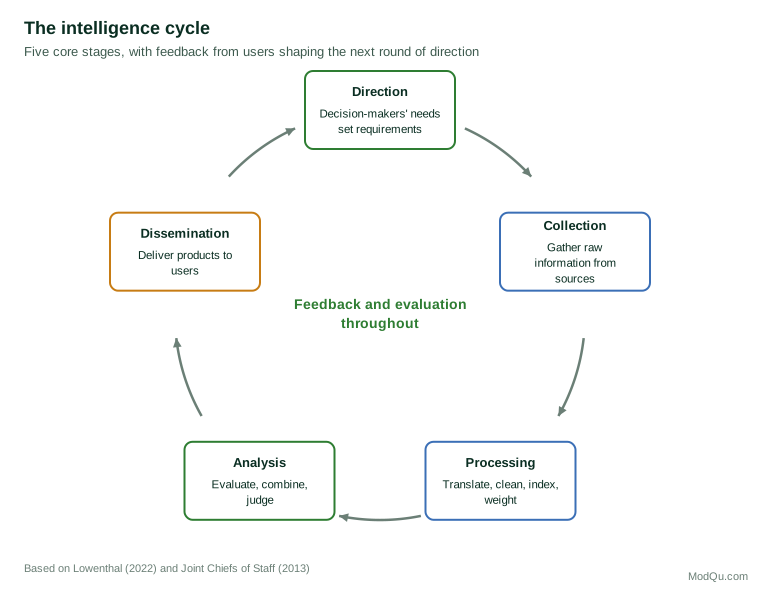
1. Direction (planning and requirements)
The cycle begins with a decision-maker's need to know. In government these needs are expressed as requirements: formal statements of what intelligence must find out, ranked by priority. Lowenthal (2022) stresses that requirements should come from policymakers, because only they know which uncertainties affect their decisions. In practice, intelligence managers often have to draft requirements themselves, because senior users are busy and do not think in those terms.
In business, the same step is often organised around key intelligence topics (KITs). Herring (1999) developed a structured interview process for identifying them, in which an intelligence manager asks executives about the decisions they face, the surprises they want to avoid and the competitors or other actors they need to understand. The resulting topics guide what the intelligence function collects and analyses.
2. Collection
Collection gathers the raw material. Government agencies distinguish collection disciplines by source: human intelligence from people, signals intelligence from communications and electronic emissions, geospatial and imagery intelligence from satellites and aircraft, measurement and signature intelligence from technical sensors, and open-source intelligence from publicly available material (Lowenthal, 2022). Businesses rely mainly on open sources, interviews with customers and industry experts, trade shows, internal sales data, and purchased databases and surveys (Fleisher & Bensoussan, 2015).
A recurring problem is imbalance. Collection is easier to expand than analysis, so organisations often gather far more than they can use. Treverton (2003) describes the shift in modern intelligence from a world of scarce information, where the hard task was obtaining secrets, to a world of abundant information, where the hard task is selecting and making sense of it.
3. Processing and exploitation
Raw material must be turned into a form that analysts can use. Intercepted communications must be decrypted and translated; satellite images must be interpreted; documents must be indexed; survey responses must be cleaned and weighted. Processing is often invisible to users but consumes a large share of resources. When it falls behind collection, valuable material can sit unread. Lowenthal (2022) describes the gap between what is collected and what is processed as one of the persistent weaknesses of large intelligence systems.
4. Analysis and production
Analysis is the stage where information becomes intelligence. Analysts evaluate the reliability of sources, combine material from different collection streams, test explanations against the evidence and form judgements about what is happening and what is likely to happen next. The results are written up as products: daily briefs, longer assessments, warning notices, estimates and profiles. Heuer (1999) showed that this stage is vulnerable to the limits of human cognition, including the tendency to fit new information into an existing mental model, and recommended structured methods to counter them.
Clark (2020) emphasises that analysis should be organised around the target, meaning the person, organisation, network or system the intelligence is about, and that a shared model of the target links collectors, analysts and users.
5. Dissemination
Finished intelligence must reach the right people, at the right time, in a form they will read. Dissemination includes choosing the format (a written report, an oral briefing, an alert on a dashboard), deciding who is cleared or entitled to receive it, and making sure the most important judgements are visible at once. Davis (2006) notes that an assessment that is accurate but arrives late, or is too long for a busy decision-maker to absorb, has little effect.
Feedback and evaluation
Most diagrams close the loop with feedback: users react to the product, and their reactions refine the next round of direction. American doctrine treats evaluation and feedback as a distinct activity that runs through all the stages rather than only at the end (Joint Chiefs of Staff, 2013). In practice feedback is the weakest link. Users rarely tell producers which products they used, which they ignored and why.
Who does each stage
The cycle also clarifies roles. In a large government system, different agencies or departments may own different stages: one collects signals, another collects imagery, and separate analytic offices write assessments. This specialisation brings expertise but creates seams where information can be lost. Users sit outside the cycle entirely in many diagrams, which can encourage producers to forget them. In a small business the opposite problem occurs: one or two people perform every stage, often alongside other duties, so that direction and feedback are squeezed out by the pressure to collect and report. Mapping who is responsible for each stage, and who speaks for the user, is a quick way to find gaps in either kind of organisation.
Measuring the cycle
One practical advantage of the cycle is that it suggests what to measure at each stage. Managers who track only the number of reports produced learn little about whether intelligence is working. A better set of measures follows the flow of work:
| Stage | Useful questions to measure |
|---|---|
| Direction | Are requirements written down, ranked and reviewed with users at least every few months? |
| Collection | What share of priority requirements has at least one productive source? |
| Processing | How long does material wait before an analyst can use it? |
| Analysis | Are judgements stated with explicit probabilities, and how often do they prove right? |
| Dissemination | Did the product reach the user before the decision, and did the user read it? |
| Feedback | How many products received a response, and what changed as a result? |
Measures like these expose bottlenecks. A team that collects heavily but has a long processing backlog needs analysts or tools, not more sources. A team whose products arrive after decisions are taken needs to change its timing or format. Gill and Phythian (2018) observe that accountability for intelligence often focuses on spectacular failures; routine measurement of each stage gives earlier warning of weaknesses.
Counterintelligence and security across the cycle
Most diagrams leave out an activity that runs alongside every stage: protecting the process from those who would exploit it. Lowenthal (2022) includes the safeguarding of intelligence processes in the definition of intelligence itself. An adversary who learns what an organisation is asking about learns its priorities; one who learns its sources can cut them off or feed them false information; one who reads its products learns what it knows and does not know. For a business, the same risks take the form of careless discussion of strategy at conferences, leaks of market research, or competitors learning which customers are being targeted. Security therefore belongs at each stage of the cycle, not only at the end.
The cycle in business
Competitive and business intelligence borrowed the cycle from government with few changes. Calof and Wright (2008) note that most corporate intelligence programmes describe their work in terms of planning, collection, analysis and dissemination. Fleisher and Bensoussan (2015) present the cycle as the organising frame for their catalogue of analytic techniques.
A simple illustration shows how the stages map onto a commercial question. A food manufacturer hears that a competitor may be about to launch a cheaper own-brand product.
- Direction: The commercial director asks whether the launch is real, when it will happen and how much it could cost the firm in sales.
- Collection: The intelligence team reviews the competitor's public statements and job advertisements, checks trade press and supplier announcements, interviews retail buyers and commissions a short consumer survey on price sensitivity.
- Processing: Survey data are cleaned and weighted; interview notes are coded; job advertisements are compiled into a timeline.
- Analysis: The team concludes that a launch within six months is likely, estimates the share of customers at risk under several price scenarios, and identifies the retailers most likely to stock the new product.
- Dissemination: A two-page brief with the main judgement in the first paragraph goes to the commercial director, followed by a briefing for the sales team.
- Feedback: After the launch, the team compares what happened with what it predicted and adjusts its methods.
The example shows why the cycle remains attractive. It gives newcomers a vocabulary, helps managers see where resources are going, and reminds everyone that collection is only one step.
What practitioners say the cycle misses
The cycle is a useful teaching tool, but many experienced practitioners argue that it misrepresents how intelligence actually works. The criticisms are discussed in detail in a separate article; the main points are summarised here.
Users do not usually give clear direction. Hulnick (2006), a former Central Intelligence Agency officer, argued that policymakers seldom set requirements in the orderly way the cycle implies. Collection agencies frequently gather what they can, and analysts draw on whatever has been collected.
The stages run in parallel, not in sequence. Collection and analysis happen simultaneously and influence each other. Analysts request new collection as they find gaps; collectors pass on material before it is processed. Johnston (2005), who studied American analysts at work, found that the real process was iterative and messy.
Analysis is not a single stage. Pirolli and Card (2005), studying how intelligence analysts work, described two linked loops: a foraging loop, in which analysts search for and filter information, and a sensemaking loop, in which they build and test explanations. Both loops run repeatedly within what the cycle calls a single step.
The relationship with users is ongoing. Kerbel and Olcott (2010) argue that the cycle encourages analysts to see themselves as producing finished products for passive customers, when the most valuable intelligence often comes from continuing conversations in which analysts and decision-makers work out the problem together.
Clark (2020) proposes a target-centric model to replace the cycle, in which collectors, analysts and users all contribute to and draw from a shared picture of the target. Davies et al. (2013), on the other hand, defend the cycle as a description of the functions that must be performed, even if the order in which they are performed varies.
Using the cycle well
The debate suggests that the cycle is best used as a checklist of functions rather than as a literal description of a process. Five practical lessons follow.
- Invest in direction. Time spent clarifying the decision and the key questions saves wasted collection later. Short structured conversations with users, of the kind Herring (1999) described, are among the most valuable activities an intelligence team can perform.
- Balance collection with the capacity to use it. More data is not better if no one has time to process and analyse it. Gill and Phythian (2018) note that the volume of collection in modern intelligence systems routinely exceeds analytic capacity.
- Treat analysis as iterative. Allow analysts to go back to collection and to revise judgements as new information arrives.
- Design dissemination around the user. Put the main judgement first, keep products short, and choose the format the user prefers.
- Build feedback deliberately. Ask users whether products helped, track the accuracy of past judgements and use the results to improve.
Why the cycle endures
Despite its critics, the cycle has persisted for more than seventy years. Herman (1996) suggests that it endures because it captures a basic truth: intelligence is a service that exists to meet users' needs, and every intelligence system must perform the same core functions of tasking, gathering, interpreting and delivering. Omand (2010) offers a revised model for the modern era but keeps the same underlying functions. Wilensky (1967) observed long ago that organisations of every kind, public and private, depend on these functions and fail in similar ways when any one of them is neglected.
Marrin (2012) argues that the deeper task is to bring intelligence practice closer to evidence about what actually works, rather than relying on models inherited from doctrine. Betts (2007) reminds us that no process design can eliminate the uncertainty at the heart of intelligence work. Seen in that light, the intelligence cycle is not a recipe that guarantees good results. It is a map of the work that must be done, and its greatest value lies in showing where an organisation's effort is concentrated and where it is missing.
References
Betts, R. K. (2007). Enemies of intelligence: Knowledge and power in American national security. Columbia University Press.
Calof, J. L., & Wright, S. (2008). Competitive intelligence: A practitioner, academic and inter-disciplinary perspective. European Journal of Marketing, 42(7/8), 717–730. https://doi.org/10.1108/03090560810877114
Clark, R. M. (2020). Intelligence analysis: A target-centric approach (6th ed.). CQ Press.
Davies, P. H. J., Gustafson, K., & Rigden, I. (2013). The intelligence cycle is dead, long live the intelligence cycle: Rethinking intelligence fundamentals for a new intelligence doctrine. In M. Phythian (Ed.), Understanding the intelligence cycle (pp. 56–75). Routledge.
Davis, J. (2006). Intelligence analysts and policymakers: Benefits and dangers of tensions in the relationship. Intelligence and National Security, 21(6), 999–1021. https://doi.org/10.1080/02684520601046325
Fleisher, C. S., & Bensoussan, B. E. (2015). Business and competitive analysis: Effective application of new and classic methods (2nd ed.). Pearson Education.
Gill, P., & Phythian, M. (2018). Intelligence in an insecure world (3rd ed.). Polity Press.
Glass, R. R., & Davidson, P. B. (1948). Intelligence is for commanders. Military Service Publishing.
Herman, M. (1996). Intelligence power in peace and war. Cambridge University Press.
Herring, J. P. (1999). Key intelligence topics: A process to identify and define intelligence needs. Competitive Intelligence Review, 10(2), 4–14.
Heuer, R. J., Jr. (1999). Psychology of intelligence analysis. Center for the Study of Intelligence, Central Intelligence Agency.
Hulnick, A. S. (2006). What's wrong with the intelligence cycle. Intelligence and National Security, 21(6), 959–979. https://doi.org/10.1080/02684520601046291
Johnston, R. (2005). Analytic culture in the US intelligence community: An ethnographic study. Center for the Study of Intelligence, Central Intelligence Agency.
Joint Chiefs of Staff. (2013). Joint intelligence (Joint Publication 2-0). U.S. Department of Defense.
Kent, S. (1949). Strategic intelligence for American world policy. Princeton University Press.
Kerbel, J., & Olcott, A. (2010). Synthesizing with clients, not analyzing for customers. Studies in Intelligence, 54(4), 11–27.
Lowenthal, M. M. (2022). Intelligence: From secrets to policy (9th ed.). CQ Press.
Marrin, S. (2012). Improving intelligence analysis: Bridging the gap between scholarship and practice. Routledge.
Omand, D. (2010). Securing the state. Hurst.
Phythian, M. (Ed.). (2013). Understanding the intelligence cycle. Routledge. https://doi.org/10.4324/9780203558478
Pirolli, P., & Card, S. (2005). The sensemaking process and leverage points for analyst technology as identified through cognitive task analysis. In Proceedings of the 2005 International Conference on Intelligence Analysis (pp. 2–4). MITRE.
Treverton, G. F. (2003). Reshaping national intelligence for an age of information. Cambridge University Press.
Wilensky, H. L. (1967). Organizational intelligence: Knowledge and policy in government and industry. Basic Books.