
Intelligence · Concepts and history
What Is Intelligence? Information, Analysis and Decision Advantage
What the word intelligence means in government and business, how it differs from plain information, and why its real purpose is to give decision-makers an advantage in time to act.
The word "intelligence" is used in two quite different ways. In everyday speech it means a mental capacity: the ability to learn, reason and solve problems. In government, the military and increasingly in business, it means something else: information that has been gathered, checked and analysed so that someone can make a better decision. This article is about the second meaning. It explains how scholars and practitioners have defined intelligence, what separates it from ordinary information, and why the most useful way to think about it is as a source of decision advantage.
A word with a long history
States have always tried to learn what their rivals intend. Andrew (2018) traces the history of intelligence from the spies of the Hebrew Bible and the scouts of ancient Greece to the codebreakers of the twentieth century, and shows that the basic problem has changed little: a ruler must decide under uncertainty, and better knowledge of the other side improves the odds. What has changed is the scale and the method. Modern intelligence services employ tens of thousands of people, collect data from satellites and networks, and run formal analytic processes that would be unrecognisable to a Renaissance ambassador reporting gossip from a foreign court.
Business borrowed the term much later. The phrase "business intelligence" appeared in the nineteenth century, but its modern sense was set by Luhn (1958), an IBM researcher who described an automatic system for sending the right documents to the right people in an organisation. Luhn defined intelligence as "the ability to apprehend the interrelationships of presented facts in such a way as to guide action towards a desired goal." That definition already contains the essential idea: intelligence is not facts alone but an understanding of how the facts relate, aimed at action.
Three classic definitions
There is no single agreed definition. Warner (2002), a historian at the Central Intelligence Agency, surveyed the many attempts and observed that the profession had been working for decades without settling what its central term meant. Three definitions remain especially influential.
Kent: knowledge, organisation and activity
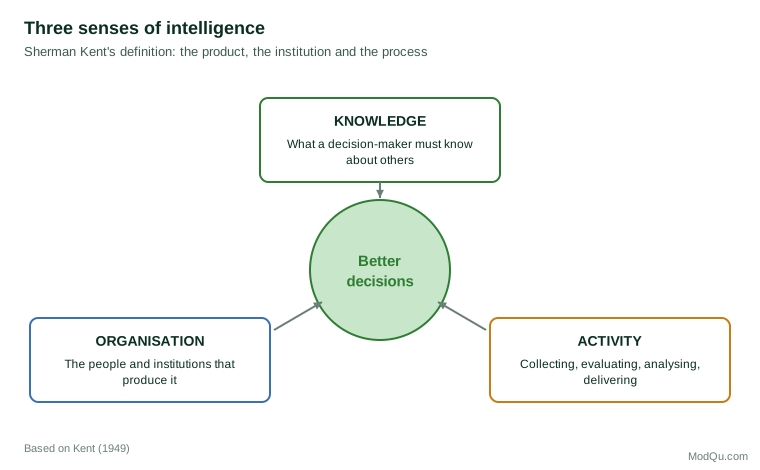
Sherman Kent, a Yale historian who became one of the founders of American intelligence analysis, argued that the word has three linked meanings (Kent, 1949). Intelligence is a kind of knowledge: what a state must know about others to protect its interests. It is a type of organisation: the institutions that produce that knowledge. And it is an activity: the work of collecting, evaluating and analysing information. Kent's triple definition is still useful because it reminds us that the product, the people and the process cannot be separated. A brilliant analytic report is worthless if no organisation can deliver it on time, and a large organisation is worthless if its activity does not produce knowledge anyone needs.
Kent's view did not go unchallenged. In a review of Kent's book, Willmoore Kendall argued that Kent saw intelligence too narrowly, as a research service that describes the outside world for policymakers who then decide what to do. Kendall wanted intelligence to engage more directly with policy, helping leaders understand which parts of the environment they could influence (Kendall, 1949). The debate between a detached, scholarly model and an engaged, policy-oriented model continues today.
Lowenthal: a process for national security
Mark Lowenthal, a former senior American intelligence official, offers a definition that has become standard in textbooks. Intelligence, Lowenthal writes, is the process by which specific types of information important to national security are requested, collected, analysed and provided to policymakers; the products of that process; the safeguarding of those processes and information by counterintelligence; and the carrying out of operations as requested by lawful authorities (Lowenthal, 2022). Two points stand out. First, intelligence begins with a request: it is driven by what decision-makers need to know. Second, the definition includes secrecy and protection, because information that an adversary knows you have may lose its value.
Warner: secret activity to understand or influence
Warner (2002) proposed a shorter definition for state intelligence: "secret, state activity to understand or influence foreign entities." This definition puts secrecy at the centre. On this view, information openly published in a newspaper is not intelligence until a state acquires and uses it in a secret process, and the influence half of the definition brings covert action within the scope of the term.
Each of these definitions was written for government. They emphasise national security, foreign entities and secrecy. Yet the same logic applies to companies, charities and public bodies that must decide under uncertainty, and much of the recent scholarly effort has gone into finding a definition broad enough to cover all of them.
What makes information into intelligence
Most practitioners agree that intelligence is information that has been transformed in four ways.
It answers a question someone needs answered. Intelligence is defined by its user. A detailed report on a competitor's hiring is intelligence for a company deciding whether to enter the same market and mere trivia for one that is not. Herman (1996) describes the intelligence relationship as a service provided to a customer, and Lowenthal (2022) begins an account of the process with the requirements set by policymakers.
It has been evaluated. Raw reports vary in reliability. A rumour from an unknown source, a figure from an official statistical agency and a satellite image are not equally trustworthy. Intelligence work grades sources and checks claims against each other before passing them on.
It has been analysed. Analysis connects facts, explains them and estimates what will happen next. A list of facts about a market is information; a judgement that demand will probably fall by a fifth over two years, with the reasons, is intelligence.
It is timely and actionable. Knowledge that arrives after the decision is history. Breakspear (2013), reviewing a century of definitions, proposed that intelligence is best understood as a corporate capability to forecast change in time to do something about it. The phrase "in time to do something about it" captures why intelligence differs from academic research, which can afford to wait for the full picture.
These four transformations explain why simply collecting more data does not produce more intelligence. Simon (1971) observed that a wealth of information creates a poverty of attention: the scarce resource in an information-rich world is not data but the attention needed to make sense of it. Much of the craft of intelligence lies in filtering, ranking and summarising so that decision-makers spend their attention on what matters.
Intelligence in business
Business and competitive intelligence apply the same ideas to markets. Calof and Wright (2008) describe competitive intelligence as the legal and ethical collection and analysis of information about competitors, customers, suppliers and the wider environment, and show that the field draws on marketing, strategy, information science and the intelligence profession itself. Fleisher and Bensoussan (2015) catalogue dozens of analytic methods used by business analysts, from industry structure analysis to scenario planning, most of which have equivalents in government practice.
Two differences matter. First, businesses work almost entirely with open and lawfully obtained information. Espionage against competitors is illegal in most jurisdictions, so the advantage comes from better collection of public material, better analysis and faster use rather than from secrets. Second, the boundary between business intelligence and business analytics is blurred. Davenport and Harris (2007) showed that firms which compete on analytics build their strategies around data and quantitative models, and much of what companies call "business intelligence" is internal reporting on sales, costs and operations rather than outward-looking assessment of rivals.
Wilensky (1967) offered a bridge between the two worlds. Studying both government agencies and large corporations, Wilensky defined organisational intelligence as the gathering, processing, interpretation and communication of the technical and political information needed in decision-making. Wilensky argued that organisations of every kind suffer similar intelligence failures, often for structural reasons: hierarchy, specialisation and secrecy distort the flow of information to the top.
Decision advantage
If intelligence is information made useful for decisions, the natural measure of its value is the improvement in decisions it makes possible. Recent writing captures this with the phrase decision advantage: the ability to decide better or faster than an adversary or competitor because one understands the situation more accurately.
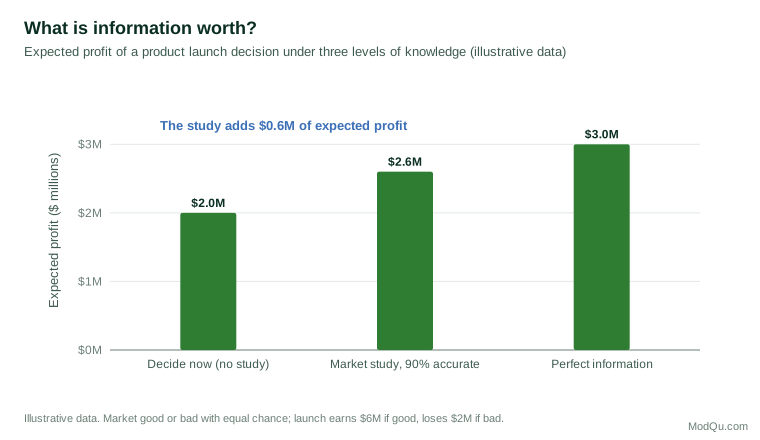
Decision theory gives the idea a precise form. Howard (1966) showed how to calculate the expected value of information: the amount by which the expected outcome of a decision improves when uncertainty is reduced before choosing. Information has value only if it could change the decision. A report that confirms what the decision-maker would have done anyway, however accurate and interesting, is worth nothing in this narrow sense. The concept is a useful discipline for intelligence managers, because it forces the question: which uncertainties, if resolved, would change what we do?
Decision advantage also has a competitive dimension. Hayek (1945) argued that the knowledge relevant to economic decisions is dispersed among many people and that prices summarise it. A firm that reads the signals faster, or gathers knowledge others have overlooked, can act before prices and competitors adjust. In military and security affairs, the same logic applies to the timing of manoeuvres, the anticipation of attacks and the reading of an adversary's intentions.
Treverton (2003) adds an important distinction between puzzles and mysteries. A puzzle has a definite answer that could in principle be found, such as how many aircraft a rival air force has. A mystery has no definite answer because it depends on future choices that have not yet been made, such as whether a foreign leader will decide to go to war. Intelligence can solve puzzles by collecting more information, but it can only frame mysteries by identifying the factors that will shape the outcome and estimating probabilities. Decision advantage in a mystery comes not from certainty but from better-calibrated judgements and earlier warning.
The limits of intelligence
Intelligence does not guarantee good decisions, and the scholarly literature is frank about its limits. Wohlstetter (1962), in a study of the Japanese attack on Pearl Harbor, found that the warning signals were present in the American system but were buried among irrelevant and misleading ones, which Wohlstetter called "noise". The problem was not a shortage of information but the difficulty of recognising which signals mattered before the event.
Betts (2007) argues that some intelligence failures are inevitable. Analysts face ambiguous evidence, adversaries who deceive, and decision-makers who may ignore or misread warnings. Organisational reforms can reduce particular kinds of failure, but each reform introduces new weaknesses. Jervis (2010), who examined the Central Intelligence Agency's assessments of the Iranian revolution of 1979 and of Iraqi weapons programmes before 2003, found that analysts were not lazy or politically captured, but their reasoning was too often unexamined: they failed to make their assumptions explicit and to ask what evidence would show them wrong.
Research on forecasting adds a hopeful note. Tetlock and Gardner (2015) report that teams of carefully selected and trained forecasters produced probability judgements on geopolitical questions that were substantially more accurate than those of most experts. Their results suggest that the quality of analysis, not only the quantity of information, can be measured and improved.
Intelligence, science and knowledge
Intelligence analysis resembles scientific inquiry in some ways and differs in others. Both seek to explain and predict, test hypotheses against evidence and correct errors. Agrell and Treverton (2015) note, however, that science can wait for evidence to accumulate and publishes its findings openly for criticism, while intelligence must often judge quickly, on incomplete evidence, and for a small and secret audience. They argue that intelligence has much to learn from science's habits of transparency and peer review, and that the two should move closer together.
Fingar (2011), who led American analytic reform after 2005, describes the goal of intelligence analysis as reducing uncertainty for decision-makers rather than eliminating it. Good intelligence tells the user what is known, what is not known, how confident the analysts are and why, so that the user can weigh the risk. This is a modest but realistic standard, and it applies equally to a national estimate and to a market assessment.
Ethics, oversight and trust
Because intelligence can involve secrecy and intrusion, it raises ethical questions that ordinary research does not. Omand (2010), a former director of the British signals intelligence agency, argues that intelligence work in a democracy must respect principles of necessity, proportionality and legal authority if it is to keep public trust. Gill and Phythian (2018) emphasise oversight by elected representatives and independent bodies as a condition of legitimacy.
For businesses the ethical questions take a different form. Collecting competitor information through deception, inducing employees to break confidentiality or scraping personal data without regard to privacy law can expose a firm to legal liability and damage its reputation. Professional competitive intelligence associations therefore publish codes of ethics, and good practice is to collect only what could be defended publicly.
A working definition
Drawing these strands together, a practical definition for both government and business might read: intelligence is information that has been collected in response to a need, evaluated for reliability, analysed for meaning, and delivered in time to improve a decision. Its purpose is decision advantage: understanding a situation better or sooner than one would otherwise, so that choices are better informed.
Several practical consequences follow from this definition:
- Start with the decision. Ask what the user must decide, by when, and which uncertainties matter most. Intelligence that does not connect to a decision is research, which has its own value but a different purpose.
- Separate evidence from judgement. Report what is known, how reliable it is and what is inferred, so that users can see where the uncertainty lies.
- Express uncertainty clearly. Use probabilities or well-defined probability terms rather than vague words, and say how confident you are.
- Value timeliness. A good-enough answer before the decision is worth more than a perfect one afterwards.
- Learn from outcomes. Track whether judgements turned out to be right, and adjust methods accordingly.
The same definition helps when choosing between sources. A survey of customers, a competitor's annual report, a sales database and an expert interview are all raw material. None of them is intelligence on its own; each becomes intelligence when it is weighed against the others and used to answer a question that matters to a decision. Combining several imperfect sources is usually more reliable than relying on one excellent one.
Viewed this way, intelligence is less a matter of secret documents than of disciplined thinking. Surveys, statistics, open sources and investigation all feed it, and the value lies in the analysis that turns them into knowledge someone can act on.
References
Agrell, W., & Treverton, G. F. (2015). National intelligence and science: Beyond the great divide in analysis and policy. Oxford University Press.
Andrew, C. (2018). The secret world: A history of intelligence. Yale University Press.
Betts, R. K. (2007). Enemies of intelligence: Knowledge and power in American national security. Columbia University Press.
Breakspear, A. (2013). A new definition of intelligence. Intelligence and National Security, 28(5), 678–693. https://doi.org/10.1080/02684527.2012.699285
Calof, J. L., & Wright, S. (2008). Competitive intelligence: A practitioner, academic and inter-disciplinary perspective. European Journal of Marketing, 42(7/8), 717–730. https://doi.org/10.1108/03090560810877114
Davenport, T. H., & Harris, J. G. (2007). Competing on analytics: The new science of winning. Harvard Business School Press.
Fingar, T. (2011). Reducing uncertainty: Intelligence analysis and national security. Stanford University Press.
Fleisher, C. S., & Bensoussan, B. E. (2015). Business and competitive analysis: Effective application of new and classic methods (2nd ed.). Pearson Education.
Gill, P., & Phythian, M. (2018). Intelligence in an insecure world (3rd ed.). Polity Press.
Hayek, F. A. (1945). The use of knowledge in society. American Economic Review, 35(4), 519–530.
Herman, M. (1996). Intelligence power in peace and war. Cambridge University Press.
Howard, R. A. (1966). Information value theory. IEEE Transactions on Systems Science and Cybernetics, 2(1), 22–26. https://doi.org/10.1109/TSSC.1966.300074
Jervis, R. (2010). Why intelligence fails: Lessons from the Iranian Revolution and the Iraq War. Cornell University Press.
Kendall, W. (1949). The function of intelligence. World Politics, 1(4), 542–552. https://doi.org/10.2307/2008837
Kent, S. (1949). Strategic intelligence for American world policy. Princeton University Press.
Lowenthal, M. M. (2022). Intelligence: From secrets to policy (9th ed.). CQ Press.
Luhn, H. P. (1958). A business intelligence system. IBM Journal of Research and Development, 2(4), 314–319. https://doi.org/10.1147/rd.24.0314
Omand, D. (2010). Securing the state. Hurst.
Simon, H. A. (1971). Designing organizations for an information-rich world. In M. Greenberger (Ed.), Computers, communications, and the public interest (pp. 37–72). Johns Hopkins Press.
Tetlock, P. E., & Gardner, D. (2015). Superforecasting: The art and science of prediction. Crown.
Treverton, G. F. (2003). Reshaping national intelligence for an age of information. Cambridge University Press.
Warner, M. (2002). Wanted: A definition of "intelligence." Studies in Intelligence, 46(3), 15–22.
Wilensky, H. L. (1967). Organizational intelligence: Knowledge and policy in government and industry. Basic Books.
Wohlstetter, R. (1962). Pearl Harbor: Warning and decision. Stanford University Press.