
Intelligence · Open-source intelligence
The Contribution of Academic and Think-Tank Sources to Intelligence Knowledge
Universities and think tanks produce a large body of expert analysis that intelligence work can draw on. This article explains what each offers, their typical weaknesses and how to judge and use them.
Intelligence analysts rarely know as much about a subject as the specialists who have studied it for decades. Universities, research institutes and think tanks produce a vast body of open analysis on economies, technologies, regions, industries and social trends. Used well, this work gives intelligence depth, method and a check on assumptions. Used carelessly, it can import errors and agendas. This article explains what academic and think-tank sources contribute and how to judge them.
What academic research offers
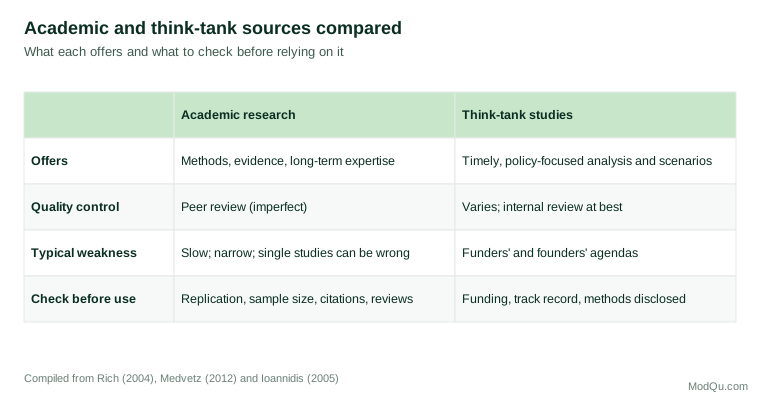
Academic research offers three things that most intelligence teams lack: rigorous methods, accumulated evidence and long-term expertise. Studies published in peer-reviewed journals describe how evidence was gathered and analysed, so readers can judge their strength. Review articles summarise decades of findings. Individual scholars may have studied a country, market or technology for an entire career.
Lowenthal (2022) notes that intelligence services increasingly consult outside experts to test their assessments and fill gaps in knowledge. Businesses can do the same, by reading research, commissioning studies or asking academics to review analyses.
Gibbons et al. (1994) described a shift towards knowledge produced in the context of application, by teams that cross disciplines and include participants from outside universities. Much useful research for business intelligence now comes from such collaborations between universities, industry and government.
Judging academic sources
Peer review is a filter, not a guarantee. Ioannidis (2005) argued that a large share of published research findings are likely to be false, particularly when studies are small, effects are small, designs are flexible and researchers have financial or intellectual interests in the result. A single striking study should be treated as a hypothesis until other work confirms it.
Citation counts, which Garfield (1955) proposed as a way of tracing how ideas spread, indicate attention but not truth. Hicks et al. (2015), in the Leiden Manifesto, warned against relying on such numbers alone and argued that quantitative indicators should support, not replace, expert judgement. Practical checks include: has the finding been replicated? How large and representative was the sample? What do review articles say? Has the work been criticised, and how did the authors respond?
What think tanks offer
Think tanks are organisations that produce research and analysis intended to influence public policy and debate. Medvetz (2012) describes them as occupying a space between academia, politics, business and the media, borrowing authority from each. They are often faster and more practical than universities, producing timely reports on current issues, scenarios and policy options.
But think tanks differ widely. Rich (2004) found that their number grew rapidly in the United States from the 1970s onwards, that many newer organisations were openly ideological and focused on promoting their views, and that their influence was greater in shaping debate than in determining final decisions. Abelson (2018), comparing Canadian and American institutes, emphasises how hard it is to measure their influence, and how their visibility in the media can exceed their actual impact.
Judging think-tank sources
Before relying on a think-tank report, analysts should ask:
- Who funds it? Funding from industries, governments or donors with a stake in the issue does not make a report wrong, but it is relevant to how its conclusions are weighed.
- What is its stated mission? An organisation founded to advance a particular view will tend to produce findings consistent with it.
- Are methods and data disclosed? Reports that explain how conclusions were reached can be checked.
- What is its track record? Have its past forecasts and analyses held up?
- Do others agree? Compare with organisations of different outlooks.
Using these sources in practice
The most effective approach is to treat academic and think-tank work as expert input to be weighed, not as conclusions to be adopted. Start with review articles and reports from several organisations with different perspectives. Note where they agree, which is often the most reliable ground, and where they disagree, which shows where uncertainty lies. For important questions, speak directly to researchers: a short conversation can reveal caveats that never appear in print. Record which sources informed each judgement, so readers can follow the reasoning. For a business, a short list of trusted research centres, university departments and institutes in each area it monitors, reviewed every year, saves time and makes it easier to notice when a new or unfamiliar organisation suddenly appears in a debate.
Conclusion
Academic research and think-tank analysis give intelligence work access to methods, evidence and expertise that few organisations could build themselves. Their value depends on judging each source on its merits: replication and method for academic work, funding, mission and transparency for think tanks. Drawing on several sources with different perspectives, and treating each as one input among many, turns this large body of open expertise into reliable intelligence.
References
Abelson, D. E. (2018). Do think tanks matter? Assessing the impact of public policy institutes (3rd ed.). McGill-Queen's University Press.
Garfield, E. (1955). Citation indexes for science: A new dimension in documentation through association of ideas. Science, 122(3159), 108–111. https://doi.org/10.1126/science.122.3159.108
Gibbons, M., Limoges, C., Nowotny, H., Schwartzman, S., Scott, P., & Trow, M. (1994). The new production of knowledge: The dynamics of science and research in contemporary societies. SAGE.
Hicks, D., Wouters, P., Waltman, L., de Rijcke, S., & Rafols, I. (2015). Bibliometrics: The Leiden Manifesto for research metrics. Nature, 520(7548), 429–431. https://doi.org/10.1038/520429a
Ioannidis, J. P. A. (2005). Why most published research findings are false. PLoS Medicine, 2(8), Article e124. https://doi.org/10.1371/journal.pmed.0020124
Lowenthal, M. M. (2022). Intelligence: From secrets to policy (9th ed.). CQ Press.
Medvetz, T. (2012). Think tanks in America. University of Chicago Press.
Rich, A. (2004). Think tanks, public policy, and the politics of expertise. Cambridge University Press.