
Intelligence · Analysis and tradecraft
Target-Centric versus Problem-Centric Approaches to Intelligence Knowledge
Intelligence work can be organised around the target being studied or around the problem a decision-maker faces. This article explains both approaches, why they emerged as alternatives to the traditional intelligence cycle, where each works best and how organisations can combine them.
How should an intelligence function organise its work? One answer is to start with the target: the adversary, competitor, market or system about which knowledge is needed, and to build up an ever more complete understanding of it. Another answer is to start with the problem: the decision a leader faces, the question that needs answering, and to bring in whatever knowledge bears on it. Both approaches have strong advocates. Both emerged partly as alternatives to the traditional model of intelligence as a linear cycle. This article explains each approach, where it works best and how the two can be combined.
The traditional cycle and its critics
For decades, intelligence work has been described as a cycle: decision-makers set requirements, collectors gather information, analysts process and analyse it, and finished intelligence is disseminated back to the decision-makers, who set new requirements. The model is useful for teaching and for organising budgets. Lowenthal (2022) describes it as a reasonable starting point while noting that reality is messier.
Many scholars and practitioners have criticised the cycle. Hulnick (2006) argued that it does not describe how intelligence actually works. Decision-makers rarely give clear direction; collection and analysis proceed in parallel rather than in sequence; and much intelligence is produced because analysts judge it important, not because anyone asked. Phythian (2013) brought together a range of critiques, which together suggest that the cycle hides the most important relationships in intelligence work: between analysts and decision-makers, and between analysts and collectors.
Herman (1996) observed that intelligence organisations are usually structured around collection methods, such as signals, imagery or human sources, while users care about subjects and problems. The resulting gap between how intelligence is produced and how it is used is one reason alternatives to the cycle have been proposed.
The target-centric approach
Robert Clark, a former intelligence officer and author of a widely used textbook, proposed the target-centric approach as a replacement for the linear cycle (Clark, 2020). Its core idea is that everyone involved, including analysts, collectors and the people who use intelligence, should work on and from a single shared model of the target.
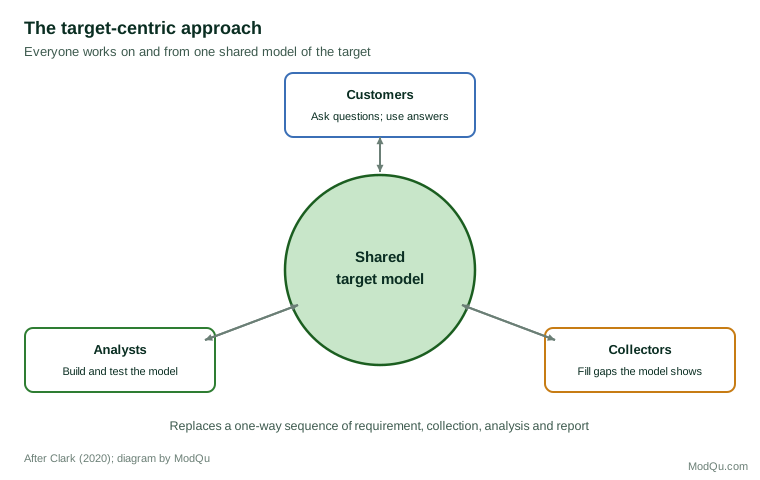
A target model is an explicit representation of the target: its structure, its relationships with other entities, its processes, its capabilities and its intentions. Clark describes many forms of model, from organisation charts and network diagrams to timelines, process flows and simulations. The model is never finished. It evolves as new information arrives and as analysts test it.
The approach has several advantages:
- Gaps become visible. A model shows which parts are well understood and which are blank. Collectors can see exactly what is needed.
- Users can interact directly. Decision-makers can ask questions of the model and see the reasoning behind answers, rather than waiting for finished reports.
- Knowledge accumulates. Instead of being scattered across many reports, knowledge about a target is held in one place and builds over time.
- Collaboration is easier. Analysts in different agencies or departments can contribute to the same model.
The approach suits targets that persist over time: a foreign military, a terrorist network, a major competitor, a supply chain. It fits naturally with Kent's (1949) view that much intelligence consists of building and maintaining basic descriptive knowledge about the world, which current reporting then keeps up to date.
The problem-centric approach
A second line of thinking starts not from the target but from the problem. Its advocates argue that what decision-makers need is help with their decisions, and that the most important questions often cut across many targets.
Kerbel and Olcott (2010), writing in the CIA's professional journal, argued that analysts should move from "analyzing for customers" to "synthesizing with clients". In their view, the traditional model treats decision-makers as customers who receive finished products. A better model treats them as partners in working through problems, with analysts helping to frame the issues, identify options and understand implications. Davis (2006) similarly emphasised the value of close working relationships between analysts and policymakers, while noting the risks that such closeness brings.
The problem-centric approach draws on a long tradition of thinking about problems themselves. Simon (1973) distinguished well-structured problems, in which the goal, the possible actions and the criteria for success are clear, from ill-structured problems, in which they are not. Rittel and Webber (1973) went further and described wicked problems: social and policy problems that have no definitive formulation, no stopping rule, no right or wrong answers, only better or worse ones, and where every attempt at a solution changes the problem. Ackoff (1979) argued that managers do not face separate problems but "messes": systems of interacting problems that must be dealt with together. Checkland (1981) developed soft systems methodology to help groups make sense of such situations, recognising that different stakeholders see the same situation through different worldviews.
Many intelligence questions are of this kind. Treverton (2003) distinguished puzzles, which have definite answers that more information could reveal, from mysteries, which depend on future choices and have no answer yet. Puzzles fit naturally with target models: how many missiles does a country have, how much does a competitor's plant produce? Mysteries, and the wicked problems that decision-makers face, often require a broader approach: what is happening in a region, what are our options, what would happen if we acted?
Comparing the approaches
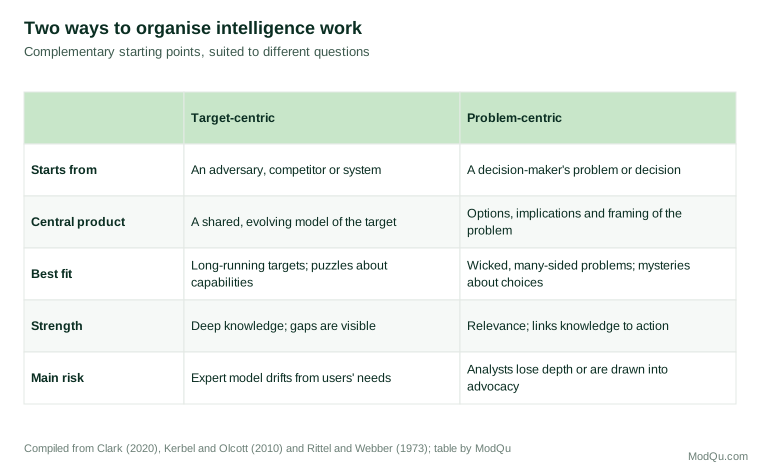
Each approach has a characteristic risk. Target-centric work can drift away from what users need. Analysts become deeply expert in their target and produce detailed knowledge that no decision-maker has asked for. Johnston (2005), in an ethnographic study of American analysts, found that many valued depth of expertise but had limited contact with the people who used their work. A model can be very good and still irrelevant.
Problem-centric work has the opposite risk. Analysts drawn into decision-makers' problems may lose depth, moving from issue to issue without building lasting expertise. They may also be drawn into advocacy, supporting the options their clients prefer rather than assessing them independently. Fingar (2011), who led American analytic production in the 2000s, stressed the need for analysts to engage closely with policymakers while maintaining their independence and objectivity.
Combining the approaches
In practice, the approaches are complementary rather than competing. Target models provide the foundation of knowledge; problem-centric engagement ensures it is used. Omand (2010) describes the purpose of intelligence as improving decisions by reducing ignorance, through situational awareness, explanation, estimation and strategic notice. Target models support the first two; engagement with decision-makers' problems makes the last two useful.
A combined approach might work as follows:
- Maintain models of enduring targets. For the competitors, markets, regulators or adversaries that matter most, maintain explicit, evolving models that collectors and analysts update continuously.
- Frame each major request as a problem. When a decision-maker asks a question, spend time with them understanding the decision behind it, the options under consideration and what would change their mind.
- Draw on several models. Most real problems involve several targets. A decision about entering a new market might draw on models of the market, two competitors, a regulator and the company's own capabilities.
- Feed what is learned back into the models. Problem-centric work often reveals gaps in the target models; these should guide collection.
- Keep independence. Close engagement with decision-makers should not mean telling them what they want to hear.
Pirolli and Card (2005), in their study of how analysts work, describe a cycle of foraging for information and making sense of it. Target models provide structure for foraging; problems provide the purpose for sensemaking. Agrell and Treverton (2015) suggest that intelligence has much to learn from science, where research programmes build cumulative knowledge about subjects but are also driven by questions that matter.
Building a good target model
A target model is only as useful as it is clear, current and honest about its gaps. Clark (2020) recommends choosing the form of model to fit the question. A network diagram suits a question about relationships, such as which suppliers a competitor depends on. A process model suits a question about how something works, such as how a rival develops and launches products. A timeline suits a question about sequence, such as the steps a regulator must take before a new rule takes effect. Many targets need several linked models.
Good models share a few features. Each element is linked to the evidence that supports it, so that users can see how firm it is. Uncertain elements are marked as such, rather than presented with the same confidence as established facts. Gaps are listed explicitly, so that collectors know where to look. And the model records when each part was last updated, since an old model can look authoritative long after the target has changed.
Models also need owners. In a target-centric organisation, a named analyst or small team is responsible for each major model, decides what goes into it and resolves conflicts between sources. Without ownership, shared models tend to become cluttered collections of unverified material that no one trusts.
Engaging with decision-makers
The problem-centric approach depends on a working relationship that many organisations find difficult. Decision-makers are busy and may not explain the decision behind their question; analysts may be reluctant to ask, or may fear that engagement will compromise their independence. Kerbel and Olcott (2010) argue that the solution is not to keep distance but to make the relationship explicit: analysts help clients think through problems, while being clear that their role is to inform, not to choose.
Practical steps help. Before starting a major piece of work, analysts can hold a short framing conversation to establish the decision, the time available, the options under consideration and what evidence would change the decision-maker's view. During the work, brief interim discussions allow the framing to be adjusted as understanding grows. Afterwards, a short review asks whether the analysis helped and what could have been done better. Each step takes little time and greatly increases the chance that the final product is used.
Analytic pathologies
Cooper (2005), in a study of failures in American intelligence analysis, identified a set of "analytic pathologies" that included an excessive focus on current reporting, weak use of models and theories, and a tendency to answer the question asked rather than the question that matters. Both approaches address parts of this list. The target-centric approach counters shallow, report-by-report analysis by insisting on cumulative models. The problem-centric approach counters irrelevance by insisting that analysis serve real decisions. Heuer (1999) adds that whatever the organisation, analysts must make their mental models explicit, since unexamined models are a major source of error. Marrin (2012) argues that improving analysis requires bringing scholarly research on methods into everyday practice, and testing which approaches actually produce better results.
Applying the approaches in business
Business intelligence teams face the same choice. A competitor intelligence unit organised around targets maintains profiles of key rivals: their products, prices, costs, leadership, strategy and likely moves. A strategy or insights team organised around problems helps executives with specific decisions: whether to enter a market, how to price a product, how to respond to a new entrant.
Both are needed. Competitor profiles are most valuable when they are explicit models, updated continuously, rather than static documents written once a year. Decision support is most valuable when it draws on those models and on customer research, framed around the real decision. A useful discipline is to begin every major piece of work with two questions: which targets does this involve, and what decision does it serve?
An illustration
A Canadian telecommunications company has a competitive intelligence team that maintains detailed profiles of its three main rivals. The profiles are thorough but rarely read. When the chief executive asks whether the company should bid for new wireless spectrum, the team at first sends the three profiles.
A new manager reorganises the work. The profiles become shared models, updated weekly, with clear gaps listed for the research team to fill. For the spectrum question, the team meets the chief executive to understand the decision: the amount the company could afford, the alternatives, and what would make bidding worthwhile. It then draws on the competitor models, a model of the regulator's past behaviour and a customer survey on demand for faster service, and presents options with their implications. The chief executive uses the analysis in the board meeting. The questions raised there reveal gaps in the competitor models, which the research team is asked to fill.
Conclusion
The target-centric approach builds deep, shared and cumulative knowledge about the things that matter to an organisation. The problem-centric approach ensures that knowledge is brought to bear on the decisions leaders actually face. Both developed partly in response to the limits of the traditional intelligence cycle, and both have characteristic risks: irrelevance on one side and loss of depth or independence on the other. The most effective intelligence functions combine them, maintaining explicit models of enduring targets and working closely with decision-makers to apply those models to real problems.
References
Ackoff, R. L. (1979). The future of operational research is past. Journal of the Operational Research Society, 30(2), 93–104. https://doi.org/10.1057/jors.1979.22
Agrell, W., & Treverton, G. F. (2015). National intelligence and science: Beyond the great divide in analysis and policy. Oxford University Press.
Checkland, P. (1981). Systems thinking, systems practice. Wiley.
Clark, R. M. (2020). Intelligence analysis: A target-centric approach (6th ed.). CQ Press.
Cooper, J. R. (2005). Curing analytic pathologies: Pathways to improved intelligence analysis. Center for the Study of Intelligence.
Davis, J. (2006). Intelligence analysts and policymakers: Benefits and dangers of tensions in the relationship. Intelligence and National Security, 21(6), 999–1021. https://doi.org/10.1080/02684520601046325
Fingar, T. (2011). Reducing uncertainty: Intelligence analysis and national security. Stanford University Press.
Herman, M. (1996). Intelligence power in peace and war. Cambridge University Press.
Heuer, R. J., Jr. (1999). Psychology of intelligence analysis. Center for the Study of Intelligence, Central Intelligence Agency.
Hulnick, A. S. (2006). What's wrong with the intelligence cycle. Intelligence and National Security, 21(6), 959–979. https://doi.org/10.1080/02684520601046291
Johnston, R. (2005). Analytic culture in the US intelligence community: An ethnographic study. Center for the Study of Intelligence, Central Intelligence Agency.
Kent, S. (1949). Strategic intelligence for American world policy. Princeton University Press.
Kerbel, J., & Olcott, A. (2010). Synthesizing with clients, not analyzing for customers. Studies in Intelligence, 54(4), 11–27.
Lowenthal, M. M. (2022). Intelligence: From secrets to policy (9th ed.). CQ Press.
Marrin, S. (2012). Improving intelligence analysis: Bridging the gap between scholarship and practice. Routledge.
Omand, D. (2010). Securing the state. Hurst.
Phythian, M. (Ed.). (2013). Understanding the intelligence cycle. Routledge. https://doi.org/10.4324/9780203558478
Pirolli, P., & Card, S. (2005). The sensemaking process and leverage points for analyst technology as identified through cognitive task analysis. In Proceedings of the 2005 International Conference on Intelligence Analysis (pp. 2–4). MITRE.
Rittel, H. W. J., & Webber, M. M. (1973). Dilemmas in a general theory of planning. Policy Sciences, 4(2), 155–169. https://doi.org/10.1007/BF01405730
Simon, H. A. (1973). The structure of ill structured problems. Artificial Intelligence, 4(3–4), 181–201. https://doi.org/10.1016/0004-3702(73)90011-8
Treverton, G. F. (2003). Reshaping national intelligence for an age of information. Cambridge University Press.