
Intelligence · Analysis and tradecraft
All-Source Intelligence Fusion Methodologies for Comprehensive Knowledge Integration
All-source fusion combines evidence from many different kinds of sources into a single, weighed assessment. This article explains the main models of fusion, the problems that arise when sources are combined and the practices that make all-source analysis reliable, in government and in business.
No single source tells the whole story. A satellite image shows a new building but not what it is for. An intercepted message mentions a project but not its location. A press release announces a product but not how it will be made. All-source intelligence combines these partial views into a single assessment that is more complete, and more reliable, than any one source could provide. The process of combining them is often called fusion. This article explains how fusion works, the models used to describe it, the problems that arise and the practices that help, with examples from both government and business.
The collection disciplines
Intelligence agencies traditionally organise collection by type of source. Lowenthal and Clark (2016) describe five main disciplines: open-source intelligence from publicly available material; human intelligence from people; signals intelligence from communications and electronic emissions; geospatial intelligence from imagery and mapping; and measurement and signature intelligence from technical sensors. Each discipline has its own strengths, blind spots and specialist staff.
The disadvantage of this organisation is that each discipline tends to report separately. Lowenthal (2022) notes that the value of intelligence lies in combining the disciplines, but that bureaucratic separation often makes this difficult. All-source analysts exist to bridge the gaps.
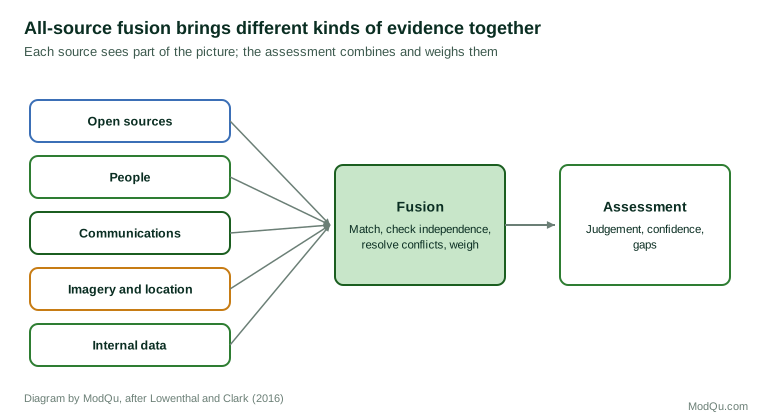
In Britain, the Joint Intelligence Committee has long served as the central body for all-source assessment, drawing on the reporting of separate agencies to produce agreed judgements for ministers. Omand (2010) describes how such central assessment helps prevent any one agency's view from dominating and allows evidence from different sources to be weighed together.
Models of fusion
Engineers working on military sensor systems developed the most widely cited model of fusion. Hall and Llinas (1997) describe the model created by the American Joint Directors of Laboratories, known as the JDL model, which divides fusion into levels of increasing abstraction. Steinberg et al. (1999) revised the model to make it applicable beyond military sensors.
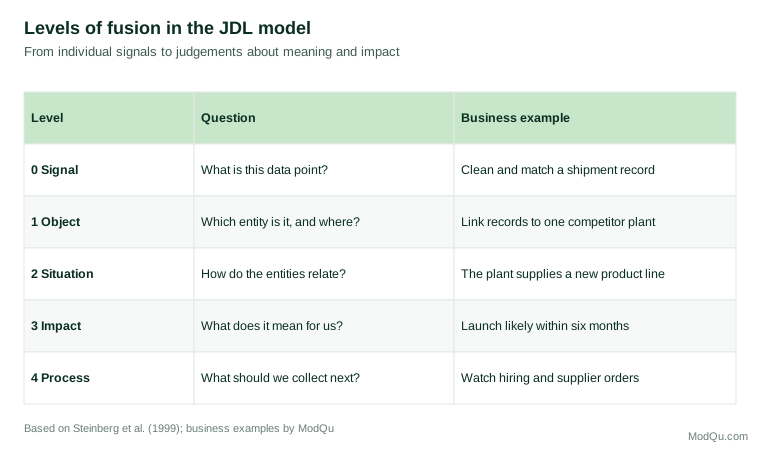
The lower levels concern data: cleaning signals and identifying the objects they refer to. The higher levels concern meaning: understanding how objects relate to each other, assessing what the situation means for the organisation and deciding what further information to seek. Human analysts do most of the work at the higher levels.
A closely related idea is situation awareness. Endsley (1995) defined it as perceiving the elements of an environment, comprehending their meaning and projecting their future status. Fusion supports all three: it gathers the elements, connects them into an understanding and provides the basis for projection.
Pirolli and Card (2005), studying how intelligence analysts actually work, described two linked loops. In the foraging loop, analysts search for and filter information. In the sensemaking loop, they build and test explanations. Fusion happens as analysts move between them, using emerging explanations to guide further search.
Problems in combining sources
Khaleghi et al. (2013), reviewing the technical literature, identify several problems that any fusion process must handle. Most apply equally to human analysis.
- Imperfect data. Sources are incomplete, imprecise and sometimes wrong.
- Conflicting reports. Sources disagree, and the analyst must decide which to believe or whether both could be partly right.
- Correlated sources. Reports that appear independent may share an origin. Treating them as separate confirmations inflates confidence, a problem sometimes called "data incest".
- Different formats and scales. Combining a photograph, a conversation and a spreadsheet requires translating them into a common understanding.
Schum (1994) emphasised that combining evidence requires attention to how each item bears on the hypotheses: some items corroborate one another, some conflict and some are redundant. Heuer (1999) recommended laying out evidence against several hypotheses in a matrix, so that the diagnostic value of each item is visible and inconsistent evidence is not ignored.
Fusion failures
Major inquiries have repeatedly found failures of fusion rather than of collection. The 9/11 Commission found that separate American agencies held pieces of information about the plot that were never combined (National Commission on Terrorist Attacks Upon the United States, 2004). In the Iraq case, analysts combined reports that appeared to corroborate one another but in some cases derived from a small number of unreliable sources (Commission on the Intelligence Capabilities of the United States Regarding Weapons of Mass Destruction, 2005).
Johnston (2005), in an ethnographic study of American intelligence analysts, found that organisational barriers, security compartments and time pressure often prevented analysts from seeing all relevant material. Treverton (2003) argued that the information age demands a shift from organisations built around secret collection towards ones built around the integration of many sources, including open ones.
Triangulation in research
Social scientists use a similar idea under a different name. Jick (1979) described triangulation: using several methods to study the same phenomenon, so that the weaknesses of one are offset by the strengths of another. When a survey, interviews and sales data all point in the same direction, confidence rises; when they diverge, the divergence itself is informative and calls for explanation.
Automated fusion and its limits
Much fusion at the lower levels is now automated. Software matches records that refer to the same company, person or vessel, links locations across data sets and flags unusual combinations of events. Khaleghi et al. (2013) review the statistical methods used, from probabilistic approaches that combine evidence according to its estimated reliability to methods designed for evidence that is vague or conflicting. Automation allows analysts to work with volumes of data that no person could read.
The higher levels remain largely human. Deciding what a situation means for an organisation, and what to do about it, depends on context, purpose and judgement that software does not supply. Automation also introduces its own risks. Matching errors can link records that do not belong together, and once linked, the error may be hard to see. Algorithms trained on past patterns may miss situations that are genuinely new. Endsley (1995) warned that operators who rely on automated systems can lose situation awareness, because they stop actively processing the information themselves. The practical lesson is to automate the routine matching and filtering, while keeping analysts engaged with the evidence and able to inspect how automated links were made.
Fusion in business intelligence teams
In companies, the equivalent of separate collection disciplines are separate departments. Market research runs surveys; sales hears from customers; finance tracks costs; the digital team watches web traffic; procurement talks to suppliers. Each sees part of the picture of a market or competitor. A business intelligence function that draws these together, with a regular forum in which evidence is compared and a single place where the combined assessment is recorded, performs the same role as an all-source analysis unit. Without it, each department reports its own partial view, and senior managers are left to fuse the evidence themselves, usually without the time or method to do it well.
Practices for reliable fusion
- Start from a model of the target. Clark (2020) recommends building an explicit model of the person, organisation or system being studied and adding each source's contribution to it. Gaps and conflicts then become visible.
- Trace sources to their origins to avoid counting the same report twice.
- Record conflicts rather than resolving them silently. A note that two sources disagree, and why one was preferred, helps readers judge the result.
- Weigh, do not count. One diagnostic, reliable report can outweigh many weak ones.
- Give analysts access. Fusion fails when analysts cannot see relevant material; security and departmental boundaries should be crossed deliberately where the question requires it.
- Use the result to direct collection. The highest level of the JDL model is process refinement: deciding what to collect next to close the most important gaps.
An illustration
A Canadian chemicals company wants to know whether a rival is about to launch a competing product. The open-source team finds a trademark filing and a job advertisement for a production manager. The sales team reports that a distributor mentioned a new supplier. Shipping data show increased imports of a key raw material at the rival's port. No single item is conclusive, but together they fit one explanation. The analyst checks that the distributor's comment did not come from the same press coverage as the trademark news, notes one conflicting item, a statement by the rival's chief executive that no launches are planned this year, and concludes that a launch within nine months is likely, with moderate confidence. The analyst lists the indicators that would confirm or contradict the judgement.
Conclusion
All-source fusion is the step that turns separate pieces of evidence into knowledge. Models such as the JDL levels and the sensemaking loops describe how it works; experience shows how often it fails when sources are kept apart, double-counted or weighed carelessly. Reliable fusion depends on explicit models, careful tracing of sources, honest treatment of conflicts and organisations that let analysts see the whole picture.
References
Clark, R. M. (2020). Intelligence analysis: A target-centric approach (6th ed.). CQ Press.
Commission on the Intelligence Capabilities of the United States Regarding Weapons of Mass Destruction. (2005). Report to the President of the United States. U.S. Government Printing Office.
Endsley, M. R. (1995). Toward a theory of situation awareness in dynamic systems. Human Factors, 37(1), 32–64. https://doi.org/10.1518/001872095779049543
Hall, D. L., & Llinas, J. (1997). An introduction to multisensor data fusion. Proceedings of the IEEE, 85(1), 6–23. https://doi.org/10.1109/5.554205
Heuer, R. J., Jr. (1999). Psychology of intelligence analysis. Center for the Study of Intelligence, Central Intelligence Agency.
Jick, T. D. (1979). Mixing qualitative and quantitative methods: Triangulation in action. Administrative Science Quarterly, 24(4), 602–611. https://doi.org/10.2307/2392366
Johnston, R. (2005). Analytic culture in the US intelligence community: An ethnographic study. Center for the Study of Intelligence, Central Intelligence Agency.
Khaleghi, B., Khamis, A., Karray, F. O., & Razavi, S. N. (2013). Multisensor data fusion: A review of the state-of-the-art. Information Fusion, 14(1), 28–44. https://doi.org/10.1016/j.inffus.2011.08.001
Lowenthal, M. M., & Clark, R. M. (Eds.). (2016). The five disciplines of intelligence collection. CQ Press.
Lowenthal, M. M. (2022). Intelligence: From secrets to policy (9th ed.). CQ Press.
National Commission on Terrorist Attacks Upon the United States. (2004). The 9/11 Commission report. W. W. Norton.
Omand, D. (2010). Securing the state. Hurst.
Pirolli, P., & Card, S. (2005). The sensemaking process and leverage points for analyst technology as identified through cognitive task analysis. In Proceedings of the 2005 International Conference on Intelligence Analysis (pp. 2–4). MITRE.
Schum, D. A. (1994). The evidential foundations of probabilistic reasoning. Wiley.
Steinberg, A. N., Bowman, C. L., & White, F. E. (1999). Revisions to the JDL data fusion model. In Proceedings of SPIE 3719: Sensor fusion: Architectures, algorithms, and applications III (pp. 430–441). SPIE. https://doi.org/10.1117/12.341367
Treverton, G. F. (2003). Reshaping national intelligence for an age of information. Cambridge University Press.