
Intelligence · Artificial and collective intelligence
"Swarm Intelligence: Collective Decision-Making and Distributed Knowledge"
Ant colonies, bee swarms and fish shoals make sound collective decisions without any leader holding the full picture. This article explains how swarm intelligence works, the principles behind it, how it has been applied in computing and robotics, and what it teaches organisations about distributed knowledge and decision-making.
An ant colony has no manager. No ant knows the layout of the nest, the location of every food source or the number of workers needed for each task. Yet colonies find short paths to food, allocate workers among foraging, nest maintenance and defence, and adjust as conditions change. A honeybee swarm of ten thousand insects chooses a new home from a dozen candidate sites, usually picking the best, though no individual bee has visited more than one or two. A school of fish turns as one to avoid a predator that only a few of its members have seen.
These are examples of swarm intelligence: intelligent collective behaviour that emerges from the interactions of many simple individuals following local rules, without central control. Bonabeau et al. (1999) defined the field as the study of how such systems solve problems, and how their principles can be used to design artificial systems. Swarm intelligence has influenced computer science, robotics and management, and it offers a distinctive perspective for anyone concerned with how knowledge spread across many people can be turned into good decisions.
Self-organisation
The central idea behind swarm intelligence is self-organisation. Camazine et al. (2001) define it as a process in which a pattern at the level of the whole system emerges solely from numerous interactions among its lower-level components, using only local information, without reference to the global pattern. The pattern is not planned or directed by anyone; it arises from the interactions.
Reynolds (1987) gave one of the clearest demonstrations. To animate flocks of birds for computer graphics, Reynolds programmed simulated "boids" to follow three local rules: avoid crowding nearby flockmates, steer towards their average heading, and move towards their average position. No boid had any representation of the flock. Yet the simulation produced realistic flocking behaviour, with groups splitting around obstacles and rejoining beyond them. Complex group behaviour required only simple individual rules and local awareness.
Sumpter (2006) reviewed research on collective animal behaviour and identified a set of recurring principles that allow groups to act effectively. Figure 1 summarises the most important of them, with examples from nature and their equivalents in organisations.
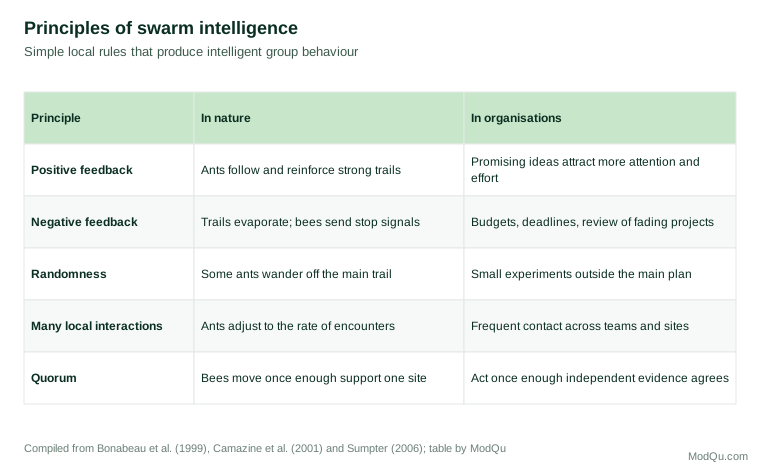
Positive feedback amplifies useful signals. When an ant finds food, it lays a chemical trail on its way back; other ants follow the trail and reinforce it, so good routes attract more traffic. Negative feedback keeps amplification in check: trails evaporate over time, food sources are exhausted, and crowding limits further recruitment. Randomness allows exploration: some individuals wander off established paths and discover new resources. Multiple interactions spread information: each individual responds to many encounters with others, so local information becomes shared. Quorum rules convert gradual changes in support into decisive action once a threshold is crossed.
Ants: trails and encounters
The classic example of ant intelligence is path-finding. In laboratory experiments, ants offered two routes of different lengths to the same food source soon concentrate on the shorter one. Ants using the shorter route return sooner, so pheromone builds up faster on it, and more ants choose it. The colony "computes" the shortest path without any ant comparing the two.
Gordon (2010) studied a different kind of colony intelligence in harvester ants in the American desert. Colonies regulate how many ants go out to forage each day according to conditions. No ant decides this. Instead, foragers returning with food encounter ants waiting inside the nest entrance, and the rate at which those inside meet successful returners determines whether they go out. When food is plentiful, foragers return quickly and the rate of encounters is high, so more ants leave. When food is scarce or conditions are dangerous, encounters fall and foraging slows. The colony adjusts its effort to conditions through a network of brief, local interactions.
Bees: a democratic decision
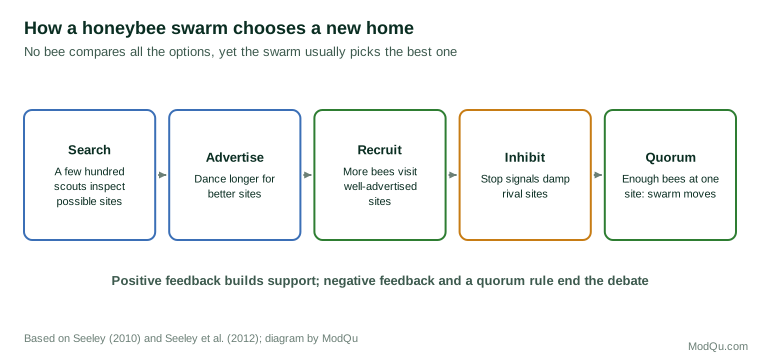
Seeley (2010) spent decades studying how honeybee swarms choose a new nest. When a colony outgrows its home, the queen and about half the workers leave and cluster on a branch. A few hundred older bees act as scouts, flying out to inspect potential cavities. Each scout that finds a promising site returns and performs a "waggle dance" to advertise it. Crucially, scouts dance longer and more vigorously for better sites, and they gradually stop dancing for any site over time. Other scouts are recruited to the advertised sites, inspect them independently and dance in turn if they approve.
Over hours or days, support grows for the better sites and fades for the weaker ones. Seeley et al. (2012) discovered an additional mechanism: scouts committed to one site deliver "stop signals" to bees dancing for rival sites, damping competition and helping the swarm avoid deadlock between equally good options. The decision is completed by a quorum rule. When scouts at a site sense that enough other scouts are present there, they return to the swarm and trigger preparations for departure. Figure 2 shows the sequence.
Seeley (2010) drew explicit lessons for human groups from the bees' process. The swarm's decision-making group consists of individuals with shared interests; leaders' influence on the outcome is minimised; a diverse range of options is explored; knowledge is aggregated through open debate; and a quorum rule balances speed and accuracy. Each scout makes her own independent assessment of a site rather than simply copying the dances she sees, which preserves the independence that Surowiecki (2004) identified as essential to wise crowds.
Fish, birds and leadership without leaders
Couzin et al. (2005) used models and experiments to examine how animal groups on the move reach decisions about direction. They found that a small proportion of informed individuals, those that know the location of food or a migration route, can guide a large group accurately, even though no one in the group knows who is informed and the informed individuals do not signal. The larger the group, the smaller the proportion of informed individuals needed. When informed individuals disagree about direction, the group either follows the majority or compromises, depending on how far apart the preferred directions are.
Couzin et al. (2011) added a surprising finding. Uninformed individuals, those with no preference, actually promote democratic outcomes. When a strongly opinionated minority competed with a less opinionated majority, adding uninformed members to the group returned control to the majority. The uninformed members diluted the influence of the most strongly committed. Couzin (2009) argued that such collective cognition, in which groups process information in ways no individual can, appears across many species and may share common principles with information processing in the brain.
Ward et al. (2008) showed how quorum rules improve accuracy. Fish deciding which way to swim past a replica predator made better decisions in larger groups. Individuals responded much more strongly to the choices of others once a threshold number had committed to an option. This quorum response filtered out individual errors while allowing correct information to spread rapidly. Sumpter (2010) synthesised such findings, showing that the same mathematical principles of feedback, quorum and amplification describe collective behaviour from insects to vertebrates.
Humans as swarms
Krause, Ruxton and Krause (2010) reviewed swarm intelligence in both animals and people. They concluded that human groups can display similar collective intelligence, particularly in estimation tasks and in coordination without central control, but that human swarms are also vulnerable to the same failures as animal groups when positive feedback runs unchecked. In humans, social influence can produce herding, fads and panics. Lorenz et al. (2011) showed that when people see each other's estimates, their answers converge without becoming more accurate, which is positive feedback without the independent assessment that keeps the bee swarm accurate.
Hutchins (1995) studied a related phenomenon in human teams. Observing the navigation crew of a naval vessel, Hutchins showed that the cognitive work of fixing the ship's position was distributed across people, instruments, charts and procedures. No single crew member held the full computation; it existed in the coordination among them. Hutchins's concept of distributed cognition describes intelligence that resides in a system of people and tools rather than in any individual mind.
Hayek (1945) made a parallel argument about economies. Hayek wrote that the knowledge needed to coordinate economic activity exists only as dispersed fragments held by many individuals, often knowledge of particular local circumstances that cannot be centralised. Prices act as signals that coordinate this dispersed knowledge without anyone needing to grasp the whole. A market, in this view, is a human swarm.
Swarm intelligence in computing
The principles of swarm intelligence have been turned into practical algorithms. Dorigo, Maniezzo and Colorni (1996) introduced the ant system, in which simulated ants construct solutions to problems such as finding the shortest route through many cities. Ants that find shorter routes deposit more simulated pheromone, which guides later ants towards good solutions, while evaporation prevents the search from becoming stuck too early. This approach, later called ant colony optimisation, has been applied to vehicle routing, scheduling and network design.
Kennedy and Eberhart (1995) developed particle swarm optimisation, inspired by bird flocking. A population of candidate solutions moves through the space of possibilities; each is pulled towards both the best position it has found itself and the best found by its neighbours. The method is simple to implement and effective for many optimisation problems.
Bonabeau (2002) described agent-based modelling, in which a system is simulated as a collection of autonomous agents following rules. Such models can reproduce emergent phenomena such as traffic jams, crowd movements and market dynamics, and help organisations explore how changes to individual rules affect outcomes for the whole system.
Swarm robotics
Swarm principles have also been applied to physical robots. Brambilla et al. (2013) review swarm robotics, in which large numbers of relatively simple robots coordinate through local interactions to perform tasks such as exploration, collective transport and construction. The approach offers robustness, since the loss of individual robots does not stop the swarm, and scalability, since more robots can be added without redesigning the system.
Rubenstein, Cornejo and Nagpal (2014) provided a striking demonstration. They built a swarm of over a thousand small, simple robots that, following only local rules and communicating with near neighbours, assembled themselves into complex shapes such as a star or a letter. No robot had a map of the whole shape or knew where all the others were. The work showed that self-organisation can be engineered at scale.
Lessons for business
Bonabeau and Meyer (2001) argued that swarm principles offer businesses ways to solve problems that defeat central planning. They described applications in routing and scheduling, where ant-inspired algorithms found efficient solutions to complex logistics problems, including cargo routing at an American airline. The broader lesson was that flexible, robust and self-organising systems can outperform rigid central control when conditions are complex and changing.
Malone (2018) extends the idea to what Malone calls superminds: groups of people and computers acting together intelligently. Many forms of organisation, from markets and communities to hierarchies, can be seen as different ways of combining dispersed knowledge, each with strengths and weaknesses.
For intelligence and research work, swarm intelligence suggests several practical lessons.
- Explore before converging. Like scout bees, many people should independently investigate options before the group commits. Early convergence loses information.
- Advertise in proportion to quality. Encourage people to signal how strongly the evidence supports their view, not just which option they favour.
- Build in negative feedback. Let support for options fade unless refreshed by new evidence, and create explicit ways to challenge rival positions.
- Use quorum rules. Decide in advance how much independent agreement is needed before acting, balancing speed against accuracy.
- Limit the influence of a few. Couzin et al. (2011) showed that the most strongly committed members can dominate unless the group includes many members without fixed views. Diverse, open-minded participants protect against capture by a minority.
- Protect independent assessment. Bees inspect sites themselves rather than copying dances. People should form views from evidence before seeing others' conclusions.
When swarms fail
Swarm intelligence is not infallible. The same positive feedback that concentrates ants on a short path can trap them on a long one if it becomes established first. Army ants have been observed following each other's trails in a closed circle until exhaustion, a "death spiral" that shows positive feedback without correction. Bee swarms can split when two sites attract equal support. Human swarms are vulnerable to cascades, bubbles and panics when individuals copy one another instead of assessing evidence for themselves.
Sumpter (2006) emphasised that effective collective behaviour depends on a balance between positive and negative feedback, and between exploration and exploitation. Systems that rely too heavily on amplification become unstable; systems that rely too heavily on damping become slow and indecisive. Designing good collective processes means tuning this balance for the problem at hand.
Swarm principles in intelligence analysis
Intelligence work faces the same problem that a swarm solves: relevant knowledge is scattered across many people, each of whom sees only part of the picture. A regional sales manager notices a competitor's new pricing; a buyer hears that a supplier is struggling; a customer service agent detects a rise in a particular complaint. None of these observations is decisive alone. Together, they may signal a significant shift.
Traditional intelligence structures collect such fragments through reporting lines and pass them to central analysts, who assemble the picture. This works, but it is slow, and it filters information through the assumptions of those at the centre. Swarm principles suggest complementary methods.
Distributed sensing with simple rules. Instead of asking staff to write full reports, give them simple rules for flagging observations: for example, report any change in a competitor's price of more than a set amount, or any customer who mentions a named rival. Like ants responding to encounters, many simple signals can reveal patterns that no single report would show.
Signals proportional to evidence. Ask contributors to rate the strength of what they have seen, as bees modulate their dances. A weak signal from many independent sources can be more telling than a strong claim from one.
Thresholds for escalation. Agree in advance how many independent signals on the same topic should trigger a formal analytic review. This is a quorum rule: it prevents overreaction to single reports while ensuring that converging evidence is not ignored.
Decay of stale signals. Let observations lose weight over time unless refreshed, like evaporating pheromone trails. This keeps the picture current and prevents old concerns from dominating attention.
Central analysis still matters. Swarm methods do not replace analysts. They improve what reaches analysts by drawing on more observers and filtering more systematically. Hutchins (1995) showed that distributed cognition still depends on well-designed roles, tools and procedures; a swarm of observers needs the same structure.
A business illustration
A consumer products company wants to identify which of thirty early-stage product concepts to develop. Previously, a senior committee chose after presentations, and choices tended to follow the most persuasive presenter. The company redesigns the process along swarm lines. Forty staff from different functions each independently review a random selection of concepts, using common criteria, and rate their confidence. Concepts that receive strong ratings are reviewed by more staff in a second round, while weakly rated concepts drop out unless someone makes a written case for them. Reviewers can flag specific concerns about competing concepts. A concept moves forward only when a set number of independent reviewers rate it highly.
The process takes about the same time as the old one but involves far more people and information. Two concepts the committee had previously ranked low reach the quorum, because reviewers from manufacturing and customer service recognise practical advantages that presenters had not emphasised. One of them becomes the company's most successful launch that year.
Conclusion
Swarm intelligence shows that groups can make sound decisions without any individual knowing the whole picture. Its mechanisms are simple: independent exploration, signals proportional to quality, positive feedback balanced by negative feedback, many local interactions and quorum rules. These principles have produced useful algorithms and robots, and they offer a model for organisations seeking to use knowledge spread across many people. The bees' lesson is not that leaders are unnecessary but that good collective decisions come from processes that gather independent evidence widely, let the best options win support on merit, and act decisively once enough agreement has formed.
References
Bonabeau, E., & Meyer, C. (2001). Swarm intelligence: A whole new way to think about business. Harvard Business Review, 79(5), 106–114.
Bonabeau, E. (2002). Agent-based modeling: Methods and techniques for simulating human systems. Proceedings of the National Academy of Sciences, 99(Suppl. 3), 7280–7287. https://doi.org/10.1073/pnas.082080899
Bonabeau, E., Dorigo, M., & Theraulaz, G. (1999). Swarm intelligence: From natural to artificial systems. Oxford University Press.
Brambilla, M., Ferrante, E., Birattari, M., & Dorigo, M. (2013). Swarm robotics: A review from the swarm engineering perspective. Swarm Intelligence, 7(1), 1–41. https://doi.org/10.1007/s11721-012-0075-2
Camazine, S., Deneubourg, J.-L., Franks, N. R., Sneyd, J., Theraulaz, G., & Bonabeau, E. (2001). Self-organization in biological systems. Princeton University Press.
Couzin, I. D. (2009). Collective cognition in animal groups. Trends in Cognitive Sciences, 13(1), 36–43. https://doi.org/10.1016/j.tics.2008.10.002
Couzin, I. D., Ioannou, C. C., Demirel, G., Gross, T., Torney, C. J., Hartnett, A., Conradt, L., Levin, S. A., & Leonard, N. E. (2011). Uninformed individuals promote democratic consensus in animal groups. Science, 334(6062), 1578–1580. https://doi.org/10.1126/science.1210280
Couzin, I. D., Krause, J., Franks, N. R., & Levin, S. A. (2005). Effective leadership and decision-making in animal groups on the move. Nature, 433(7025), 513–516. https://doi.org/10.1038/nature03236
Dorigo, M., Maniezzo, V., & Colorni, A. (1996). Ant system: Optimization by a colony of cooperating agents. IEEE Transactions on Systems, Man, and Cybernetics, Part B, 26(1), 29–41. https://doi.org/10.1109/3477.484436
Gordon, D. M. (2010). Ant encounters: Interaction networks and colony behavior. Princeton University Press.
Hayek, F. A. (1945). The use of knowledge in society. American Economic Review, 35(4), 519–530.
Hutchins, E. (1995). Cognition in the wild. MIT Press.
Kennedy, J., & Eberhart, R. (1995). Particle swarm optimization. In Proceedings of ICNN'95: International Conference on Neural Networks (Vol. 4, pp. 1942–1948). IEEE. https://doi.org/10.1109/ICNN.1995.488968
Krause, J., Ruxton, G. D., & Krause, S. (2010). Swarm intelligence in animals and humans. Trends in Ecology & Evolution, 25(1), 28–34. https://doi.org/10.1016/j.tree.2009.06.016
Lorenz, J., Rauhut, H., Schweitzer, F., & Helbing, D. (2011). How social influence can undermine the wisdom of crowd effect. Proceedings of the National Academy of Sciences, 108(22), 9020–9025. https://doi.org/10.1073/pnas.1008636108
Malone, T. W. (2018). Superminds: The surprising power of people and computers thinking together. Little, Brown.
Reynolds, C. W. (1987). Flocks, herds and schools: A distributed behavioral model. Computer Graphics, 21(4), 25–34. https://doi.org/10.1145/37402.37406
Rubenstein, M., Cornejo, A., & Nagpal, R. (2014). Programmable self-assembly in a thousand-robot swarm. Science, 345(6198), 795–799. https://doi.org/10.1126/science.1254295
Seeley, T. D. (2010). Honeybee democracy. Princeton University Press.
Seeley, T. D., Visscher, P. K., Schlegel, T., Hogan, P. M., Franks, N. R., & Marshall, J. A. R. (2012). Stop signals provide cross inhibition in collective decision-making by honeybee swarms. Science, 335(6064), 108–111. https://doi.org/10.1126/science.1210361
Sumpter, D. J. T. (2006). The principles of collective animal behaviour. Philosophical Transactions of the Royal Society B, 361(1465), 5–22. https://doi.org/10.1098/rstb.2005.1733
Sumpter, D. J. T. (2010). Collective animal behavior. Princeton University Press.
Surowiecki, J. (2004). The wisdom of crowds. Doubleday.
Ward, A. J. W., Sumpter, D. J. T., Couzin, I. D., Hart, P. J. B., & Krause, J. (2008). Quorum decision-making facilitates information transfer in fish shoals. Proceedings of the National Academy of Sciences, 105(19), 6948–6953. https://doi.org/10.1073/pnas.0710344105