
Intelligence · Artificial and collective intelligence
When Crowds Are Wise and When They Are Not
The same crowd that makes an accurate estimate can also follow a fad or a bubble. This article explains the conditions under which group judgement fails, from social influence and information cascades to shared bias, and how to design processes that keep crowds wise.
The wisdom of crowds has a famous opposite. In 1841, the Scottish journalist Charles Mackay published an account of financial manias, witch hunts and popular fads under the title Extraordinary Popular Delusions and the Madness of Crowds (Mackay, 1841). Both traditions describe real phenomena. Galton's (1907) fairground crowd estimated the weight of an ox with striking accuracy; investors in many bubbles since have collectively driven prices to levels that later collapsed. The question for anyone using group judgement is not whether crowds are wise but when they are, and how to keep them that way.
What makes the difference
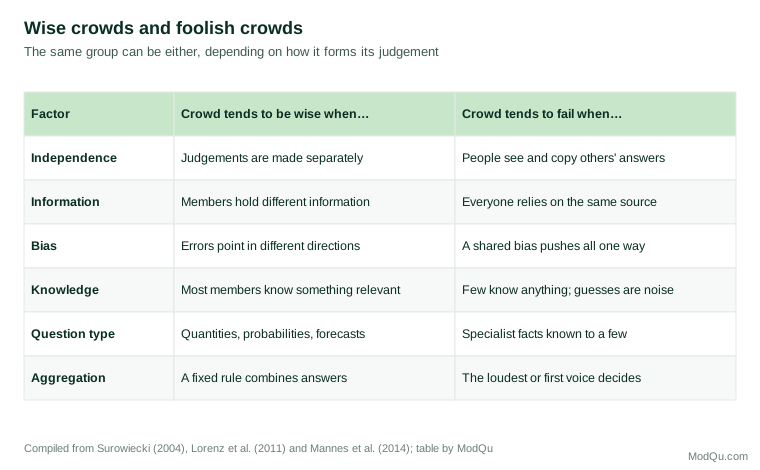
Surowiecki (2004) argued that crowds judge well when their members hold diverse views, judge independently, draw on local knowledge, and have their judgements combined by a fixed method. When these conditions break down, the crowd's advantage shrinks or reverses. Figure 1 sets out the contrast.
Social influence
The most common way crowds lose their wisdom is by watching each other. Lorenz et al. (2011) asked groups to estimate quantities such as the population density of Switzerland. When participants saw others' answers between rounds, their estimates converged, but not on the truth. The range of answers narrowed, so the group became more confident, while accuracy stayed the same or worsened. Social influence reduced diversity without adding information.
Salganik, Dodds and Watts (2006) showed the effect on a larger scale. They created an online music market in which thousands of participants could listen to and download unknown songs. In some versions, participants could see how many times each song had been downloaded; in others, they could not. When download counts were visible, popular songs became far more popular and success became much less predictable: the same song could be a hit in one version of the market and ignored in another. Early, partly random choices were amplified by later participants copying them.
Cascades and bubbles
Bikhchandani, Hirshleifer and Welch (1992) explained why copying can be rational for each individual and yet damaging for the group. In an information cascade, people observe the choices of those before them and reasonably conclude that the earlier choosers knew something. Once enough people have chosen the same way, later individuals ignore their own private information and follow. The cascade can then rest on very little real evidence, and it can reverse suddenly when new information arrives.
Shiller (2000) described how such dynamics feed financial bubbles. Rising prices attract attention, stories spread explaining why prices will keep rising, and more investors buy, pushing prices higher. Each participant is responding to what others are doing, so the collective judgement becomes a feedback loop rather than an aggregation of independent views.
Shared bias
Crowds also fail when their members share the same error. Averaging cancels errors that point in different directions but not errors that point the same way. Simmons et al. (2011) studied people betting on American football games against a point spread designed to make each side equally likely to win. Bettors systematically favoured the stronger team, even when the spread made that a poor bet, and the bias persisted when they had more information and stronger incentives. The crowd's error was not random noise but a common intuition, and averaging could not remove it.
Davis-Stober et al. (2014) showed formally that the advantage of a crowd over an individual depends on how much individual errors are correlated. When errors are highly correlated, a well-chosen individual can outperform the average.
Discussion and groupthink
Face-to-face discussion is not the same as independent aggregation. Kerr and Tindale (2004), reviewing research on group decision-making, found that groups often do worse than the average of their members on judgement tasks, especially when discussion is dominated by a few voices or when members focus on information they already share. Janis (1982) described groupthink, in which cohesive groups suppress doubt and converge on poor decisions. Sunstein (2006) documented how deliberating groups tend to move to more extreme positions than their members held at the start, a pattern known as group polarisation.
When influence can help
Not all social influence is harmful. Becker, Brackbill and Centola (2017) found that in decentralised networks, where each person saw the estimates of a few others rather than of a single central figure, estimates became more accurate after exchange. People who were far from the truth tended to adjust more than those who were close. The structure of the network mattered: influence concentrated in a few central individuals damaged accuracy, while evenly spread influence improved it.
Choosing better crowds
Since the conditions for wisdom vary, some researchers have looked for ways to select the best part of a crowd. Mannes, Soll and Larrick (2014) found that averaging the judgements of a small "select crowd", the five or so people with the best recent track record, often performed better than either the whole crowd or the single best individual. It combined the benefits of expertise and of averaging. Budescu and Chen (2015) developed a method that measures each person's contribution to the crowd's accuracy and weights them accordingly.
Prelec, Seung and McCoy (2017) proposed a different approach for questions where most people are wrong. By asking each respondent for both their answer and their prediction of how others will answer, analysts can identify answers that are more common than people expected, which often reveals a knowledgeable minority.
Designing for wise crowds
For organisations using group judgement in intelligence, forecasting or planning, the research suggests clear rules:
- Collect judgements independently first. Record them before anyone sees others' views.
- Hide running totals. Do not display votes, averages or popularity counts while judgements are being made.
- Recruit for difference. Include people with different information sources, roles and backgrounds.
- Check for shared bias. Ask whether the whole group might be misled by the same source, incentive or intuition.
- Use a fixed aggregation rule. Decide in advance how answers will be combined, rather than letting discussion settle it.
- Track records. Over time, give more weight to people whose judgements prove accurate.
- Treat convergence with suspicion. Unanimity after discussion may reflect influence rather than evidence.
Warning signs
Several signs suggest that a group judgement may have lost its wisdom:
- Estimates cluster tightly around the first or most senior view. Agreement may reflect anchoring rather than evidence.
- Everyone cites the same source. A single report or data set can create the appearance of consensus from one piece of information.
- Confidence rises while new evidence does not. Lorenz et al. (2011) found exactly this pattern after social influence.
- Dissenters fall silent. If people who held different views at the start no longer voice them, the group may be suppressing information.
- The consensus has a strong story but weak numbers. Persuasive narratives spread faster than careful evidence, as bubbles repeatedly show.
When these signs appear, the remedy is to return to independent judgements and to seek out people whose information differs.
A business illustration
A technology company asks its product managers to estimate the market share a new feature will capture. The first round is run in a meeting: the vice-president speaks first, and the estimates that follow cluster tightly around it. Six months later, the feature has captured less than half the predicted share. For the next launch, the intelligence team collects estimates anonymously before any meeting. The range is much wider, and the median is markedly lower than the vice-president's figure. Two engineers who had worked with customers in pilot tests give the lowest estimates and explain why. The final forecast proves far closer to the result.
Conclusion
Crowds are wise when their members bring different information, think independently and have their views combined by a sound method. They become foolish when people copy each other, share the same bias or defer to a dominant voice. Larrick and Soll (2006) showed that the averaging principle is powerful but widely underappreciated; the research on crowd failure shows it is also fragile. Protecting independence and diversity is the price of collective wisdom.
References
Becker, J., Brackbill, D., & Centola, D. (2017). Network dynamics of social influence in the wisdom of crowds. Proceedings of the National Academy of Sciences, 114(26), E5070–E5076. https://doi.org/10.1073/pnas.1615978114
Bikhchandani, S., Hirshleifer, D., & Welch, I. (1992). A theory of fads, fashion, custom, and cultural change as informational cascades. Journal of Political Economy, 100(5), 992–1026. https://doi.org/10.1086/261849
Budescu, D. V., & Chen, E. (2015). Identifying expertise to extract the wisdom of crowds. Management Science, 61(2), 267–280. https://doi.org/10.1287/mnsc.2014.1909
Davis-Stober, C. P., Budescu, D. V., Dana, J., & Broomell, S. B. (2014). When is a crowd wise? Decision, 1(2), 79–101.
Galton, F. (1907). Vox populi. Nature, 75(1949), 450–451. https://doi.org/10.1038/075450a0
Janis, I. L. (1982). Groupthink: Psychological studies of policy decisions and fiascoes (2nd ed.). Houghton Mifflin.
Kerr, N. L., & Tindale, R. S. (2004). Group performance and decision making. Annual Review of Psychology, 55, 623–655. https://doi.org/10.1146/annurev.psych.55.090902.142009
Larrick, R. P., & Soll, J. B. (2006). Intuitions about combining opinions: Misappreciation of the averaging principle. Management Science, 52(1), 111–127. https://doi.org/10.1287/mnsc.1050.0459
Lorenz, J., Rauhut, H., Schweitzer, F., & Helbing, D. (2011). How social influence can undermine the wisdom of crowd effect. Proceedings of the National Academy of Sciences, 108(22), 9020–9025. https://doi.org/10.1073/pnas.1008636108
Mackay, C. (1841). Memoirs of extraordinary popular delusions and the madness of crowds. Richard Bentley.
Mannes, A. E., Soll, J. B., & Larrick, R. P. (2014). The wisdom of select crowds. Journal of Personality and Social Psychology, 107(2), 276–299. https://doi.org/10.1037/a0036677
Prelec, D., Seung, H. S., & McCoy, J. (2017). A solution to the single-question crowd wisdom problem. Nature, 541(7638), 532–535. https://doi.org/10.1038/nature21054
Salganik, M. J., Dodds, P. S., & Watts, D. J. (2006). Experimental study of inequality and unpredictability in an artificial cultural market. Science, 311(5762), 854–856. https://doi.org/10.1126/science.1121066
Shiller, R. J. (2000). Irrational exuberance. Princeton University Press.
Simmons, J. P., Nelson, L. D., Galak, J., & Frederick, S. (2011). Intuitive biases in choice versus estimation: Implications for the wisdom of crowds. Journal of Consumer Research, 38(1), 1–15.
Sunstein, C. R. (2006). Infotopia: How many minds produce knowledge. Oxford University Press.
Surowiecki, J. (2004). The wisdom of crowds. Doubleday.