
Intelligence · Concepts and history
Strategic, Operational and Tactical Intelligence
Intelligence is produced at three levels, strategic, operational and tactical, each serving different decisions, users and time horizons. This article explains the distinction in military, policing and business settings, how the levels interact, and what goes wrong when they are confused.
Not all intelligence serves the same purpose. A national leader deciding whether to build up the armed forces over the next decade, a general planning a campaign over the coming months and a platoon commander deciding which road to take this afternoon all need intelligence, but they need very different kinds. The same is true in business: a board considering whether to enter a new country, a regional manager planning a product launch and a salesperson preparing for tomorrow's meeting each require knowledge suited to their decision. The intelligence profession captures these differences with three levels: strategic, operational and tactical. This article explains each level, traces the origins of the distinction, shows how it applies in military, policing and business settings, and examines what happens when organisations neglect one level or confuse them.
Where the levels come from
The distinction began in military thought. Clausewitz, writing in the early nineteenth century, distinguished strategy, the use of engagements to achieve the object of the war, from tactics, the use of armed forces in the engagement itself (Clausewitz, 1832/1976). Clausewitz was also acutely aware of the limits of intelligence in war, observing that many reports are contradictory, more are false and most are uncertain, so that commanders must judge on imperfect information.
The middle level came later. Military theorists in the Soviet Union developed the idea of an "operational art" linking strategy and tactics through the planning and conduct of campaigns. Luttwak (1980) argued that Western, and especially American, military thinking had long neglected this operational level, focusing instead on attrition and tactics, and that this neglect had real costs. Over the following decade NATO doctrine formally adopted three levels of war: strategic, operational and tactical. American joint doctrine now describes intelligence at each level, supporting national and theatre strategy, the planning of campaigns and major operations, and the conduct of battles and engagements (Joint Chiefs of Staff, 2013).
Freedman (2013) shows that the word "strategy" itself spread from military use into politics and business during the twentieth century, carrying the hierarchy of levels with it. In management, Anthony (1965) proposed a closely parallel framework of strategic planning, management control and operational control, in which decisions at each level differ in time horizon, scope and the kind of information they require. Gorry and Scott Morton (1971) combined Anthony's levels with the degree of structure in a decision to show what kind of information system each decision needed.
The three levels defined
Strategic intelligence
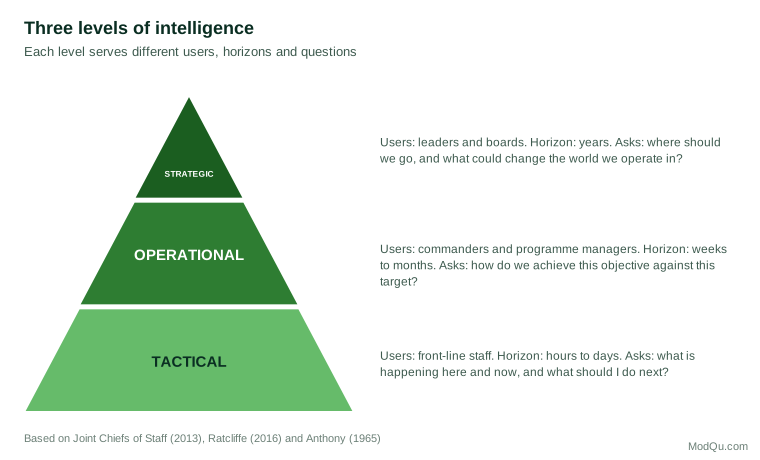
Strategic intelligence supports the decisions that set long-term direction: national security policy, the allocation of defence resources, a company's choice of markets and business model. Its users are senior leaders, its time horizon is years, and its subject matter is broad: the capabilities and intentions of other states or firms, trends in technology, demographics, economics and politics, and the likely shape of the future environment.
Kent (1949) wrote primarily about this level. Kent described strategic intelligence as the knowledge a nation needs about other nations to protect its interests, including basic descriptions of their geography, economies and institutions, current reporting of events and, most demanding of all, estimates of their future behaviour. Strategic intelligence is necessarily estimative. Treverton (2003) distinguishes puzzles, which have answers that better collection could reveal, from mysteries, which depend on future choices that no one can yet know. Strategic questions are often mysteries: whether a rival state will choose war, whether a new technology will displace an industry. The best strategic intelligence frames these mysteries, identifies the drivers and indicators that will shape them and estimates the probabilities of different outcomes.
Operational intelligence
Operational intelligence supports the planning and conduct of campaigns or major programmes: a military operation over weeks or months, a police investigation into an organised crime group, a company's launch of a product in a new region. Its users are senior managers or commanders responsible for a defined objective. It answers questions such as: what is the adversary's order of battle in this theatre, how is this criminal network structured and financed, which competitors will respond to our launch and how?
Clark (2020) argues that intelligence at this level is best organised around a model of the target: a detailed and continuously updated picture of the network, organisation or system that the operation is aimed at. Operational intelligence links strategic aims to tactical action by identifying where effort will have the greatest effect.
Tactical intelligence
Tactical intelligence supports immediate decisions by people in direct contact with the situation: a unit commander, a patrol officer, a salesperson or a call-centre supervisor. Its time horizon is hours to days, its scope is narrow and its emphasis is on accuracy, speed and specific detail. Where is the enemy unit now? Which address is the suspect likely to visit? What did this customer buy last time, and what did their procurement team say about our competitor's offer?
Tactical intelligence is often more certain than strategic intelligence, because it deals with observable facts in the near term. Its challenge is speed and delivery: getting the right detail to the right person at the moment of decision.
A comparison across fields
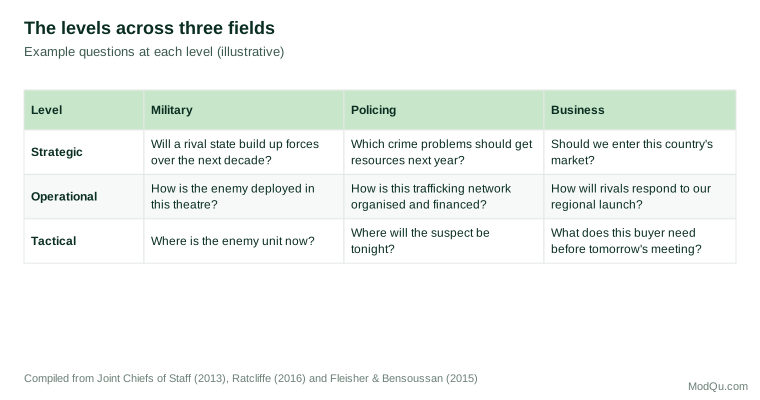
The same three levels appear, with different vocabulary, in defence, policing and business.
Policing
Policing adopted the levels explicitly through intelligence-led policing. Ratcliffe (2016) describes how police intelligence serves strategic decisions about priorities and resources (for example, whether to focus on drug markets or burglary next year), operational decisions about targeting specific crime problems or networks, and tactical decisions about specific arrests, searches and patrols. Carter and Carter (2009) note that many police agencies were initially stronger at tactical intelligence, supporting individual cases, than at the strategic analysis needed to set priorities, and that intelligence-led policing requires both.
Business
In business the levels map onto the familiar distinction between corporate strategy, business-unit planning and day-to-day operations. Fleisher and Bensoussan (2015) describe analytic techniques suited to each level: industry and macro-environmental analysis for strategic decisions, competitor and customer analysis for operational planning, and sales and pricing support for tactical decisions. Porter (1980) set out the industry and competitor analysis that underpins strategic intelligence in firms, asking what drives competition in an industry and how rivals are likely to behave. Calof and Wright (2008) observe that competitive intelligence practitioners frequently find themselves pulled towards tactical requests, such as quick profiles of a competitor before a bid, at the expense of the strategic work that may matter more in the long run.
Ghoshal and Kim (1986), studying how large firms gathered and used intelligence about their environment, found that many had extensive systems for collecting market information but that these systems often failed to deliver it in a form that shaped strategic decisions at the top. The gap they described, between plentiful tactical and operational information and scarce strategic intelligence, remains common.
How the levels interact
The three levels are not separate worlds. They depend on each other in both directions.
Strategy sets the frame for operations and tactics. Operational and tactical intelligence efforts are only useful if they serve the right objectives. A police force that collects excellent tactical intelligence on burglary while its real problem is organised fraud is using its resources well at the wrong task. Rumelt (2011) argues that good strategy begins with a diagnosis of the critical challenge; strategic intelligence contributes much of that diagnosis.
Tactical observations feed strategic understanding. Many strategic changes first appear as small tactical signals: a competitor's salespeople offering unusual discounts, a few customers asking about a new technology, a change in the pattern of minor crimes. Grabo (2002), in a classic work on strategic warning, emphasises that warning of major threats often depends on recognising patterns across many tactical indicators. Organisations that keep tactical reports in separate silos lose this early warning.
Operational intelligence translates between them. Because it deals with specific campaigns or programmes, operational intelligence is where strategic aims are turned into concrete targets and where tactical lessons are aggregated into judgements about what is and is not working.
Products at each level
Because the levels serve different decisions, they call for different products. Mixing up the formats is one of the quickest ways to make intelligence unusable.
Strategic products are typically assessments, estimates and scenario studies. They are produced infrequently, perhaps annually or when a major decision approaches, and they are judged by the quality of their reasoning and the clarity of their uncertainty. A good strategic assessment states its key judgements at the start, explains the drivers behind them, sets out alternative outcomes and identifies indicators that would show which outcome is emerging. Kent (1949) regarded this estimative work as the highest form of intelligence because it requires the analyst to go beyond the evidence to a reasoned view of the future.
Operational products include target profiles, network charts, campaign assessments and regular situation reports for a specific programme. They are updated as the operation develops and are judged by whether they help planners focus effort where it will have the most effect. Clark (2020) recommends that the target model itself, rather than a series of separate reports, be the central operational product, so that everyone works from the same picture.
Tactical products are alerts, briefings, short profiles, maps and data feeds delivered to frontline staff, often through the systems they already use. They are judged by speed, accuracy and convenience. A tactical product that arrives a day late, or that requires a frontline officer to log into a separate system, will often go unused however good its content.
Uncertainty and confidence at each level
The levels also differ in the kind of uncertainty they carry. Tactical intelligence deals mostly with facts that exist now and could in principle be observed: where a unit is, what a customer bought, which vehicle was seen. Its uncertainty comes chiefly from incomplete or unreliable observation, and better collection can often reduce it.
Strategic intelligence deals mostly with the future and with intentions. Its uncertainty comes not only from missing information but from the fact that the outcome has not yet been decided. More collection helps, but it cannot remove the uncertainty entirely. Good strategic intelligence therefore expresses judgements as probabilities, distinguishes the analyst's confidence in the evidence from the likelihood of the outcome, and revisits judgements as indicators change. Operational intelligence lies in between: the target exists and can be studied, but its response to the operation is uncertain.
Recognising these differences protects decision-makers from two opposite errors. One is to expect strategic intelligence to deliver the precision of tactical reporting, and to dismiss it as useless when it cannot. The other is to treat tactical certainty as if it settled strategic questions, as when a precise count of a competitor's stores today is mistaken for knowledge of its plans for next year.
Common failures
Each level has characteristic failures, and many problems arise at the boundaries between them.
Tactical excellence, strategic surprise
Wohlstetter (1962), in a study of the attack on Pearl Harbor, showed that American agencies possessed many tactical indicators of Japanese preparations but failed to assemble them into a strategic judgement that an attack on Hawaii was likely. The signals were scattered across agencies, buried in noise and interpreted through the assumption that Japan would not take such a risk. Betts (1978) argues that failures of this kind are partly inevitable, because the strategic significance of tactical information is often clear only in hindsight.
Strategic intelligence that never reaches operations
Strategic assessments can be accurate but inert. A report concluding that a market is shifting towards subscription models has little effect if product and sales teams continue to plan as before. Mintzberg (1994), in a critique of formal strategic planning, argued that strategy often emerges from the accumulation of operational decisions rather than from plans handed down, and that planning processes detached from operations rarely change behaviour. Intelligence that stays at the strategic level suffers the same fate.
Mismatched time horizons
Users at each level have different needs for speed and depth. Eisenhardt (1989), studying firms in fast-moving industries, found that the quickest strategic decision-makers used more real-time information, not less, and considered several alternatives at once. Intelligence functions that apply the slow, deliberate methods of strategic assessment to tactical questions frustrate their users; those that apply the quick, superficial methods of tactical support to strategic questions mislead them.
Confusing current reporting with estimates
Lowenthal (2022) and Fingar (2011) both note the tendency of intelligence organisations to be absorbed by current intelligence, reporting what happened yesterday, at the expense of longer-term strategic assessment. Current reporting is in demand, easy to produce and rewarded with immediate attention. Strategic work is slower and its value is harder to see. Without deliberate protection, the strategic level withers.
Skills and people
The levels also call on different skills, which affects recruitment and training. Strategic analysts need broad knowledge of the environment, comfort with ambiguity, the ability to reason about the intentions of others and the writing skill to convey uncertain judgements to senior readers. Operational analysts need depth on a particular target, skill in methods such as network and link analysis, and close working relationships with the people running the operation. Tactical analysts need speed, accuracy, familiarity with data systems and an understanding of what frontline staff can use in the moment.
Few individuals excel at all three. Organisations often promote their best tactical analysts into strategic roles and are disappointed when the habits that served well at one level, such as precision about facts and quick turnaround, prove less suited to estimating long-term trends. Deliberate training for each level, and rotation that exposes analysts to the others, helps people understand how their work connects to decisions above and below them.
Organising for all three levels
Several practical principles follow for organisations that want intelligence at every level.
- Map decisions to levels. List the main decisions the organisation makes, sort them into strategic, operational and tactical, and identify what intelligence each needs, how often and in what form.
- Protect strategic capacity. Assign some analysts to longer-term work and shield them from the flow of urgent tactical requests, or schedule regular strategic reviews that require analysis beyond the current week.
- Build channels upward. Create simple ways for tactical observations, from sales staff, frontline officers or customer service, to reach analysts who can look for patterns. Grabo (2002) argues that warning depends on such channels.
- Translate downward. When strategic assessments are made, spell out their implications for operational planning and tactical behaviour, and check later whether they were acted upon.
- Match methods to level. Use estimative techniques, scenarios and explicit probabilities for strategic questions; target models and network analysis for operational ones; and fast, accurate data delivery for tactical ones.
- Keep analysts close to users at each level. Davis (2006) stresses that analysts must understand the decisions they support; this understanding looks different for a board, a programme manager and a frontline team.
The levels in a single example
A regional bank illustrates how the levels fit together. At the strategic level, the board asks whether digital-only competitors will take a significant share of its retail customers over the next five years. Intelligence draws on market research, competitor financial reports, technology trends and customer surveys to estimate the probability and scale of the threat under several scenarios. At the operational level, the head of retail banking plans a campaign to retain younger customers in the cities where digital competitors are strongest; intelligence profiles those competitors' offers, identifies the customer segments most at risk and monitors the campaign's effect. At the tactical level, branch staff and call-centre agents receive alerts when a customer shows signs of moving money to a competitor, together with suggested offers. Tactical data on which customers leave and why flow back up to inform the operational campaign and, aggregated over time, the board's strategic assessment.
Conclusion
The distinction between strategic, operational and tactical intelligence is one of the most useful ideas the profession has to offer. Herman (1996) notes that intelligence systems are judged by how well they serve the decisions of their users, and those decisions differ fundamentally across levels in scope, time horizon and tolerance for uncertainty. Organisations that recognise the levels can design intelligence products, methods and channels for each, and can watch for the characteristic failures at each boundary. Those that do not are likely to drown in tactical detail while missing the strategic changes that matter most.
References
Anthony, R. N. (1965). Planning and control systems: A framework for analysis. Division of Research, Graduate School of Business Administration, Harvard University.
Betts, R. K. (1978). Analysis, war, and decision: Why intelligence failures are inevitable. World Politics, 31(1), 61–89. https://doi.org/10.2307/2009967
Calof, J. L., & Wright, S. (2008). Competitive intelligence: A practitioner, academic and inter-disciplinary perspective. European Journal of Marketing, 42(7/8), 717–730. https://doi.org/10.1108/03090560810877114
Carter, D. L., & Carter, J. G. (2009). Intelligence-led policing: Conceptual and functional considerations for public policy. Criminal Justice Policy Review, 20(3), 310–325. https://doi.org/10.1177/0887403408327381
Clark, R. M. (2020). Intelligence analysis: A target-centric approach (6th ed.). CQ Press.
Clausewitz, C. von. (1976). On war (M. Howard & P. Paret, Eds. & Trans.). Princeton University Press. (Original work published 1832)
Davis, J. (2006). Intelligence analysts and policymakers: Benefits and dangers of tensions in the relationship. Intelligence and National Security, 21(6), 999–1021. https://doi.org/10.1080/02684520601046325
Eisenhardt, K. M. (1989). Making fast strategic decisions in high-velocity environments. Academy of Management Journal, 32(3), 543–576. https://doi.org/10.5465/256434
Fingar, T. (2011). Reducing uncertainty: Intelligence analysis and national security. Stanford University Press.
Fleisher, C. S., & Bensoussan, B. E. (2015). Business and competitive analysis: Effective application of new and classic methods (2nd ed.). Pearson Education.
Freedman, L. (2013). Strategy: A history. Oxford University Press.
Ghoshal, S., & Kim, S. K. (1986). Building effective intelligence systems for competitive advantage. Sloan Management Review, 28(1), 49–58.
Gorry, G. A., & Scott Morton, M. S. (1971). A framework for management information systems. Sloan Management Review, 13(1), 55–70.
Grabo, C. M. (2002). Anticipating surprise: Analysis for strategic warning. Joint Military Intelligence College.
Herman, M. (1996). Intelligence power in peace and war. Cambridge University Press.
Joint Chiefs of Staff. (2013). Joint intelligence (Joint Publication 2-0). U.S. Department of Defense.
Kent, S. (1949). Strategic intelligence for American world policy. Princeton University Press.
Lowenthal, M. M. (2022). Intelligence: From secrets to policy (9th ed.). CQ Press.
Luttwak, E. N. (1980). The operational level of war. International Security, 5(3), 61–79. https://doi.org/10.2307/2538420
Mintzberg, H. (1994). The rise and fall of strategic planning. Free Press.
Porter, M. E. (1980). Competitive strategy: Techniques for analyzing industries and competitors. Free Press.
Ratcliffe, J. H. (2016). Intelligence-led policing (2nd ed.). Routledge.
Rumelt, R. P. (2011). Good strategy/bad strategy: The difference and why it matters. Crown Business.
Treverton, G. F. (2003). Reshaping national intelligence for an age of information. Cambridge University Press.
Wohlstetter, R. (1962). Pearl Harbor: Warning and decision. Stanford University Press.