
Intelligence · Market and competitive intelligence
Patent and Technology Intelligence
Patents are public documents that reveal where companies are investing in technology, often years before products appear. This article explains how patent and technology intelligence works, what patent data can and cannot show, and how to use it for early warning.
Most competitive information is hard to obtain. Companies guard their research plans, product roadmaps and technical know-how closely. Yet in exchange for legal protection, inventors must publish detailed descriptions of their inventions in patent applications, which become public, usually about eighteen months after the first filing. Millions of these documents are freely searchable. They form one of the largest and most detailed public sources of information about what companies are working on. Patent and technology intelligence is the analysis of patents, scientific publications and related sources to understand technological trends, competitors' research directions and emerging threats and opportunities.
What patents reveal
A patent document contains a great deal of structured information: the applicant and inventors, their locations, filing and publication dates, technical classification codes, a detailed description of the invention, the legal claims defining what is protected, and citations to earlier patents and scientific literature. Each element can be analysed.
- Who is active. Counting filings by applicant shows which companies are investing in a technology and how their activity changes over time.
- What they are working on. Classification codes and text show the technical areas of focus, and changes in focus can signal a shift in strategy.
- Where. The countries in which protection is sought indicate the markets a company intends to serve.
- Who invents. Inventor names reveal research teams, their movement between companies and collaboration networks.
- How inventions build on each other. Citations link patents into networks of related technology.
Ernst (2003) describes how companies use patent information for strategic technology management: assessing their own and competitors' technology positions, identifying potential partners or acquisition targets, monitoring new entrants and spotting technological change early.
Patents as indicators: strengths and cautions
Griliches (1990), reviewing the use of patent statistics in economics, concluded that patents are a valuable indicator of inventive activity, available in great detail over long periods, but a noisy one. Most patents have little economic value, while a few are extremely valuable. Simple counts therefore mix the important with the trivial.
Citations help separate them. Trajtenberg (1990), studying computed tomography scanners, found that patent counts weighted by the number of times each patent was later cited were closely related to the social value of the innovations, while simple counts were not. Hall et al. (2005) found that firms' stocks of highly cited patents were associated with their stock market value, beyond what research spending and simple patent counts explained. Highly cited patents tend to be the important ones.
Citations also trace the flow of knowledge. Jaffe et al. (1993) showed that patents were more likely to cite earlier patents from the same city or region than would be expected by chance, evidence that knowledge spills over most readily among nearby inventors. For intelligence purposes, citation networks show which firms build on whose work and where technological communities are forming.
There are important cautions:
- Not everything is patented. Cohen et al. (2000), surveying research and development managers in American manufacturing, found that in many industries firms relied more on secrecy, lead time and complementary capabilities than on patents to protect their innovations. Patents were most important in industries such as pharmaceuticals and chemicals. Absence of patents does not mean absence of activity.
- Patents are filed for many reasons. Companies patent to block competitors, to trade in cross-licensing negotiations, or to signal capability, not only to protect products they intend to make.
- There is a delay. Applications are usually published about eighteen months after first filing, so patent data show activity that began at least that long ago.
- Counting rules matter. The same invention may be filed in many countries. Analysts usually count patent families, groups of filings covering the same invention, rather than individual documents.
Methods of analysis
Porter and Cunningham (2005) describe tech mining: combining text mining, bibliometrics and patent analysis to extract intelligence about emerging technologies from large collections of documents. Abbas et al. (2014), reviewing patent analysis techniques, identify approaches ranging from simple counts and trend charts to text mining, network analysis of citations and visual patent maps that group documents by technical similarity.
Common analyses include:
- Trend analysis: counts of filings over time by technology and applicant, revealing growing and declining areas.
- Portfolio comparison: comparing competitors' patent holdings by technical area, quality and geographic coverage.
- Citation analysis: identifying the most influential patents and the firms that build on them.
- White-space analysis: finding technical areas with little patenting, which may represent opportunities or areas of low commercial interest.
- Inventor tracking: following key inventors as they move between firms.
Daim et al. (2006) showed how combining patent analysis with bibliometric analysis of scientific publications can help forecast emerging technologies. Scientific publications typically precede patents, which precede products; tracking all three gives a longer view.
Early warning
Patent activity can provide early warning of competitive change. Figure 1 shows a hypothetical but typical pattern: a company that was a minor player in a technology begins filing heavily, years before it launches a product.
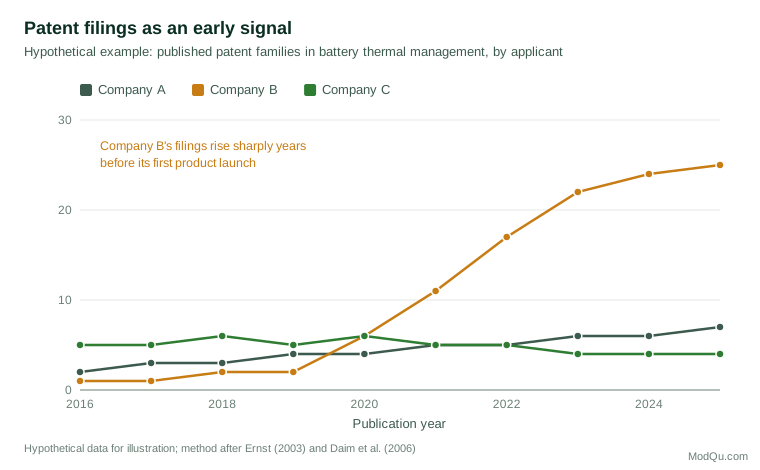
Gilad (2004) argues that early warning is the central purpose of competitive intelligence. Patent data are particularly useful for detecting entrants from other industries, which may not appear in conventional competitor monitoring. Christensen (1997) showed that disruptive technologies often come from firms outside the established industry; patent searches by technology rather than by known competitor can reveal them.
Rogers (2003) described how innovations diffuse over time through populations of adopters. Patent and publication trends can indicate where a technology stands in its development: early scientific publications, then rising patenting by research organisations and start-ups, then patenting by large firms as commercialisation approaches.
Using technology intelligence
Technology intelligence is only valuable if it reaches people who can act on it. Cohen and Levinthal (1990) argued that firms need absorptive capacity, built through their own research, to recognise and use external knowledge. A company with no expertise in a field will struggle to interpret patent trends in it. Effective programmes therefore pair intelligence analysts with engineers and scientists who can judge the significance of what is found.
Fleisher and Bensoussan (2015) and Calof and Wright (2008) emphasise integrating patent analysis with other sources, such as job postings, conference presentations, regulatory filings and trade press, to build a fuller picture.
An illustration
An auto parts supplier monitors patents in battery thermal management, a technology important to electric vehicles. Its analysts notice that a consumer electronics company with no automotive business has filed a rapidly growing number of patent families in the area, with inventors recruited from two battery manufacturers and filings in the major vehicle-producing countries. Citation analysis shows that the new filings build on the supplier's own earlier patents. Combined with job postings for automotive engineers, the evidence suggests the electronics company is preparing to enter the supplier's market. The supplier begins discussions with vehicle makers earlier than planned and reviews whether any of the new filings could restrict its own product plans.
Common pitfalls
Several mistakes recur in patent intelligence work.
- Counting documents instead of inventions. One invention filed in ten countries produces ten documents. Counting families rather than documents avoids inflating the activity of firms that file widely (Hall et al., 2005).
- Ignoring the publication delay. Applications are normally published about eighteen months after filing, so the most recent two years of any chart understate activity. A decline at the right-hand edge of a trend line is often an artefact of this delay rather than a real fall.
- Treating all patents as equal. Most patents are cited rarely and never used commercially. Weighting by forward citations, as Trajtenberg (1990) proposed, gives a better picture of technical importance.
- Searching only by company name. Firms file through subsidiaries, acquired companies and individual inventors, and names are spelled inconsistently. Searches should combine company names with technology classes and keywords.
- Forgetting what is not patented. Some firms protect key knowledge as trade secrets, and in some industries, such as software and services, patenting is a weak guide to innovation (Cohen et al., 2000). Absence of patents is not absence of activity.
A short checklist helps: define the technology with classification codes as well as keywords, count families, adjust for publication delay, weight by citations, and ask an engineer to read the most important documents before drawing conclusions.
Conclusion
Patents are a rich public source of technology intelligence. Analysed carefully, with attention to quality through citations, to families rather than individual documents and to the limits of what patents capture, they reveal competitors' research directions, new entrants and emerging technologies, often years before products reach the market. The value comes from combining patent data with scientific literature, other open sources and the judgement of technical experts, and from using the results for early warning rather than retrospective description.
References
Abbas, A., Zhang, L., & Khan, S. U. (2014). A literature review on the state-of-the-art in patent analysis. World Patent Information, 37, 3–13. https://doi.org/10.1016/j.wpi.2013.12.006
Calof, J. L., & Wright, S. (2008). Competitive intelligence: A practitioner, academic and inter-disciplinary perspective. European Journal of Marketing, 42(7/8), 717–730. https://doi.org/10.1108/03090560810877114
Christensen, C. M. (1997). The innovator's dilemma: When new technologies cause great firms to fail. Harvard Business School Press.
Cohen, W. M., & Levinthal, D. A. (1990). Absorptive capacity: A new perspective on learning and innovation. Administrative Science Quarterly, 35(1), 128–152. https://doi.org/10.2307/2393553
Cohen, W. M., Nelson, R. R., & Walsh, J. P. (2000). Protecting their intellectual assets: Appropriability conditions and why U.S. manufacturing firms patent (or not) (NBER Working Paper No. 7552). National Bureau of Economic Research. https://doi.org/10.3386/w7552
Daim, T. U., Rueda, G., Martin, H., & Gerdsri, P. (2006). Forecasting emerging technologies: Use of bibliometrics and patent analysis. Technological Forecasting and Social Change, 73(8), 981–1012. https://doi.org/10.1016/j.techfore.2006.04.004
Ernst, H. (2003). Patent information for strategic technology management. World Patent Information, 25(3), 233–242. https://doi.org/10.1016/S0172-2190(03)00077-2
Fleisher, C. S., & Bensoussan, B. E. (2015). Business and competitive analysis: Effective application of new and classic methods (2nd ed.). Pearson Education.
Gilad, B. (2004). Early warning: Using competitive intelligence to anticipate market shifts, control risk, and create powerful strategies. AMACOM.
Griliches, Z. (1990). Patent statistics as economic indicators: A survey. Journal of Economic Literature, 28(4), 1661–1707.
Hall, B. H., Jaffe, A., & Trajtenberg, M. (2005). Market value and patent citations. RAND Journal of Economics, 36(1), 16–38.
Jaffe, A. B., Trajtenberg, M., & Henderson, R. (1993). Geographic localization of knowledge spillovers as evidenced by patent citations. Quarterly Journal of Economics, 108(3), 577–598. https://doi.org/10.2307/2118401
Porter, A. L., & Cunningham, S. W. (2005). Tech mining: Exploiting new technologies for competitive advantage. Wiley.
Rogers, E. M. (2003). Diffusion of innovations (5th ed.). Free Press.
Trajtenberg, M. (1990). A penny for your quotes: Patent citations and the value of innovations. RAND Journal of Economics, 21(1), 172–187. https://doi.org/10.2307/2555502