
Intelligence · Organisational intelligence
"Organisational Intelligence: How Companies Learn and Sense Their Environment"
Some organisations consistently notice change sooner and respond better than others. This article explains organisational intelligence, the capacity of an organisation as a whole to gather, interpret, remember and act on information, and what distinguishes intelligent organisations from merely well-informed ones.
An organisation can employ many intelligent people and still behave unintelligently. Warnings are ignored, lessons are forgotten and the same mistakes recur. Other organisations, with no more talent, seem to notice change early and respond well. The difference lies in organisational intelligence: the capacity of an organisation as a whole, not just its individuals, to gather information, make sense of it, retain what it learns and act on it.
Origins of the idea
Wilensky (1967) introduced the term in a study of how governments and companies use information. Wilensky defined organisational intelligence as the gathering, processing, interpretation and communication of the information needed in decision-making. Wilensky's central finding was that intelligence failures were usually organisational rather than individual. Hierarchy, specialisation and secrecy distorted information as it moved upwards: bad news was softened, specialists did not share with each other, and leaders heard what subordinates thought they wanted to hear.
Albrecht (2003) later described organisational intelligence as the capacity of an organisation to mobilise all of its brain power and focus that brain power on achieving its mission. Albrecht emphasised shared vision, willingness to change, morale, alignment and the sharing of knowledge, arguing that collective intelligence depends as much on culture as on information systems.
Four capabilities
Research on organisational learning identifies the capabilities that make up organisational intelligence. Huber (1991) described four processes: acquiring knowledge, distributing information, interpreting it and storing it in organisational memory. Walsh and Ungson (1991) explained that organisational memory resides not only in records and databases but in individuals, culture, routines, structures and even the physical workplace. Figure 1 brings these capabilities together.
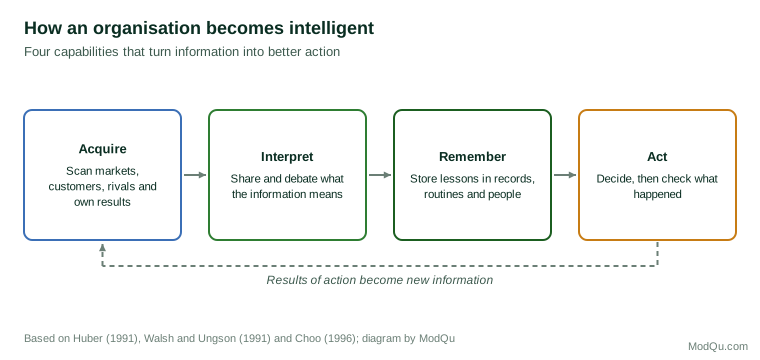
Choo (1996) described the "knowing organisation" as one that links three activities: sense-making, interpreting what is happening in its environment; knowledge creation, generating new understanding and capabilities; and decision-making, choosing and acting. An organisation that senses well but cannot decide, or decides without sensing, falls short.
Sinkula (1994) applied these ideas to markets, showing how firms acquire, distribute and interpret market information, and how past experience shapes what they notice. Cohen and Levinthal (1990) added that an organisation's ability to recognise and use new external information, its absorptive capacity, depends on what it already knows. Intelligence builds on intelligence.
Balancing exploration and exploitation
March (1991) identified a lasting tension. Organisations can exploit what they already know, refining existing products and methods, or explore new possibilities through search, experiment and variation. Exploitation brings reliable short-term returns; exploration brings uncertain but potentially large long-term gains. Organisations tend to favour exploitation because its rewards are faster and more certain, and so gradually lose the ability to adapt. An intelligent organisation deliberately protects some capacity for exploration.
Signs of an intelligent organisation
Senge (1990) described the learning organisation, in which people continually expand their capacity to create the results they want, and collective aspiration is set free. Drawing on this and the research above, several signs indicate high organisational intelligence:
- Bad news travels upwards quickly and without distortion.
- Information is shared across departments rather than held within them.
- Disagreement about what information means is welcomed and resolved by evidence.
- Lessons from past decisions are recorded and actually consulted.
- The organisation runs small experiments and learns from failures.
- Decision-makers can say what they know, what they do not know, and how they would find out.
Common obstacles
Wilensky's (1967) diagnosis still applies. The most common obstacles to organisational intelligence are structural: layers of hierarchy that filter bad news, departments that guard their information, and incentives that reward people for appearing certain rather than for being right. Cultural obstacles matter too. Where admitting a mistake is punished, lessons are hidden rather than shared. Removing these obstacles often does more for an organisation's intelligence than any new information system.
An illustration
Two regional retailers face the arrival of a large discount competitor. In the first, store managers notice changes in customer traffic but report only sales figures, which hold up for several months. Head office learns of the threat from the press. In the second, store managers routinely send short notes on competitor activity, a small team reviews them weekly, and the board receives a monthly summary with an assessment of what the changes might mean. The second retailer adjusts its pricing and ranges a full season earlier. Both employed capable people; only one was organised to use what they knew.
Conclusion
Organisational intelligence is the capacity of an organisation, not just its members, to sense, interpret, remember and act. It depends on structures that let information flow, a culture that welcomes unwelcome news, memory that preserves lessons, and a balance between exploiting what is known and exploring what is new. Building it is less a matter of hiring clever people than of organising so that their knowledge counts.
References
Albrecht, K. (2003). The power of minds at work: Organizational intelligence in action. AMACOM.
Choo, C. W. (1996). The knowing organization: How organizations use information to construct meaning, create knowledge and make decisions. International Journal of Information Management, 16(5), 329–340. https://doi.org/10.1016/0268-4012(96)00020-5
Cohen, W. M., & Levinthal, D. A. (1990). Absorptive capacity: A new perspective on learning and innovation. Administrative Science Quarterly, 35(1), 128–152. https://doi.org/10.2307/2393553
Huber, G. P. (1991). Organizational learning: The contributing processes and the literatures. Organization Science, 2(1), 88–115. https://doi.org/10.1287/orsc.2.1.88
March, J. G. (1991). Exploration and exploitation in organizational learning. Organization Science, 2(1), 71–87. https://doi.org/10.1287/orsc.2.1.71
Senge, P. M. (1990). The fifth discipline: The art and practice of the learning organization. Doubleday.
Sinkula, J. M. (1994). Market information processing and organizational learning. Journal of Marketing, 58(1), 35–45. https://doi.org/10.1177/002224299405800103
Walsh, J. P., & Ungson, G. R. (1991). Organizational memory. Academy of Management Review, 16(1), 57–91. https://doi.org/10.5465/amr.1991.4278992
Wilensky, H. L. (1967). Organizational intelligence: Knowledge and policy in government and industry. Basic Books.