
Intelligence · Analysis and tradecraft
Intelligence Preparation of the Environment as Foundational Knowledge Building
Military planners do not start with the enemy; they start with the terrain, the weather and the people around it. This article explains intelligence preparation of the environment and how businesses can use the same discipline before they analyse competitors.
Before an army plans an operation, its intelligence staff work through a structured process to understand the area where the operation will take place: the ground, the weather, the population, the infrastructure and the forces that might oppose it. In United States doctrine the process is called intelligence preparation of the battlefield at the tactical level and joint intelligence preparation of the operational environment at the joint level (Joint Chiefs of Staff, 2014; U.S. Department of the Army, 2019). Other organisations use the broader label intelligence preparation of the environment. Whatever the name, the idea is the same: build a shared, documented understanding of the environment first, so that later analysis and decisions rest on a common foundation.
This article explains the process, why it works as a form of knowledge building, and how commercial intelligence teams can adapt it for market entry, product launches and competitive planning.
Where the idea comes from
Sherman Kent, one of the founders of modern intelligence analysis, argued that strategic intelligence must include basic descriptive knowledge of a country or region, not only reports on current events and estimates of what will happen (Kent, 1949). Descriptive knowledge is the background against which new information makes sense. Without it, analysts cannot tell whether a report is significant or routine.
Military doctrine turned this principle into a repeatable procedure. The aim is to describe how the environment will affect both one's own side and opponents, to evaluate the opponents, and to work out what they are likely to do (U.S. Department of the Army, 2019). Intelligence textbooks treat this kind of structured groundwork as part of the analyst's basic craft (Lowenthal, 2017; Heuer & Pherson, 2015).
The four steps
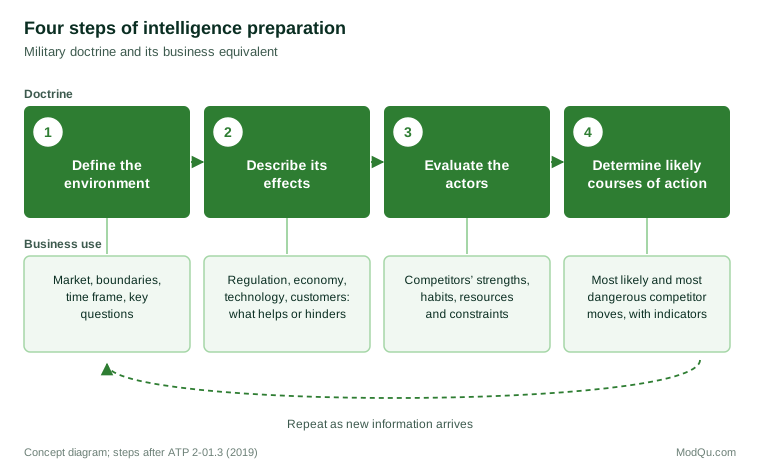
Current US Army doctrine describes four steps (U.S. Department of the Army, 2019). Joint doctrine uses a similar sequence for larger operations (Joint Chiefs of Staff, 2014). Figure 1 shows the steps with their business equivalents.
Step 1: Define the operational environment
Analysts set the boundaries of the problem: the geographic area, the time period, the actors that matter and the questions the commander needs answered. They also identify what is already known and what is missing. This step prevents the common failure of collecting large amounts of information without a clear purpose.
Step 2: Describe environmental effects on operations
Analysts examine how terrain, weather, infrastructure and civil conditions will help or hinder each side. Doctrine uses checklists to make the review systematic, for example by considering political, military, economic, social, information and infrastructure factors. The output is not a description for its own sake but a judgement about effects: which routes are usable, which areas are favourable, which conditions limit what anyone can do.
Step 3: Evaluate the threat
Analysts build a picture of the opposing forces: their composition, capabilities, habitual methods, strengths and weaknesses. Doctrine calls the habitual methods "doctrinal templates", models of how an opponent normally operates when unconstrained by the environment.
Step 4: Determine threat courses of action
Finally, analysts combine the environment and the opponent's habits to identify the courses of action the opponent might adopt. They usually develop at least the most likely and the most dangerous options, and they list the indicators that would show which option is being followed. These indicators then guide collection, so that the organisation watches for the signals that matter.
Why it works as knowledge building
Intelligence preparation of the environment is valuable less because of any single step than because of what it produces: a structured, shared and revisable base of knowledge.
It builds situation awareness. Endsley (1995) described situation awareness as three levels: perceiving relevant elements of the environment, understanding what they mean, and projecting their future state. The four steps map closely onto these levels. Steps 1 and 2 support perception and understanding; steps 3 and 4 support projection.
It supports sensemaking. Weick (1995) argued that organisations act on plausible interpretations of ambiguous situations, and that those interpretations are built socially and retrospectively. Klein et al. (2006) described sensemaking as the deliberate effort to connect pieces of information into a frame that explains them and can be revised. A documented environmental picture gives a team a common frame to test, rather than as many private frames as there are analysts.
It reduces surprise, but cannot eliminate it. Studies of strategic surprise show that warning failures often arise not from a lack of information but from the failure to interpret it against the right background. Wohlstetter (1962) showed that the signals preceding the attack on Pearl Harbor were present but lost among noise and competing interpretations. Betts (1978) argued that some intelligence failures are inevitable, because ambiguity and the limits of analysis cannot be removed. Grabo (2004) stressed that warning depends on careful, cumulative analysis of indicators against a sound understanding of the adversary. Intelligence preparation provides that understanding and the indicator lists that make warning possible.
It structures the analysis. Heuer and Pherson (2015) present many structured analytic techniques designed to make assumptions explicit and reduce cognitive bias. Intelligence preparation of the environment applies the same logic at the start of a project: by forcing analysts to describe the environment and the opponent before forecasting, it reduces the temptation to jump to the scenario that first comes to mind.
What the process produces
The four steps are a means to an end. In military practice their outputs are concrete products that other staff use directly, and the same products translate well to business.
An environment summary. A short document, usually with maps or diagrams, that states the boundaries of the problem and the main environmental factors, each with its effect. In a business setting this might be a two-page market brief listing regulatory, economic, technological and customer conditions, and what each means for the plan.
Actor profiles. For each significant competitor, partner or regulator, a profile covering capabilities, resources, past behaviour and known constraints. Profiles are kept up to date and reused, so that each new project does not start from nothing.
Course-of-action sketches. Brief descriptions of what each important actor might do, ranked by likelihood and by potential harm. These give planners something specific to prepare against and give decision-makers a clear view of the range of possibilities.
An indicator list and collection plan. A list of observable signs that would show which course of action is unfolding, linked to the sources that could detect them and the people responsible for watching. This is the bridge between preparation and monitoring.
A list of gaps and assumptions. A record of what is not known and what the analysis assumes. Gaps become collection priorities; assumptions become items to check, for example with a key assumptions check of the kind described by Heuer and Pherson (2015).
Kept together in one place, these products form an organisation's working knowledge base about a market. They are useful well beyond the project that created them, because new staff, new questions and new decisions can start from an established foundation.
Applying it in business
Business strategy has its own traditions of environmental analysis. Aguilar (1967) studied how managers scan their business environments for information, and later research found that the amount and type of scanning vary with strategy and with how uncertain the environment is perceived to be (Duncan, 1972; Hambrick, 1982). Daft et al. (1988) found that chief executives scanned more frequently when they saw their environment as more uncertain, and that higher-performing firms scanned more broadly in such conditions. Porter (1980) provided a framework for competitor analysis built on each competitor's goals, assumptions, strategy and capabilities. Intelligence preparation of the environment brings these elements together into one disciplined sequence.
A hypothetical example shows how. A Canadian maker of home water filters is considering entry into a new regional market.
- Define the environment. The team sets the market boundary (household filters sold through retail and online channels in the region), the time frame (the next three years) and the key questions: how large is the reachable market, who will respond to entry, and what could stop the launch?
- Describe the effects. The team reviews certification rules, import duties, retailer concentration, water-quality concerns and consumer attitudes. The judgement is concrete: certification will take nine months, two retail chains control most shelf space, and recent publicity about local water quality favours entry.
- Evaluate the actors. The team profiles the three main competitors and the two dominant retailers: their pricing history, promotional habits, financial strength and past reactions to new entrants.
- Determine likely courses of action. The team concludes that the most likely response is a price promotion by the market leader, and the most dangerous is an exclusive supply agreement with the largest retailer. It lists indicators for each, such as unusual promotional calendars or job postings for key-account roles, and assigns someone to monitor them.
The result is not a forecast but a foundation. When news arrives during the launch, the team can place it immediately in context. This is the practical value Gilad (2004) and Day and Schoemaker (2006) describe in their work on early warning and peripheral vision: organisations that have mapped their environment can recognise weak signals before they become obvious.
Common mistakes
- Treating it as a one-off report. The environment changes. Intelligence preparation should be updated as new information arrives, which is why Figure 1 shows a loop.
- Describing without judging. Long lists of facts about the market are not intelligence. Each factor should end in a statement of its effect on the organisation's options.
- Mirror-imaging. Analysts assume competitors will act as their own organisation would. Step 3 should be based on evidence of how each competitor has actually behaved.
- Considering only the most likely option. The most dangerous course of action deserves as much attention, because it carries the greatest cost if missed.
- Skipping the indicators. Without indicators, step 4 cannot guide collection, and the process loses its warning value.
Key takeaways
Intelligence preparation of the environment is a disciplined way of building the background knowledge that all later analysis depends on. It defines the problem, describes how the environment shapes what is possible, evaluates the actors, and identifies their likely and dangerous courses of action together with the indicators that would reveal them. Its strength lies in making that knowledge explicit, shared and revisable. Businesses can borrow the method directly for market entry, launches and competitive planning, provided they keep it current and use it to decide what to watch, not only to describe what they already know.
References
Aguilar, F. J. (1967). Scanning the business environment. Macmillan.
Betts, R. K. (1978). Analysis, war, and decision: Why intelligence failures are inevitable. World Politics, 31(1), 61–89. https://doi.org/10.2307/2009967
Daft, R. L., Sormunen, J., & Parks, D. (1988). Chief executive scanning, environmental characteristics, and company performance: An empirical study. Strategic Management Journal, 9(2), 123–139. https://doi.org/10.1002/smj.4250090204
Day, G. S., & Schoemaker, P. J. H. (2006). Peripheral vision: Detecting the weak signals that will make or break your company. Harvard Business School Press.
Duncan, R. B. (1972). Characteristics of organizational environments and perceived environmental uncertainty. Administrative Science Quarterly, 17(3), 313–327. https://doi.org/10.2307/2392145
Endsley, M. R. (1995). Toward a theory of situation awareness in dynamic systems. Human Factors, 37(1), 32–64. https://doi.org/10.1518/001872095779049543
Gilad, B. (2004). Early warning: Using competitive intelligence to anticipate market shifts, control risk, and create powerful strategies. AMACOM.
Grabo, C. M. (2004). Anticipating surprise: Analysis for strategic warning. University Press of America.
Hambrick, D. C. (1982). Environmental scanning and organizational strategy. Strategic Management Journal, 3(2), 159–174. https://doi.org/10.1002/smj.4250030207
Heuer, R. J., Jr., & Pherson, R. H. (2015). Structured analytic techniques for intelligence analysis (2nd ed.). CQ Press.
Joint Chiefs of Staff. (2014). Joint intelligence preparation of the operational environment (Joint Publication 2-01.3).
Kent, S. (1949). Strategic intelligence for American world policy. Princeton University Press.
Klein, G., Moon, B., & Hoffman, R. R. (2006). Making sense of sensemaking 1: Alternative perspectives. IEEE Intelligent Systems, 21(4), 70–73. https://doi.org/10.1109/MIS.2006.75
Lowenthal, M. M. (2017). Intelligence: From secrets to policy (7th ed.). CQ Press.
Porter, M. E. (1980). Competitive strategy: Techniques for analyzing industries and competitors. Free Press.
U.S. Department of the Army. (2019). Intelligence preparation of the battlefield (ATP 2-01.3).
Weick, K. E. (1995). Sensemaking in organizations. Sage.
Wohlstetter, R. (1962). Pearl Harbor: Warning and decision. Stanford University Press.