
Intelligence · Concepts and history
Human Intelligence (HUMINT): The Psychology of Interpersonal Knowledge Generation
Human intelligence is knowledge gained from people. This article explains what psychological research shows about getting accurate information through conversation: why rapport outperforms pressure, why lie detection is so hard, and how good interviewing improves recall.
Human intelligence, or HUMINT, is information obtained from people: agents, defectors, travellers, experts, employees, customers and witnesses. In national security it is the oldest collection discipline and still the one best suited to learning intentions, plans and motives, which rarely appear in satellite images or intercepted signals (Lowenthal, 2022). Lowenthal and Clark (2016) describe it as the discipline most dependent on personal relationships and judgement. Outside government, much the same activity happens in expert interviews, customer research, due diligence conversations and internal investigations. In every setting, the quality of the information depends on psychology: on whether the source is willing to talk, able to remember accurately and telling the truth. This article summarises what research shows about each of these.
Willingness: rapport works better than pressure
A common assumption is that people reveal more when pressed hard. The evidence points the other way. Meissner et al. (2014) reviewed experimental and field studies comparing accusatorial interviewing, which relies on confrontation, control and pressure to confess, with information-gathering approaches, which rely on rapport, open questions and active listening. Information-gathering methods produced more true confessions and fewer false ones. Evans et al. (2013), in an experiment designed to mimic intelligence interviews, found that an information-gathering approach yielded more relevant and accurate information than an accusatorial one.
Field evidence agrees. Alison et al. (2013) analysed recordings of police interviews with suspects in terrorism cases in the United Kingdom. Interviewers who showed respect, empathy and adaptability, and who avoided hostility and attempts to dominate, obtained more useful information, and rapport-based behaviour reduced suspects' use of counter-interview tactics such as silence.
Principles of social influence explain part of the effect. Cialdini (2001) summarises research on why people comply with requests, identifying reciprocity, consistency, social proof, liking, authority and scarcity as recurring influences. A source who feels respected, who has received something of value and who likes the interviewer is more likely to share information. The same principles can be misused to manipulate, which is why ethical limits matter.
Memory: how to help people recall
Even a willing source may remember poorly. Memory is reconstructive: people fill gaps with expectations, and leading questions can introduce details that were never there. The cognitive interview, developed by Fisher and Geiselman (1992), applies findings from memory research to improve recall. The interviewer asks the person to mentally reinstate the context of the event, to report everything however trivial it seems, to recall events in different orders and to describe them from different perspectives, while avoiding leading questions and interruptions.
Memon et al. (2010), in a meta-analysis of 25 years of studies, found that the cognitive interview produces a large increase in correct details compared with standard interviews, with only a small increase in errors. For anyone gathering information from people, whether witnesses, employees or expert informants, the practical lesson is to ask open questions, allow time and resist the urge to fill silences or suggest answers.
Truthfulness: why lie detection is hard
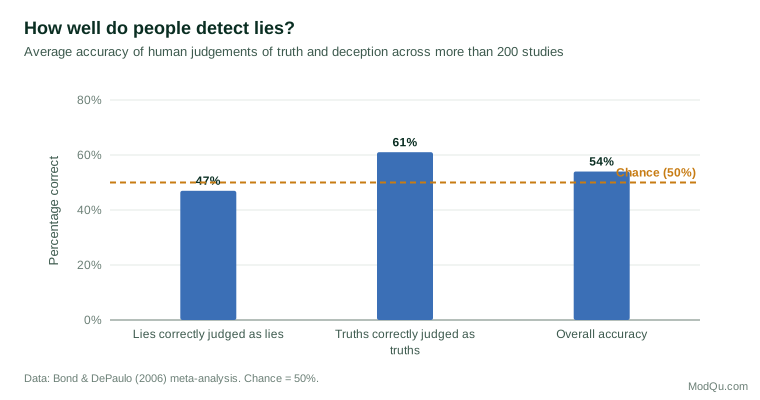
Intelligence officers, police and business people often believe they can tell when someone is lying. Research says this confidence is mostly misplaced. Bond and DePaulo (2006) combined results from more than 200 studies and found that people correctly classified statements as truths or lies only about 54% of the time, against 50% expected by chance. They were better at recognising truths than lies, reflecting a general tendency to believe what they are told.
Vrij et al. (2010) explain why. Popular cues to lying, such as avoiding eye contact or fidgeting, are weakly related or unrelated to deception, and liars and truth-tellers are both nervous when they feel suspected. More promising approaches change the interview rather than watching the person more closely: asking unexpected questions that a liar has not prepared for, asking for events to be told in reverse order to increase mental load, and checking details against independent evidence.
The strategic use of evidence technique, described by Granhag and Hartwig (2015), builds on this. The interviewer holds back what is already known and first invites a free account, then asks questions that touch on the evidence. Truth-tellers' accounts tend to fit the evidence; liars, who try to avoid incriminating topics, tend to contradict it. The method relies on the interviewer's preparation rather than on reading body language.
Evaluating what sources say
Collecting information from people is only half the task; the other half is judging how much weight it deserves. Intelligence practice separates two questions that are easily confused. The first concerns the source: does this person have genuine access to what they describe, have they been reliable before, and do they have a motive to exaggerate, mislead or please? The second concerns the information: is it plausible, is it consistent with other evidence, and is it first-hand or passed on from someone else? A reliable source can report something they misunderstood, and an unreliable one can occasionally report something true, so both questions must be asked every time.
The same discipline helps in business research. An industry expert interviewed by telephone may speak with confidence about a competitor's plans, but the analyst should ask how the expert could know, when they last had contact with the company, and whether anyone else confirms the claim. Recording these judgements alongside the information makes later analysis far more reliable.
Lessons for information gathering
These findings apply well beyond espionage:
- Build rapport first. Respect, honesty about purpose and genuine interest produce more and better information than pressure.
- Ask open questions and listen. Let the source talk; avoid leading questions that plant answers.
- Use memory-friendly techniques. Reinstating context and allowing several retellings improves recall.
- Do not trust your instinct for lies. Check claims against other sources instead of reading body language.
- Prepare and use evidence carefully. Knowing what can be verified, and when to reveal it, is more reliable than intuition.
- Stay within ethical limits. Coercion and deception damage trust, produce unreliable information and may be unlawful.
Conclusion
Human intelligence is ultimately about conversation. The psychology of that conversation, how people decide to share, how they remember and how they conceal, has been studied extensively, and the conclusions are consistent: rapport, patience, good questions and independent verification outperform force and intuition. Whether the source is a defector, a witness or a customer, these principles turn interviews into reliable knowledge.
References
Alison, L. J., Alison, E., Noone, G., Elntib, S., & Christiansen, P. (2013). Why tough tactics fail and rapport gets results: Observing Rapport-Based Interpersonal Techniques (ORBIT) to generate useful information from terrorists. Psychology, Public Policy, and Law, 19(4), 411–431. https://doi.org/10.1037/a0034564
Bond, C. F., Jr., & DePaulo, B. M. (2006). Accuracy of deception judgments. Personality and Social Psychology Review, 10(3), 214–234. https://doi.org/10.1207/s15327957pspr1003_2
Cialdini, R. B. (2001). Influence: Science and practice (4th ed.). Allyn & Bacon.
Evans, J. R., Meissner, C. A., Ross, A. B., Houston, K. A., Russano, M. B., & Horgan, A. J. (2013). Obtaining guilty knowledge in human intelligence interrogations: Comparing accusatorial and information-gathering approaches with a novel experimental paradigm. Journal of Applied Research in Memory and Cognition, 2(2), 83–88. https://doi.org/10.1016/j.jarmac.2013.03.002
Fisher, R. P., & Geiselman, R. E. (1992). Memory-enhancing techniques for investigative interviewing: The cognitive interview. Charles C Thomas.
Granhag, P. A., & Hartwig, M. (2015). The strategic use of evidence technique: A conceptual overview. In P. A. Granhag, A. Vrij, & B. Verschuere (Eds.), Detecting deception: Current challenges and cognitive approaches (pp. 231–251). Wiley. https://doi.org/10.1002/9781118510001.ch10
Lowenthal, M. M., & Clark, R. M. (Eds.). (2016). The five disciplines of intelligence collection. CQ Press.
Lowenthal, M. M. (2022). Intelligence: From secrets to policy (9th ed.). CQ Press.
Meissner, C. A., Redlich, A. D., Michael, S. W., Evans, J. R., Camilletti, C. R., Bhatt, S., & Brandon, S. (2014). Accusatorial and information-gathering interrogation methods and their effects on true and false confessions: A meta-analytic review. Journal of Experimental Criminology, 10(4), 459–486. https://doi.org/10.1007/s11292-014-9207-6
Memon, A., Meissner, C. A., & Fraser, J. (2010). The cognitive interview: A meta-analytic review and study space analysis of the past 25 years. Psychology, Public Policy, and Law, 16(4), 340–372. https://doi.org/10.1037/a0020518
Vrij, A., Granhag, P. A., & Porter, S. (2010). Pitfalls and opportunities in nonverbal and verbal lie detection. Psychological Science in the Public Interest, 11(3), 89–121. https://doi.org/10.1177/1529100610390861