
Intelligence · Concepts and history
Data, Information, Intelligence and Knowledge: Drawing the Distinctions
Data, information, intelligence and knowledge are often used as if they meant the same thing. This article sets out how each term is defined, where intelligence fits, and why the distinctions matter for anyone who commissions or uses research.
Organisations talk about being "data-driven", "information-rich" and "knowledge-based", and they buy "business intelligence" software. The words are often used loosely, as if they meant the same thing. They do not. Each names a different stage in the journey from raw observation to a decision, and confusing them leads to predictable mistakes, such as collecting ever more data while decision-makers remain no better informed. This article sets out the standard distinctions and shows where intelligence fits among them.
The classic hierarchy
The most widely cited framework is the data–information–knowledge–wisdom (DIKW) hierarchy, usually credited to the systems theorist Russell Ackoff. Ackoff (1989) described data as symbols that represent properties of objects and events; information as data processed to be useful, answering questions such as who, what, where and when; knowledge as the know-how that makes it possible to turn information into instructions; and wisdom as the ability to judge what is worth doing. Rowley (2007), reviewing how textbooks present the hierarchy, found broad agreement on this ordering, though considerable variation in the definitions themselves.
Zins (2007) asked 45 information scientists from 16 countries to define the three central terms and recorded 130 different definitions. Despite the variety, a common pattern appeared: data are raw, unorganised representations; information is data placed in a context that gives it meaning; and knowledge is something held by a person, combining information with experience and understanding.
Data
Data are recorded observations: a transaction amount, a survey answer coded 1 to 5, a temperature reading, the time a web page was loaded. On their own they say little. The number 42 could be an age, a price or a count of complaints. Data become useful only when someone knows what they represent and how they were collected.
Even this apparently simple level contains judgement. Someone decided what to measure, how to categorise it and what to leave out. A survey that records only "satisfied" or "dissatisfied" cannot later reveal how strongly people felt. For this reason Tuomi (1999) argued that the hierarchy is in an important sense upside down: data are produced from existing knowledge, because we need knowledge to decide what to record and how.
Information
Information is data organised to inform. Shannon (1948), in the mathematical theory that underpins modern communications, defined information as the reduction of uncertainty about which of several possible messages has been sent, deliberately setting meaning aside. Most organisational writers use a richer sense. Davenport and Prusak (1998) describe information as a message that makes a difference to its receiver: it is meant to change how the receiver perceives something. Floridi (2005) argues that semantic information must also be true; on this view a false report is misinformation, not information.
Buckland (1991) adds that the word is used in three ways: information as a process (the act of being informed), as knowledge (what is conveyed), and as a thing (documents and data that carry it). Much confusion in organisations comes from treating information-as-thing, such as a report sitting in a shared folder, as if it automatically produced information-as-knowledge in the minds of those who need it.
Knowledge
Knowledge belongs to people and, in a looser sense, to organisations. Davenport and Prusak (1998) describe it as a fluid mix of experience, values, context and expert insight that provides a framework for evaluating new information. Polanyi (1966) observed that "we can know more than we can tell": much expertise is tacit, carried in skills and judgement that cannot be fully written down. Nonaka (1994) built on this to describe how organisations create knowledge by converting between tacit and explicit forms, for example when an experienced salesperson's intuitions are written up as a playbook and then absorbed by new staff through practice.
Choo (1996) describes the "knowing organisation" as one that uses information in three linked ways: to make sense of changes in its environment, to create new knowledge, and to make decisions. Each depends on the others. A firm that collects information but never interprets it collectively cannot learn from it.
Wisdom and judgement
The top rung of Ackoff's hierarchy, wisdom, receives less attention in organisational writing, partly because it is hard to define and harder to manage. Ackoff (1989) associated it with the ability to evaluate ends as well as means: to judge not only how to do something but whether it is worth doing. In intelligence terms, wisdom shows in the choice of questions. An analytic team can produce an accurate, timely assessment of the wrong problem. Senior judgement about which questions deserve attention, and about how much weight to give an assessment once it arrives, remains with the people who decide, and good intelligence supports that judgement rather than replacing it.
Where does intelligence fit?
Intelligence is not simply another rung on the ladder. It is best understood as knowledge produced for a particular purpose: to inform a decision, under time pressure, often about other actors whose intentions are hidden or uncertain.
Kent (1949) defined intelligence as the knowledge that leaders must have to safeguard national welfare, together with the organisations and activities that produce it. Lowenthal (2022) emphasises that all intelligence is information, but not all information is intelligence; information becomes intelligence when it has been collected, evaluated and analysed in response to the needs of a decision-maker. Breakspear (2013) proposed that intelligence is a capability to forecast change in time to act on it.
Three features set intelligence apart from knowledge in general:
- It is decision-oriented. It exists to answer a question someone must act on, not to add to a general store of understanding.
- It is time-bound. An assessment that arrives after the decision has lost most of its value.
- It deals with uncertainty openly. Because it often concerns future events and other people's intentions, intelligence states probabilities and confidence levels rather than presenting conclusions as settled facts.
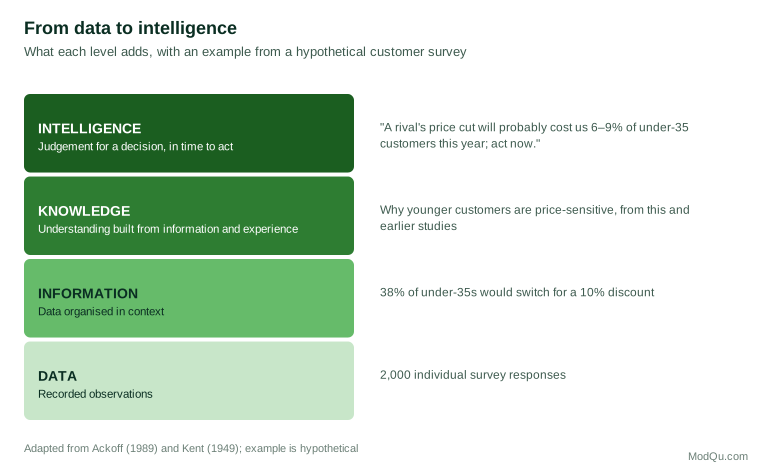
An example makes the distinctions concrete. A company runs a survey of 2,000 customers. The individual responses are data. A table showing that 38% of customers under 35 say they would switch provider for a 10% discount is information. The marketing team's understanding of why younger customers are price-sensitive, built from this survey, earlier studies and years of experience, is knowledge. A short assessment to the chief executive, stating that a competitor's planned price cut is likely to cost the firm 6 to 9% of its under-35 customers within a year unless it responds, and recommending a targeted retention offer, is intelligence.
Evidence, signals and noise
Between information and intelligence sits a step that is easy to overlook: evaluation. Not every piece of information deserves the same weight. A figure from an audited annual report, a comment overheard at a trade fair and a post on social media may all bear on the same question, but they differ greatly in reliability. Intelligence practice therefore treats incoming information as evidence to be graded, not as fact to be stored. Analysts ask who produced it, how they could know, whether they had reason to mislead, and whether independent sources agree.
The same step separates useful signals from noise. In any large flow of information, most items are irrelevant to the decision at hand, some are misleading and a few matter a great deal. The skill lies in recognising the few early enough. This is one reason why the distinction between information and intelligence is not merely academic: an organisation can be flooded with accurate information and still be surprised, because no one turned the relevant pieces into a judgement and passed it to the person who needed it.
Evaluation also works in the other direction. Knowledge shapes what counts as a signal. An analyst who understands how a market normally behaves will notice an unusual pattern of price changes that a newcomer would miss. This is another sense in which the hierarchy runs both ways: knowledge is needed to see which information is worth turning into intelligence.
Criticisms of the hierarchy
The tidy pyramid has been criticised. Frické (2009) argued that it rests on a mistaken theory of knowledge, as if wisdom could be manufactured by piling up data. Boisot and Canals (2004) noted that different disciplines define the terms inconsistently and that information is better seen as the outcome of an agent filtering data through prior knowledge and expectations. Tuomi (1999), as already noted, argued that knowledge comes first.
These critiques have a practical message. Organisations cannot become better informed simply by gathering more data. Simon (1971) warned that a wealth of information consumes the attention of those who receive it, creating a poverty of attention. Intelligence work is, in large part, the disciplined spending of attention: deciding which questions matter, which sources deserve trust and which findings must reach a decision-maker now.
Why the distinctions matter
Keeping the terms apart helps in four practical ways:
- Commissioning research. Asking for "data" invites a spreadsheet; asking for "intelligence" invites an assessment that answers a question. Being clear about which is needed saves time and money.
- Judging value. The value of data lies in its quality and coverage; the value of intelligence lies in whether it improved a decision.
- Designing systems. Dashboards and data warehouses supply information. They do not by themselves supply the analysis and judgement that turn information into intelligence.
- Protecting knowledge. Much of an organisation's knowledge is tacit and leaves when people do. Recording reasoning as well as conclusions helps it survive.
The four words describe a progression in usefulness, not a progression in volume. A single well-founded judgement delivered at the right moment can be worth more than a terabyte of unexamined data.
References
Ackoff, R. L. (1989). From data to wisdom. Journal of Applied Systems Analysis, 16, 3–9.
Boisot, M., & Canals, A. (2004). Data, information and knowledge: Have we got it right? Journal of Evolutionary Economics, 14(1), 43–67. https://doi.org/10.1007/s00191-003-0181-9
Breakspear, A. (2013). A new definition of intelligence. Intelligence and National Security, 28(5), 678–693. https://doi.org/10.1080/02684527.2012.699285
Buckland, M. K. (1991). Information as thing. Journal of the American Society for Information Science, 42(5), 351–360. https://doi.org/10.1002/(SICI)1097-4571(199106)42:5<351::AID-ASI5>3.0.CO;2-3
Choo, C. W. (1996). The knowing organization: How organizations use information to construct meaning, create knowledge and make decisions. International Journal of Information Management, 16(5), 329–340. https://doi.org/10.1016/0268-4012(96)00020-5
Davenport, T. H., & Prusak, L. (1998). Working knowledge: How organizations manage what they know. Harvard Business School Press.
Floridi, L. (2005). Is semantic information meaningful data? Philosophy and Phenomenological Research, 70(2), 351–370. https://doi.org/10.1111/j.1933-1592.2005.tb00531.x
Frické, M. (2009). The knowledge pyramid: A critique of the DIKW hierarchy. Journal of Information Science, 35(2), 131–142. https://doi.org/10.1177/0165551508094050
Kent, S. (1949). Strategic intelligence for American world policy. Princeton University Press.
Lowenthal, M. M. (2022). Intelligence: From secrets to policy (9th ed.). CQ Press.
Nonaka, I. (1994). A dynamic theory of organizational knowledge creation. Organization Science, 5(1), 14–37. https://doi.org/10.1287/orsc.5.1.14
Polanyi, M. (1966). The tacit dimension. Doubleday.
Rowley, J. (2007). The wisdom hierarchy: Representations of the DIKW hierarchy. Journal of Information Science, 33(2), 163–180. https://doi.org/10.1177/0165551506070706
Shannon, C. E. (1948). A mathematical theory of communication. Bell System Technical Journal, 27(3), 379–423. https://doi.org/10.1002/j.1538-7305.1948.tb01338.x
Simon, H. A. (1971). Designing organizations for an information-rich world. In M. Greenberger (Ed.), Computers, communications, and the public interest (pp. 37–72). Johns Hopkins Press.
Tuomi, I. (1999). Data is more than knowledge: Implications of the reversed knowledge hierarchy for knowledge management and organizational memory. Journal of Management Information Systems, 16(3), 103–117. https://doi.org/10.1080/07421222.1999.11518258
Zins, C. (2007). Conceptual approaches for defining data, information, and knowledge. Journal of the American Society for Information Science and Technology, 58(4), 479–493. https://doi.org/10.1002/asi.20508