
Intelligence · Business intelligence
Data Governance Frameworks for Trustworthy Intelligence
Intelligence built on data can be trusted only if someone is responsible for that data. This article explains what data governance is, the main frameworks for organising it, and practical steps for making it work without burying the organisation in bureaucracy.
Business intelligence depends on data that people trust. Trust, in turn, depends on someone being responsible for that data: deciding what it means, how good it must be, who may use it and how long it is kept. Data governance is the system of decision rights and accountabilities that provides that responsibility. Without it, departments define the same measures differently, quality problems go unfixed, sensitive data are exposed and reports contradict one another. This article explains what data governance involves and how to organise it.
What data governance is
Khatri and Brown (2010) define data governance as deciding who has decision rights and accountability for an organisation's decisions about its data. It is distinct from data management, which carries out those decisions day to day. Governance sets the rules; management applies them. The distinction mirrors Weill and Ross's (2004) work on information technology governance, which found that organisations designing decision rights deliberately obtained more value from their technology.
Alhassan et al. (2016), analysing the research literature, found that governance activities fall into three groups: defining policies, standards and roles; implementing them; and monitoring whether they are followed.
Five decision domains
Khatri and Brown (2010) identify five domains in which governance decisions are needed, shown in Figure 1.
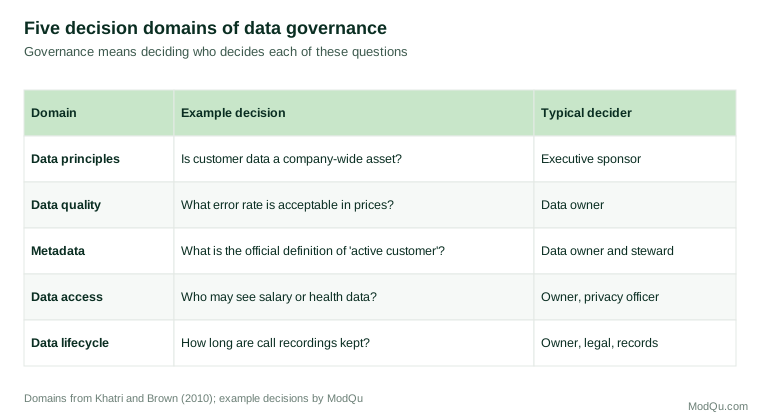
Data principles establish how data are regarded, for example as a shared corporate asset rather than the property of the department that collects them. Data quality decisions set standards for accuracy, completeness and timeliness. Metadata decisions define what data mean, so that "revenue" or "active customer" is understood the same way everywhere. Data access decisions determine who may see and use which data. Data lifecycle decisions govern how data are created, stored, archived and deleted.
Roles
Governance assigns these decisions to people. Otto (2011), studying large telecommunications companies, found common roles. An executive sponsor provides authority and resolves conflicts. A governance council of senior business and technology representatives sets policies and priorities. Data owners, usually business managers, are accountable for particular data domains, such as customer or product data. Data stewards maintain quality and definitions day to day. A central data office supports them with tools, standards and coordination.
DAMA International (2017) presents a comparable structure in its body of knowledge for data management, placing governance at the centre of all other data management functions.
No single model fits all
Weber et al. (2009) argue that governance must fit the organisation's structure, culture and strategy. A centralised company may run governance through a single council; a diversified group may let each business unit govern its own data and coordinate only shared entities. Abraham et al. (2019), reviewing the research, describe governance as a combination of structural mechanisms (roles and committees), procedural mechanisms (policies, standards and processes) and relational mechanisms (communication, training and collaboration). All three are needed; formal structures without relationships produce rules that nobody follows.
Risk, value and law
Tallon (2013) argues that governance must balance the value of data against its risks and costs. More data and wider access create opportunities for analysis, but also risks of breaches, misuse and regulatory penalties, and the costs of storing and protecting data grow with volume. Governance decides where that balance lies.
Law sets minimum standards. In Canada, the Personal Information Protection and Electronic Documents Act (2000) requires organisations to obtain consent for collecting personal information, use it only for identified purposes, keep it accurate and protect it. Similar laws exist in many countries. Governance translates such obligations into specific rules for each dataset.
Principles developed for research data offer a useful model. Wilkinson et al. (2016) proposed that data should be findable, accessible, interoperable and reusable. Applied inside an organisation, these principles mean that data should be catalogued, available to those entitled to use them, described in standard ways and documented well enough to be used by people who did not collect them.
Making governance work
Governance often fails by becoming bureaucracy: long policy documents, slow committees and forms that people avoid. Practical approaches include:
- Start with problems people feel. Begin with the data whose inconsistency causes the most visible pain, such as customer counts that differ between reports.
- Assign owners in the business. Data owners should be the managers who depend on the data, not technical staff.
- Agree definitions publicly. Publish a glossary of key terms and measures, and use it in every report.
- Build governance into tools. Mark certified datasets, enforce access rules automatically and check quality continuously.
- Measure results. Track quality measures, disputes over figures and access incidents to show whether governance is working.
- Keep it proportionate. Apply strict controls to critical and sensitive data and lighter rules elsewhere.
An example
A credit union found that its board received three different figures for the number of members each quarter, from marketing, finance and member services. Each department counted joint accounts, dormant accounts and deceased members differently. The credit union appointed the head of member services as owner of member data, agreed a single definition with the other departments and published it. A steward checked the count each month against the agreed rules. Within two quarters the board received one figure, with a note explaining how it was calculated, and discussions moved from arguing about the number to deciding what to do about it.
Conclusion
Data governance gives business intelligence its foundation of trust. It answers the question of who decides what data mean, how good they must be, who may use them and how long they are kept. The research shows that no single structure suits every organisation, but every successful approach assigns clear ownership, agrees definitions, protects sensitive data and monitors results. Done in proportion to the risks and value involved, governance makes intelligence trustworthy without making it slow.
References
Abraham, R., Schneider, J., & vom Brocke, J. (2019). Data governance: A conceptual framework, structured review, and research agenda. International Journal of Information Management, 49, 424–438. https://doi.org/10.1016/j.ijinfomgt.2019.07.008
Alhassan, I., Sammon, D., & Daly, M. (2016). Data governance activities: An analysis of the literature. Journal of Decision Systems, 25(sup1), 64–75. https://doi.org/10.1080/12460125.2016.1187397
DAMA International. (2017). DAMA-DMBOK: Data management body of knowledge (2nd ed.). Technics Publications.
Khatri, V., & Brown, C. V. (2010). Designing data governance. Communications of the ACM, 53(1), 148–152. https://doi.org/10.1145/1629175.1629210
Otto, B. (2011). Organizing data governance: Findings from the telecommunications industry and consequences for large service providers. Communications of the Association for Information Systems, 29, 45–66. https://doi.org/10.17705/1CAIS.02903
Personal Information Protection and Electronic Documents Act, S.C. 2000, c. 5 (Canada).
Tallon, P. P. (2013). Corporate governance of big data: Perspectives on value, risk, and cost. Computer, 46(6), 32–38. https://doi.org/10.1109/MC.2013.155
Weber, K., Otto, B., & Österle, H. (2009). One size does not fit all—A contingency approach to data governance. Journal of Data and Information Quality, 1(1), Article 4. https://doi.org/10.1145/1515693.1515696
Weill, P., & Ross, J. W. (2004). IT governance: How top performers manage IT decision rights for superior results. Harvard Business School Press.
Wilkinson, M. D., Dumontier, M., Aalbersberg, I. J., Appleton, G., Axton, M., Baak, A., Blomberg, N., Boiten, J.-W., da Silva Santos, L. B., Bourne, P. E., Bouwman, J., Brookes, A. J., Clark, T., Crosas, M., Dillo, I., Dumon, O., Edmunds, S., Evelo, C. T., Finkers, R., … Mons, B. (2016). The FAIR Guiding Principles for scientific data management and stewardship. Scientific Data, 3, Article 160018. https://doi.org/10.1038/sdata.2016.18