
Intelligence · Market and competitive intelligence
"Customer Intelligence: Building a Complete View of the Customer"
Customer intelligence brings together what an organisation knows about its customers so that it can serve them better and allocate effort wisely. This article explains how to build a complete customer view, the analyses it supports and the privacy limits that apply.
Most organisations know a great deal about their customers, but the knowledge is scattered. Sales records sit in one system, service calls in another, website visits in a third and survey responses in a spreadsheet. Each department sees part of the customer and none sees the whole. Customer intelligence is the work of bringing these pieces together and turning them into understanding that guides decisions: which customers to prioritise, what they need, which are likely to leave and how much each relationship is worth. This article explains how a complete customer view is built, what it makes possible and where its limits lie.
Why customer intelligence matters
Research on market orientation has long argued that understanding customers is a core capability. Kohli and Jaworski (1990) defined market orientation as the organisation-wide generation of intelligence about current and future customer needs, its dissemination across departments and the organisation's response to it. Day (1994) described "market sensing" as one of the distinctive capabilities of market-driven firms: the ability to learn about customers and competitors continuously and to act on what is learned.
Customer intelligence also changes how firms think about value. Rust et al. (2004) argued that marketing decisions should be judged by their effect on customer equity, the total discounted lifetime value of a firm's customers. Gupta et al. (2004) showed that, for several companies, a reasonable estimate of firm value could be obtained from the value of their customer base. If customers are assets, knowing which are most valuable, and why, becomes a central management question.
Building the complete view
Payne and Frow (2005) describe customer relationship management as a strategic process that includes integrating information from every point of contact with the customer. The practical steps are easier to describe than to carry out.
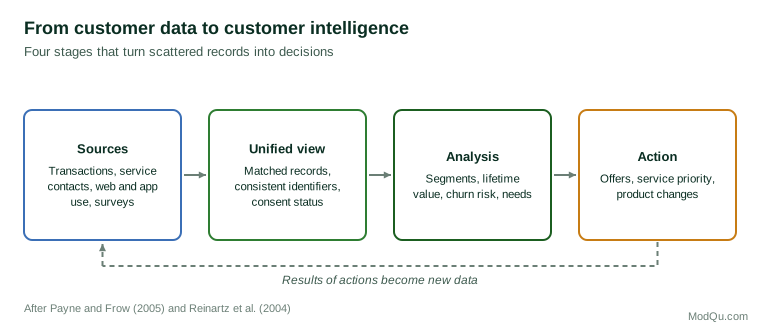
Collect. Identify every source that holds customer information: orders, invoices, service tickets, call notes, website and app behaviour, loyalty programmes and survey responses.
Match. Link records that refer to the same customer. This is often the hardest step, because names, addresses and email addresses are recorded inconsistently. A shared customer identifier, assigned at first contact and used everywhere, saves much later effort.
Enrich. Add context: the customer's industry and size for business customers, or stated preferences and survey answers for consumers. Survey data are particularly valuable because they capture attitudes and intentions that transactions cannot reveal.
Govern. Record where each piece of data came from, when it was last updated and what the customer has consented to.
Reinartz et al. (2004) found that firms whose customer management processes covered the whole relationship, from acquisition through maintenance to ending unprofitable relationships, performed better, and that technology alone did not produce the benefit.
What a complete view makes possible
Segmentation
Grouping customers by needs, behaviour or value allows tailored offers and service. Segments based on observed behaviour and stated needs together are usually more useful than those based on demographics alone.
Customer lifetime value
Lifetime value estimates the future profit a customer will generate. Schmittlein et al. (1987) developed a model for estimating, from purchase histories alone, which customers are still active and how many purchases they are likely to make. Fader et al. (2005) showed that three simple measures, recency, frequency and monetary value (RFM), can be linked to lifetime value through a formal model, giving firms a practical way to rank customers.
Churn prediction
Predicting which customers are likely to leave allows the firm to intervene. Neslin et al. (2006) compared many churn models submitted to a tournament and found that the choice of method made a substantial difference to predictive accuracy and to the profit from retention campaigns.
Sales and service priority
Kumar et al. (2008) showed that a sales campaign focused on customers with high predicted value, rather than on past revenue, produced higher profits. A complete view lets sales and service staff see each customer's history and value before they make contact.
Privacy and trust
Customer intelligence depends on customers' willingness to share information, and that willingness depends on trust. Acquisti et al. (2015) review evidence that people's privacy preferences are uncertain, depend on context and can be shaped by how choices are presented, which gives firms both power and responsibility. Martin et al. (2017) found that data breaches and perceived misuse of customer data harm firm performance, and that giving customers transparency and control can reduce the damage.
In Canada, the Personal Information Protection and Electronic Documents Act requires meaningful consent for the collection and use of personal information, and similar laws apply elsewhere. Good practice is to collect only what is needed, explain clearly how it will be used, keep it secure and let customers see and correct what is held about them.
Common pitfalls
Customer intelligence projects often stall for predictable reasons. The first is treating the work as a technology purchase: a new system without agreed definitions, data ownership and processes produces a new place to store inconsistent data. The second is building the view and then not using it: if frontline staff cannot see the information when they talk to customers, the investment is wasted. The third is ignoring what customers say. Behavioural data show what customers did, not why, and only asking them reveals needs that are not yet reflected in purchases.
Measuring whether it works
A customer intelligence programme should be judged by the decisions it changes and their results, not by the volume of data collected. Useful measures include retention and repeat-purchase rates for the segments targeted, the accuracy of churn and value predictions when checked against what customers actually did, the share of frontline contacts in which staff had the full customer history available, and the profit from campaigns guided by the analysis compared with those that were not. Rust et al. (2004) argue that linking marketing actions to changes in customer equity allows firms to compare very different investments, such as service improvements and advertising, on the same basis. Holding back a small comparison group when a new campaign or service change is introduced is the simplest way to show its effect. Without such evidence, a customer view easily becomes an expensive database that no one trusts.
An illustration
An insurance broker finds that its renewal rate is falling. Its customer records sit in separate systems for policies, claims and calls. After matching them, analysts discover that customers who made a claim and then called the service line more than twice were three times as likely to leave at renewal. A short survey of recent leavers confirms that slow claim handling was the main reason. The broker introduces a priority queue for customers with open claims and tracks renewal rates for that group, which become the measure of whether the change worked.
Conclusion
Customer intelligence turns scattered records into a single view of each customer and uses that view to segment, value, retain and serve customers better. Its value depends less on technology than on careful matching of records, combining behavioural and survey data, putting the results in front of the people who deal with customers and handling personal information in ways that keep customers' trust.
References
Acquisti, A., Brandimarte, L., & Loewenstein, G. (2015). Privacy and human behavior in the age of information. Science, 347(6221), 509–514. https://doi.org/10.1126/science.aaa1465
Day, G. S. (1994). The capabilities of market-driven organizations. Journal of Marketing, 58(4), 37–52. https://doi.org/10.1177/002224299405800404
Fader, P. S., Hardie, B. G. S., & Lee, K. L. (2005). RFM and CLV: Using iso-value curves for customer base analysis. Journal of Marketing Research, 42(4), 415–430. https://doi.org/10.1509/jmkr.2005.42.4.415
Gupta, S., Lehmann, D. R., & Stuart, J. A. (2004). Valuing customers. Journal of Marketing Research, 41(1), 7–18. https://doi.org/10.1509/jmkr.41.1.7.25084
Kohli, A. K., & Jaworski, B. J. (1990). Market orientation: The construct, research propositions, and managerial implications. Journal of Marketing, 54(2), 1–18. https://doi.org/10.1177/002224299005400201
Kumar, V., Venkatesan, R., & Reinartz, W. (2008). Performance implications of adopting a customer-focused sales campaign. Journal of Marketing, 72(5), 50–68. https://doi.org/10.1509/jmkg.72.5.050
Martin, K. D., Borah, A., & Palmatier, R. W. (2017). Data privacy: Effects on customer and firm performance. Journal of Marketing, 81(1), 36–58. https://doi.org/10.1509/jm.15.0497
Neslin, S. A., Gupta, S., Kamakura, W., Lu, J., & Mason, C. H. (2006). Defection detection: Measuring and understanding the predictive accuracy of customer churn models. Journal of Marketing Research, 43(2), 204–211. https://doi.org/10.1509/jmkr.43.2.204
Payne, A., & Frow, P. (2005). A strategic framework for customer relationship management. Journal of Marketing, 69(4), 167–176. https://doi.org/10.1509/jmkg.2005.69.4.167
Reinartz, W., Krafft, M., & Hoyer, W. D. (2004). The customer relationship management process: Its measurement and impact on performance. Journal of Marketing Research, 41(3), 293–305. https://doi.org/10.1509/jmkr.41.3.293.35991
Rust, R. T., Lemon, K. N., & Zeithaml, V. A. (2004). Return on marketing: Using customer equity to focus marketing strategy. Journal of Marketing, 68(1), 109–127. https://doi.org/10.1509/jmkg.68.1.109.24030
Schmittlein, D. C., Morrison, D. G., & Colombo, R. (1987). Counting your customers: Who are they and what will they do next? Management Science, 33(1), 1–24. https://doi.org/10.1287/mnsc.33.1.1