
Intelligence · Concepts and history
Criticisms of the Intelligence Cycle and Alternative Models
The intelligence cycle is taught everywhere, yet many practitioners and scholars say it misdescribes how intelligence really works. This article sets out the main criticisms and the leading alternatives, from target-centric analysis to sensemaking loops, and what each means for practice.
The intelligence cycle, a circle running from direction to collection, processing, analysis and dissemination and back again, is the most widely taught model of intelligence work. It appears in military doctrine, government training courses and corporate competitive intelligence manuals. Yet it has been criticised for decades by the people who know intelligence best. Former officers, academic specialists and organisational researchers have argued that the cycle describes an idealised bureaucratic process rather than the way intelligence is actually produced and used, and that its persistence encourages the wrong habits. This article summarises the main criticisms, describes the alternative models that have been proposed, and considers what the debate means for anyone running an intelligence function today.
A model with a long life
The cycle's roots lie in military staff practice of the 1940s. An early published version appeared in a short American Army text for commanders (Glass & Davidson, 1948), and Kent (1949) described a comparable sequence of research steps for strategic intelligence. In the decades that followed, the cycle became the standard teaching device. Lowenthal (2022) presents it as the conventional starting point for understanding the intelligence process, while warning readers that reality is more complicated. Phythian (2013) brought together a collection of essays that examine the cycle from many angles; most contributors find serious faults with it, but few argue that it should be discarded entirely.
The model has obvious attractions. It is simple, it names the main functions, and it reminds collectors that their work is useful only if it reaches analysts and users. Its critics do not dispute that these functions exist. Their objection is that the cycle's shape, a neat sequence of stages driven from the top, misrepresents how the functions relate to each other and to the people who use intelligence.
The main criticisms
1. Decision-makers rarely provide direction
The cycle begins with users stating what they need to know. Hulnick (2006), a former Central Intelligence Agency officer who later taught intelligence studies, argued that this almost never happens in the orderly way the diagram suggests. Senior policymakers are busy, often unsure what they need until events force a question on them, and reluctant to reveal their thinking to intelligence agencies. In practice, Hulnick observed, intelligence managers infer requirements from policy statements, past interest and their own judgement, and collection systems run largely on established priorities and the capabilities they happen to have.
Davis (2006), who spent a career studying the analyst–policymaker relationship, agrees that the relationship is closer to a negotiation than to a chain of command. Users may want support for decisions already made; analysts may want to warn of problems users would prefer not to hear about. A model that shows direction flowing smoothly from user to producer hides these tensions.
2. Collection and analysis run in parallel
The cycle shows collection preceding analysis. Hulnick (2006) pointed out that in large intelligence systems the two proceed simultaneously and largely independently. Collectors gather material according to standing priorities whether or not analysts have asked for it, and analysts work with whatever arrives. Where the two do interact, the relationship runs both ways: analysts identify gaps and request specific collection, and new collection prompts new analytic questions.
Johnston (2005), an anthropologist who conducted an ethnographic study of analytic work inside the American intelligence community, found the process to be highly iterative. Analysts moved back and forth between searching for information, reading, forming hypotheses and writing, and the boundaries between stages were blurred. Johnston also found that many analysts spent much of their time on current reporting and had little opportunity for the deeper research that the cycle's analytic stage implies.
3. The cycle hides the cognitive work of analysis
By reducing analysis to one box, the cycle says little about how analysts think. Pirolli and Card (2005), drawing on cognitive task analysis of intelligence analysts, described two nested loops. In the foraging loop, analysts search for information, filter it and extract what seems relevant. In the sensemaking loop, they build schemas and hypotheses, look for evidence that supports or contradicts them, and finally present a case. Both loops involve constant movement upward (from data to theory) and downward (from theory back to data). Heuer (1999) had earlier shown that the biases which most often derail analysis, such as seeing what one expects to see, operate inside this hidden box.
Weick (1995) and Klein et al. (2006) describe sensemaking as an active process of fitting data into frames and adjusting frames to fit the data. On this view analysis is not a stage between processing and dissemination but a continuous activity that shapes what is collected, how it is processed and what is eventually reported.
4. Users are treated as passive customers
In the cycle, finished intelligence flows out to users, who then provide feedback. Kerbel and Olcott (2010) argue that this "producer–consumer" model, borrowed from manufacturing, leads analysts to think of their job as delivering products rather than helping decision-makers understand problems. They propose a model of synthesis with clients, in which analysts and users work together continuously, sharing partial understanding and refining questions as they go. Treverton (2003) similarly argues that in an age of abundant information the most valuable service intelligence can offer is often not a finished report but a continuing conversation that helps users frame mysteries and weigh uncertain judgements.
5. The model overstates the role of secrets
The cycle was designed for an era in which the most valuable information was secret and hard to obtain. Treverton (2003) describes the shift from a world of scarce information to one of abundance, in which open sources often contain much of what decision-makers need and the bottleneck lies in analysis and attention rather than collection. A model built around collection disciplines can encourage organisations to invest in gathering more material when the real need is to make better sense of what is already available.
6. It is a poor guide to failure and reform
Because the cycle shows every stage as equally important and every failure as a broken link, it can mislead reform efforts. Betts (2007) argues that many intelligence failures arise from the inherent difficulty of predicting adversaries' decisions and from the political relationship between intelligence and policy, neither of which is visible in the diagram. Reforms aimed at tightening the links in the chain may leave these deeper causes untouched.
Defences of the cycle
Not all scholars are ready to abandon the model. Davies et al. (2013), writing from British experience, argue that the cycle is best read as a list of functions that any intelligence system must perform, not as a flowchart of the order in which they happen. Seen this way, criticisms that the stages overlap or run in parallel miss the point. They also note that British doctrine has long used a simpler four-stage version in which analysis is part of processing, which avoids some of the American model's rigidity.
Evans (2009), examining military intelligence failures, argues that the cycle remains a useful diagnostic tool. When an operation goes wrong, asking which function failed, whether direction was unclear, collection inadequate, processing delayed, analysis flawed or dissemination too slow, helps investigators locate the problem. Abandoning the cycle altogether, Evans suggests, would remove a common language for discussing such failures. Gill and Phythian (2018) take a middle path: they keep the cycle's functions but redraw them as a web of interactions shaped by the wider political and organisational environment.
Alternative models
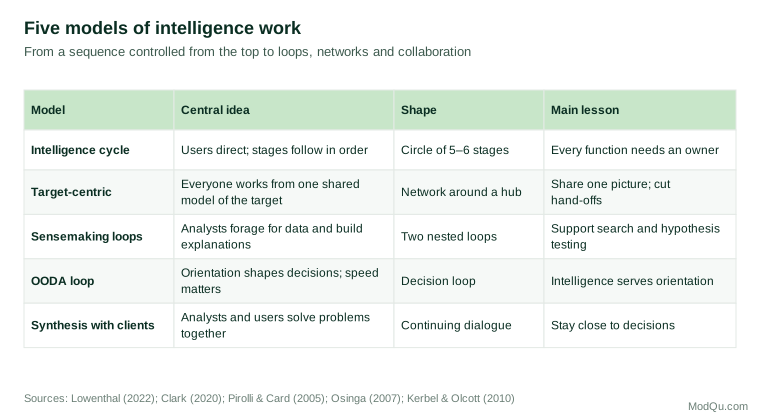
Several alternatives have been proposed. They differ in emphasis but share a move away from linear sequence towards networks, loops and shared understanding.
The target-centric model
The most fully developed alternative is Clark's target-centric approach. Clark (2020) argues that intelligence should be organised around a shared model of the target, whether a hostile state, a terrorist network, a competitor or a supply chain. Collectors, analysts and users all contribute to the model and draw from it. Collectors see where the model has gaps and direct their efforts accordingly; analysts update it as new information arrives; users consult it directly and add their own questions. The process is a network rather than a circle, and the target model is the hub.
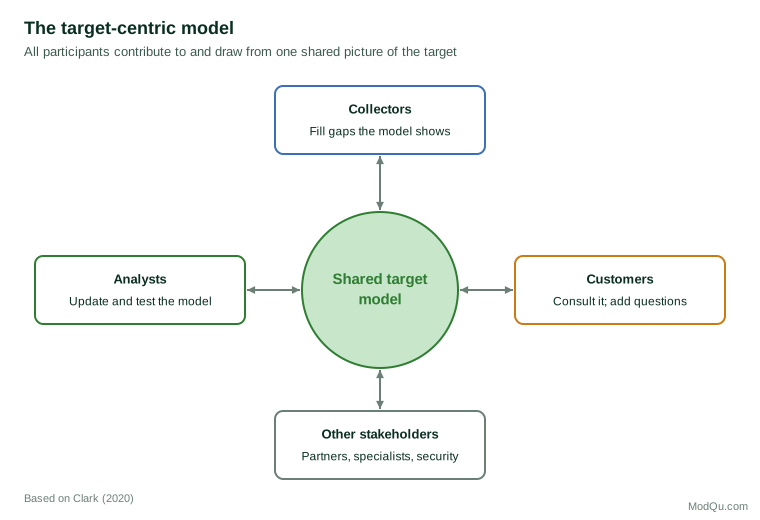
The advantages are speed and shared understanding. Because everyone works from the same model, there is less delay between collection and analysis and less risk that users receive a picture different from the one analysts hold. The challenges are practical: building and maintaining shared models requires tools, trust and access controls that many organisations lack.
Sensemaking loops
Pirolli and Card's (2005) foraging and sensemaking loops have been influential in the design of analytic software and in analyst training. They suggest that support for analysts should focus on the points where loops tend to stall: the cost of searching, the limits of working memory when holding many pieces of evidence, and the difficulty of generating and testing alternative hypotheses. The model is less a replacement for the cycle than a magnified view of its analytic stage.
Decision cycles: OODA and situation awareness
Military theorists have offered models that place intelligence inside the decision process itself. The best known is John Boyd's observe–orient–decide–act (OODA) loop, which Osinga (2007) shows was intended as a theory of how organisations adapt in competitive environments, not merely as a model of fast decisions. In Boyd's framing, the decisive step is orientation, in which information is interpreted through culture, experience and prior analysis. Intelligence contributes most by improving orientation, and an organisation that orients faster and more accurately than its adversary gains an advantage.
Endsley (1995) describes situation awareness in three levels: perceiving elements of the environment, comprehending their meaning, and projecting their future state. Endsley's model, developed for pilots and operators of complex systems, maps neatly onto intelligence: collection supports perception, analysis supports comprehension, and estimates support projection.
Synthesis with clients
Kerbel and Olcott (2010) propose replacing the producer–consumer relationship with continuing collaboration. Analysts would spend more time with decision-makers, sharing provisional judgements and working through problems together. Agrell and Treverton (2015) see a parallel in the way science increasingly involves users in framing research questions. The risk, which Kent (1949) feared, is that analysts become too close to policy and lose their independence; supporters argue that independence lies in the integrity of judgement, not in physical distance.
Revised cycles
Some authors keep the cycle's shape but change its content. Omand (2010), a former British intelligence coordinator, proposes a revised model for modern intelligence in which the core functions are connected as a network rather than a ring, so that collection, analysis and dissemination can interact directly. Gill and Phythian (2018) place the functions within a wider "web" that includes oversight, the political environment and the target's own countermeasures.
A business illustration
Consider a mid-sized software company that wants to understand a fast-growing rival. Organised around the classic cycle, the work might run like this: the strategy director lists questions once a year; a researcher gathers news, filings and analyst reports; an analyst writes a quarterly competitor profile; the profile is emailed to senior managers; and almost no one replies. Months can pass between a new development and the moment anyone who decides on pricing or product plans hears about it.
Organised around a target-centric model, the same company would keep a single living profile of the rival, perhaps a shared document or an internal wiki page. Sales staff add what they hear from customers who are comparing the two products; product managers note new features as they appear; the analyst maintains the structure, tests claims against evidence and flags judgements with stated confidence; and senior managers read the profile when a decision approaches, adding questions directly. Collection gaps are visible to everyone, because the profile shows what is not known. The analyst's job shifts from producing reports to curating shared understanding and alerting decision-makers when something important changes.
Neither arrangement is free of problems. The living profile can become cluttered, unverified claims can slip in, and sensitive information may need tighter control than an open document allows. But the illustration shows why many practitioners find the alternatives closer to how useful intelligence actually emerges inside organisations: through many contributors, continuous updating and frequent contact with the people who decide.
Measuring what the models imply
Each model also suggests different measures of success. Under the cycle, natural measures are outputs: reports produced, requirements answered, sources tasked. Under the target-centric and collaborative models, the natural measures are outcomes: whether decision-makers had an accurate picture when they needed it, how quickly significant changes were noticed, and whether judgements later proved correct. Output measures are easier to count but can reward activity for its own sake. Outcome measures are harder to collect but closer to the purpose of intelligence. An organisation that changes its model without changing its measures is likely to drift back to the old habits.
Why the debate matters
The argument about models might seem academic. It is not, because models shape organisations. If intelligence work is imagined as a cycle, it is natural to create separate units for collection, processing, analysis and dissemination, measure each by its own outputs and pass work between them. If it is imagined as a network around a target, it is natural to create cross-functional teams and measure them by the quality of shared understanding. Marrin (2012) argues that intelligence practice has too often relied on inherited doctrine rather than evidence about what works, and the persistence of the cycle is a case in point.
The debate also affects how intelligence relates to its users. Fingar (2011), describing American analytic reforms after 2005, emphasises that the most useful analytic support came when analysts understood the decisions their users faced and could tailor judgements to them. This is easier when the model of the process puts the user in continuous contact with analysts rather than at the end of a chain.
Herman (1996) reminds us that intelligence is a service, and that the value of any model lies in how well it helps that service meet users' needs. Warner (2002) observes that confusion about what intelligence is makes it harder to agree on how it should be done; a clearer understanding of the process is part of a clearer understanding of the profession.
Lessons for practice
For a business or public body building an intelligence function, the critics and defenders together suggest a practical synthesis:
- Use the cycle as a checklist, not a flowchart. Make sure every function, direction, collection, processing, analysis, dissemination and feedback, has an owner, but do not expect them to happen in strict order.
- Put a shared picture at the centre. Whether called a target model, a competitor profile or a market map, a single living document that everyone updates reduces duplication and inconsistency.
- Keep analysts close to users. Regular conversations about upcoming decisions are more valuable than formal requirements documents that are written once and forgotten.
- Support the analytic loops. Give analysts time and tools to search, organise evidence and test alternative explanations, and do not let current reporting crowd out deeper work.
- Treat orientation as the goal. The aim is not to produce reports but to help decision-makers see the situation more accurately than they otherwise would.
- Learn from failures with more than one model. When something goes wrong, ask which function failed, but also ask whether the relationship with users, the framing of the problem or the shared picture was at fault.
Conclusion
The intelligence cycle has survived more than seventy years of criticism because it captures something real: intelligence requires tasking, gathering, interpretation and delivery. Its critics have shown that the neat circle hides the messy, iterative, collaborative reality of intelligence work and can encourage organisations to over-invest in collection, isolate analysts and treat users as passive recipients. The alternatives, target-centric networks, sensemaking loops, decision cycles and continuing collaboration with clients, each correct part of that picture. The best practice borrows from all of them, keeping the cycle's list of functions while organising the work around shared understanding and the decisions it is meant to serve.
References
Agrell, W., & Treverton, G. F. (2015). National intelligence and science: Beyond the great divide in analysis and policy. Oxford University Press.
Betts, R. K. (2007). Enemies of intelligence: Knowledge and power in American national security. Columbia University Press.
Clark, R. M. (2020). Intelligence analysis: A target-centric approach (6th ed.). CQ Press.
Davies, P. H. J., Gustafson, K., & Rigden, I. (2013). The intelligence cycle is dead, long live the intelligence cycle: Rethinking intelligence fundamentals for a new intelligence doctrine. In M. Phythian (Ed.), Understanding the intelligence cycle (pp. 56–75). Routledge.
Davis, J. (2006). Intelligence analysts and policymakers: Benefits and dangers of tensions in the relationship. Intelligence and National Security, 21(6), 999–1021. https://doi.org/10.1080/02684520601046325
Endsley, M. R. (1995). Toward a theory of situation awareness in dynamic systems. Human Factors, 37(1), 32–64. https://doi.org/10.1518/001872095779049543
Evans, G. (2009). Rethinking military intelligence failure: Putting the wheels back on the intelligence cycle. Defence Studies, 9(1), 22–46. https://doi.org/10.1080/14702430802621903
Fingar, T. (2011). Reducing uncertainty: Intelligence analysis and national security. Stanford University Press.
Gill, P., & Phythian, M. (2018). Intelligence in an insecure world (3rd ed.). Polity Press.
Glass, R. R., & Davidson, P. B. (1948). Intelligence is for commanders. Military Service Publishing.
Herman, M. (1996). Intelligence power in peace and war. Cambridge University Press.
Heuer, R. J., Jr. (1999). Psychology of intelligence analysis. Center for the Study of Intelligence, Central Intelligence Agency.
Hulnick, A. S. (2006). What's wrong with the intelligence cycle. Intelligence and National Security, 21(6), 959–979. https://doi.org/10.1080/02684520601046291
Johnston, R. (2005). Analytic culture in the US intelligence community: An ethnographic study. Center for the Study of Intelligence, Central Intelligence Agency.
Kent, S. (1949). Strategic intelligence for American world policy. Princeton University Press.
Kerbel, J., & Olcott, A. (2010). Synthesizing with clients, not analyzing for customers. Studies in Intelligence, 54(4), 11–27.
Klein, G., Moon, B., & Hoffman, R. R. (2006). Making sense of sensemaking 1: Alternative perspectives. IEEE Intelligent Systems, 21(4), 70–73. https://doi.org/10.1109/MIS.2006.75
Lowenthal, M. M. (2022). Intelligence: From secrets to policy (9th ed.). CQ Press.
Marrin, S. (2012). Improving intelligence analysis: Bridging the gap between scholarship and practice. Routledge.
Omand, D. (2010). Securing the state. Hurst.
Osinga, F. P. B. (2007). Science, strategy and war: The strategic theory of John Boyd. Routledge.
Phythian, M. (Ed.). (2013). Understanding the intelligence cycle. Routledge. https://doi.org/10.4324/9780203558478
Pirolli, P., & Card, S. (2005). The sensemaking process and leverage points for analyst technology as identified through cognitive task analysis. In Proceedings of the 2005 International Conference on Intelligence Analysis (pp. 2–4). MITRE.
Treverton, G. F. (2003). Reshaping national intelligence for an age of information. Cambridge University Press.
Warner, M. (2002). Wanted: A definition of "intelligence." Studies in Intelligence, 46(3), 15–22.
Weick, K. E. (1995). Sensemaking in organizations. Sage.