
Intelligence · Organisational intelligence
Cognitive Diversity in Analytic Teams for Broader Knowledge Perspectives
Teams whose members think in different ways can see more possibilities and catch more errors than teams of like-minded people, but only if the differences are used well. This article explains what cognitive diversity is, what research shows about its effects, why intelligence analysis is especially vulnerable to uniform thinking, and how to build and manage diverse analytic teams.
Intelligence failures are often failures of imagination. Analysts did not consider that an adversary might act in an unexpected way, that a competitor might abandon its traditional strategy, or that a trusted source might be wrong. Looking back, the warning signs were often visible, but nobody in the room thought to interpret them differently. One reason is that the people in the room tended to think alike.
Cognitive diversity refers to differences in how people think: the perspectives, knowledge, mental models and problem-solving approaches they bring to a task. This article explains what research shows about cognitive diversity in teams, why intelligence analysis is especially vulnerable to uniform thinking, and how organisations can build and manage analytic teams that see problems from more than one angle.
What cognitive diversity is
Diversity in teams can mean many things. Harrison and Klein (2007) distinguish three kinds. Separation refers to differences in opinions, values or attitudes along a single dimension. Variety refers to differences in kinds of knowledge or experience, such as different professional backgrounds. Disparity refers to differences in status, power or pay. These have different effects. Variety in knowledge and perspective tends to help problem solving; disparity in power tends to suppress it, because lower-status members defer to higher-status ones.
Cognitive diversity is mainly about variety. Page (2007) identifies several components: different perspectives, or ways of representing a problem; different interpretations, or ways of categorising information; different heuristics, or rules for finding solutions; and different predictive models, or beliefs about cause and effect. A team whose members represent and approach a problem in different ways can explore more possible solutions than a team whose members all think alike.
Demographic diversity, such as differences in gender, ethnicity, nationality or age, is related but not identical. Different backgrounds often bring different experiences and perspectives, but not always; and people with similar backgrounds can think very differently. Both kinds matter, and research on each sheds light on the other.
What research shows
Diversity can beat ability. Hong and Page (2004), using a mathematical model of problem solving, showed that under certain conditions a group of diverse problem solvers can outperform a group of the individually best problem solvers, because the best solvers tend to think alike and get stuck in the same places. The result depends on its assumptions: the problem must be difficult, and the diverse solvers must each be reasonably capable. But it illustrates a general point: what matters for a team is not only how good each member is, but how different their approaches are.
Crowds can be wise if they are diverse and independent. Surowiecki (2004) argued that groups can produce better judgements than individual experts when their members hold diverse information, judge independently and have their views aggregated sensibly. When members influence each other too much, errors become correlated and the advantage disappears.
Collective intelligence depends on interaction. Woolley et al. (2010) found evidence of a general "collective intelligence" factor that predicted how well groups performed across many tasks. It was not strongly related to the average or maximum intelligence of members. It was related to how evenly members took turns in conversation, to members' social sensitivity and to the proportion of women in the group, which the authors linked to social sensitivity.
Diverse groups process information more carefully. Sommers (2006), studying mock juries, found that racially diverse juries deliberated longer, discussed more case facts and made fewer factual errors than all-white juries. The improvement came partly from the white jurors themselves, who were more thorough in a diverse group. Phillips et al. (2009) found that groups that included a socially different newcomer performed better on a problem-solving task than groups whose newcomer was similar, even though members of the diverse groups felt less confident and found the interaction less comfortable.
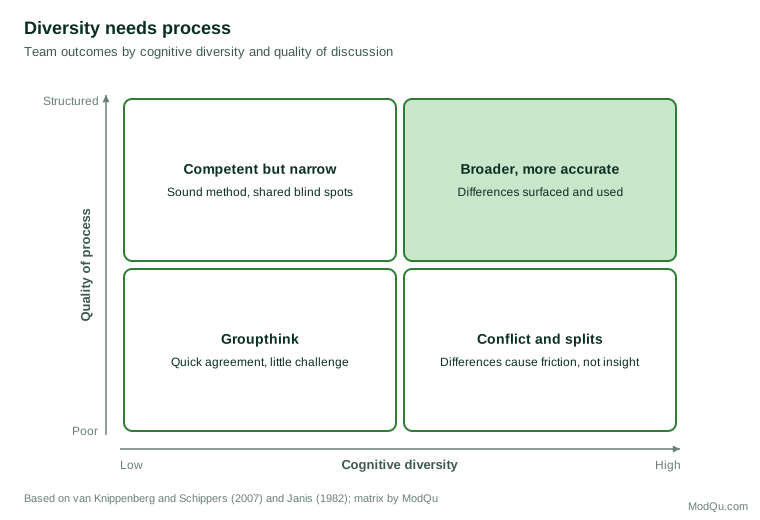
The overall evidence is mixed. Reviews of research on workplace diversity show that its effects are not automatically positive. Williams and O'Reilly (1998), reviewing forty years of research, found that diversity could improve creativity and decision quality but could also reduce cohesion and increase conflict. Van Knippenberg and Schippers (2007) concluded that diversity helps when teams elaborate on their different information and perspectives, and harms when it leads to divisions into subgroups. Horwitz and Horwitz (2007), in a meta-analysis, found that diversity in task-related attributes such as functional background and education was positively related to team performance, while demographic diversity on its own showed little direct effect. Stahl et al. (2010), studying cultural diversity, found that it increased creativity but reduced social integration.
Conflict about tasks differs from conflict about relationships. Jehn et al. (1999) found that informational diversity tended to increase task conflict, which could improve performance, while differences in values tended to increase relationship conflict, which harmed it. The lesson is that disagreement about the work can be productive, but personal friction is not.
Why intelligence analysis is vulnerable
Intelligence analysis is especially exposed to uniform thinking for several reasons.
Recruitment from similar backgrounds. McPherson et al. (2001) showed that people tend to form ties with others similar to themselves, a pattern called homophily. Organisations that recruit through existing networks tend to hire people like those already there. Syed (2019) argues that homogeneous teams develop shared blind spots, using the example of a national intelligence agency whose workforce lacked the cultural and religious knowledge needed to understand a new kind of threat.
Shared mental models. Heuer (1999) emphasised that analysts interpret information through mental models built from experience. These models are useful but can blind analysts to evidence that does not fit. When everyone on a team shares the same model, nobody is positioned to notice its limits.
Groupthink. Janis (1982) described groupthink: a mode of thinking in cohesive groups in which the desire for agreement overrides realistic appraisal of alternatives. Its symptoms include an illusion of unanimity, self-censorship and pressure on dissenters. Intelligence teams, which often work under pressure and value cohesion, are vulnerable.
Unshared information stays hidden. Stasser and Titus (1985) found that group discussions focus on information that all members already share, while information held by only one member is often never mentioned, even when it is decisive. A team's diverse knowledge is useless if it is not brought into the discussion.
Expertise breeds confidence. Tetlock (2005), in a long study of expert political forecasts, found that experts who viewed the world through a single big idea forecast worse than those who drew on many ideas and were willing to adjust. A team dominated by one school of thought shares that weakness.
Jervis (2010), examining intelligence failures concerning the Iranian revolution and Iraq's weapons programmes, found that analysts' shared assumptions were rarely questioned, and that alternative explanations of the evidence received little attention.
Making diversity work
Research suggests that diversity improves analysis only when teams surface and use their differences. Several practices help.
Recruit for different thinking. Look beyond the usual backgrounds: hire people from different disciplines, industries, countries and life experiences. In a business intelligence team, this might mean combining economists with engineers, former sales staff, data scientists and people who know key markets from the inside.
Mix teams deliberately. When forming a team for an important assessment, include people with different expertise and viewpoints, not only those who know the subject best.
Collect views independently first. Ask each member to write down their own judgement before discussion. This reduces the influence of whoever speaks first or holds the most senior position, and preserves the independence that makes diverse views valuable. Sunstein and Hastie (2015) recommend this approach, together with leaders who speak last and explicit requests for information that members hold alone.
Bring out unshared information. Give each member time to present what they know that others may not. Ask explicitly: "What do you know that the rest of us might not?"
Encourage authentic dissent. Nemeth et al. (2001) found that authentic dissent, from someone who genuinely holds a different view, stimulated more and better thinking than a devil's advocate assigned to argue a position. Teams should welcome real disagreement, not just staged opposition.
Use structured techniques. Techniques such as analysis of competing hypotheses, key assumptions checks and red teaming make alternative views part of the process. The Development, Concepts and Doctrine Centre (2021) describes red teaming as a way of challenging plans and assessments by deliberately adopting other perspectives, including those of adversaries.
Build psychological safety. Edmondson (1999) showed that team members speak up when they feel safe from embarrassment or punishment. Leaders can foster this by inviting challenge, thanking those who disagree and admitting their own uncertainty.
Manage conflict. Keep disagreement focused on evidence and reasoning, not on people. Agree in advance how disagreements will be recorded, for example by noting dissenting views in the final product.
Reduce status differences in discussion. Disparity in power suppresses contributions. Leaders who speak last, rotating facilitators and anonymous input can help.
The role of the team leader
The team leader has more influence than anyone else on whether diversity helps or harms. Janis (1982) found that groupthink was more likely when leaders stated their preferred conclusion early, when groups were insulated from outside views and when there were no procedures for considering alternatives. Leaders can reverse each of these conditions.
First, leaders can withhold their own view until others have spoken. Second, they can invite outsiders into important discussions. Third, they can build alternatives into the process, for example by asking at every major assessment what the strongest case for a different conclusion would be. Fourth, they can make clear that changing one's mind in response to evidence is a strength, not a weakness. Tetlock (2005) found that the forecasters who performed best were those willing to revise their views; leaders who model this behaviour make it easier for team members to do the same.
Leaders also shape who is heard. In many teams, a few people do most of the talking. Woolley et al. (2010) found that groups in which conversation was dominated by a few members performed worse across a range of tasks. Simple practices, such as going round the table, inviting written contributions and asking quieter members directly for their view, spread participation more evenly.
Questions to ask when forming an analytic team
When assembling a team for an important piece of work, leaders can ask:
- Which disciplines and kinds of experience are relevant to this question?
- Who on the team has seen this kind of situation from the inside, such as a customer, supplier, regulator or competitor would?
- Whose views are likely to differ from the majority, and how will we make sure they are heard?
- How will we collect independent judgements before discussion?
- Who will challenge our key assumptions, and when?
- How will disagreements be recorded in the final product?
Diversity in distributed teams
Many analytic teams now work across offices, countries and time zones. Distributed teams can draw on a wider range of local knowledge and cultural perspectives, which is a real advantage for intelligence work about international markets or threats. But distance also makes it easier for subgroups to form and for remote members to be left out of informal discussion. Stahl et al. (2010) found that the process losses associated with cultural diversity were larger in some settings than others, and that good team processes reduced them. For distributed analytic teams, this means writing down key judgements and assumptions so that everyone can see and challenge them, rotating meeting times so that the same members are not always inconvenienced, and making sure that local knowledge from every location is actively sought, not only the views of the headquarters team.
Diversity beyond the team
An analytic team can also draw on diversity beyond its own members. Consulting outside experts with different views, inviting colleagues from other departments to review assessments, and using forecasting exercises that pool many independent judgements all bring in perspectives the team lacks. Surowiecki (2004) and Tetlock (2005) both suggest that aggregating diverse independent judgements tends to improve accuracy. Even a short review by someone who knows the subject from a different angle, such as a customer, supplier or engineer, can reveal assumptions the team has not noticed.
Common mistakes
- Assuming that diversity works automatically. Without good process, diversity can produce conflict and subgroups rather than better analysis.
- Seeking diversity in appearance only. Demographic diversity matters, but teams also need differences in knowledge and thinking, and members must feel able to express them.
- Asking for comments after the conclusion is set. Late challenges rarely change a conclusion that has already been agreed.
- Relying on a token dissenter. One different voice in a group of like-minded people is easily ignored.
- Mistaking comfort for performance. Diverse teams may feel less comfortable while producing better work; a harmonious team may be a team that never disagrees.
A business illustration
A pharmaceutical company's intelligence team, made up mostly of former research scientists, assesses whether a rival drug in development is likely to succeed. Its first assessment, based on clinical trial data, judges success likely. Before finalising, the team leader invites three colleagues to join a review: a market access specialist, a former regulator and a sales manager with long experience in the relevant therapeutic area. Each writes an independent judgement before discussion.
The market access specialist points out that even if the drug works, insurers may not pay for it at the expected price because cheaper alternatives exist. The former regulator notes that the regulator has recently asked for additional safety data on similar drugs. The sales manager reports that prescribing doctors are sceptical. None of these points concerns the science, which is where the original team's expertise lies. The revised assessment judges that the drug will probably be approved but is unlikely to achieve the commercial success the rival expects. The team adds the three reviewers to its regular panel for major assessments.
Conclusion
Cognitive diversity gives analytic teams a wider range of perspectives, interpretations and approaches, which can help them see possibilities and errors that a uniform team would miss. Research shows, however, that diversity improves performance only when teams bring out and use their differences, through independent judgement, sharing of unique information, authentic dissent, structured techniques and psychological safety. Intelligence organisations that recruit for different ways of thinking, mix teams deliberately and manage their discussions well are better placed to avoid the failures of imagination that have marked so many intelligence surprises.
References
Development, Concepts and Doctrine Centre. (2021). Red teaming handbook (3rd ed.). UK Ministry of Defence.
Edmondson, A. (1999). Psychological safety and learning behavior in work teams. Administrative Science Quarterly, 44(2), 350–383. https://doi.org/10.2307/2666999
Harrison, D. A., & Klein, K. J. (2007). What's the difference? Diversity constructs as separation, variety, or disparity in organizations. Academy of Management Review, 32(4), 1199–1228. https://doi.org/10.5465/amr.2007.26586096
Heuer, R. J., Jr. (1999). Psychology of intelligence analysis. Center for the Study of Intelligence, Central Intelligence Agency.
Hong, L., & Page, S. E. (2004). Groups of diverse problem solvers can outperform groups of high-ability problem solvers. Proceedings of the National Academy of Sciences, 101(46), 16385–16389. https://doi.org/10.1073/pnas.0403723101
Horwitz, S. K., & Horwitz, I. B. (2007). The effects of team diversity on team outcomes: A meta-analytic review of team demography. Journal of Management, 33(6), 987–1015. https://doi.org/10.1177/0149206307308587
Janis, I. L. (1982). Groupthink: Psychological studies of policy decisions and fiascoes (2nd ed.). Houghton Mifflin.
Jehn, K. A., Northcraft, G. B., & Neale, M. A. (1999). Why differences make a difference: A field study of diversity, conflict, and performance in workgroups. Administrative Science Quarterly, 44(4), 741–763. https://doi.org/10.2307/2667054
Jervis, R. (2010). Why intelligence fails: Lessons from the Iranian Revolution and the Iraq War. Cornell University Press.
McPherson, M., Smith-Lovin, L., & Cook, J. M. (2001). Birds of a feather: Homophily in social networks. Annual Review of Sociology, 27, 415–444. https://doi.org/10.1146/annurev.soc.27.1.415
Nemeth, C., Brown, K., & Rogers, J. (2001). Devil's advocate versus authentic dissent: Stimulating quantity and quality. European Journal of Social Psychology, 31(6), 707–720. https://doi.org/10.1002/ejsp.58
Page, S. E. (2007). The difference: How the power of diversity creates better groups, firms, schools, and societies. Princeton University Press.
Phillips, K. W., Liljenquist, K. A., & Neale, M. A. (2009). Is the pain worth the gain? The advantages and liabilities of agreeing with socially distinct newcomers. Personality and Social Psychology Bulletin, 35(3), 336–350. https://doi.org/10.1177/0146167208328062
Sommers, S. R. (2006). On racial diversity and group decision making: Identifying multiple effects of racial composition on jury deliberations. Journal of Personality and Social Psychology, 90(4), 597–612. https://doi.org/10.1037/0022-3514.90.4.597
Stahl, G. K., Maznevski, M. L., Voigt, A., & Jonsen, K. (2010). Unraveling the effects of cultural diversity in teams: A meta-analysis of research on multicultural work groups. Journal of International Business Studies, 41(4), 690–709. https://doi.org/10.1057/jibs.2009.85
Stasser, G., & Titus, W. (1985). Pooling of unshared information in group decision making: Biased information sampling during discussion. Journal of Personality and Social Psychology, 48(6), 1467–1478. https://doi.org/10.1037/0022-3514.48.6.1467
Sunstein, C. R., & Hastie, R. (2015). Wiser: Getting beyond groupthink to make groups smarter. Harvard Business Review Press.
Surowiecki, J. (2004). The wisdom of crowds. Doubleday.
Syed, M. (2019). Rebel ideas: The power of diverse thinking. John Murray.
Tetlock, P. E. (2005). Expert political judgment: How good is it? How can we know? Princeton University Press.
van Knippenberg, D., & Schippers, M. C. (2007). Work group diversity. Annual Review of Psychology, 58, 515–541. https://doi.org/10.1146/annurev.psych.58.110405.085546
Williams, K. Y., & O'Reilly, C. A., III. (1998). Demography and diversity in organizations: A review of 40 years of research. Research in Organizational Behavior, 20, 77–140.
Woolley, A. W., Chabris, C. F., Pentland, A., Hashmi, N., & Malone, T. W. (2010). Evidence for a collective intelligence factor in the performance of human groups. Science, 330(6004), 686–688. https://doi.org/10.1126/science.1193147