
Intelligence · Organisational intelligence
Building an Intelligence Function in a Small or Medium Business
Small and medium businesses rarely have analysts or research budgets, yet they face the same need to understand markets, customers and competitors as large firms. This article explains how a smaller business can build a practical intelligence function, starting with a few hours a week and growing as it proves its value.
Large companies often have market research departments, competitive intelligence teams and data analysts. Small and medium-sized businesses usually have none of these. Their owners and managers gather information informally, through conversations with customers, suppliers and industry contacts, and act on instinct. This works well while the market is stable and the business is close to its customers. It works less well when a new competitor arrives, a major customer changes direction or a technology shifts the ground. An intelligence function, even a very small one, gives a business a systematic way to notice such changes and think them through before acting.
Why smaller businesses need intelligence
Storey (1994), in a widely cited study of the small business sector, showed that smaller firms face distinctive constraints: limited resources, dependence on a few customers or products, and management concentrated in one or two people. These features make smaller businesses more vulnerable to surprises. A change that a large firm could absorb can threaten a small firm's survival.
At the same time, smaller businesses have advantages. They are close to their customers, decisions can be made quickly, and information does not have to pass through many layers. Wilensky (1967) showed that hierarchy and specialisation distort intelligence in large organisations. A small business that organises its knowledge well can be more intelligent, in this sense, than a much larger rival.
Research on market orientation supports the value of systematic intelligence. Kohli and Jaworski (1990) defined market orientation as the organisation-wide generation of market intelligence, its dissemination across departments and the organisation's responsiveness to it. Jaworski and Kohli (1993) found that market orientation was associated with better business performance and greater employee commitment. These are capabilities of process and culture, not of size.
What the research shows about practice
Studies of intelligence in smaller firms show a consistent picture. Smith et al. (2010), examining small and medium enterprises in France, found that awareness and use of competitive intelligence had grown, but that practices remained largely informal and dependent on the owner-manager. Wright, Eid and Fleisher (2009) studied intelligence practices in a different sector and found that firms varied widely in how far they had formalised the activity, and that more formal approaches were associated with greater use of intelligence in strategy.
Garcia-Alsina, Ortoll and Cobarsí-Morales (2013) identified factors that enable or inhibit intelligence practices. Enablers included management support, a culture of sharing information and clear links between intelligence and decisions. Inhibitors included lack of time, lack of skills, and the perception that intelligence is a luxury rather than a necessity. Calof and Wright (2008) note that the field draws on practitioners, academics and several disciplines, and that much practical guidance is available to firms of any size.
Start with decisions, not data
The most common mistake is to start by collecting information. A smaller business has no capacity to collect everything, and information without a purpose quickly becomes a pile of unread alerts. The right starting point is the decisions the business faces.
Herring (1999) developed the idea of key intelligence topics: a short list of the subjects on which senior managers most need intelligence, identified through interviews with them. Topics typically fall into three groups: strategic decisions and actions, such as entering a new market or launching a product; early warning, such as signs of new competitors or regulatory change; and descriptions of key players, such as major customers, competitors and suppliers. Rockart (1979) offered a related approach, asking executives to identify the critical success factors for their business and the information needed to monitor them.
For a small business, three to five key topics are enough to start. Examples might include: Is our largest customer likely to change supplier in the next year? What will the new competitor in our region do on price? Will new regulations raise our costs? Which product lines are growing in our market?
Where the information comes from
Aguilar (1967), in an early study of how managers scan their business environment, found that most useful information came from personal sources: customers, suppliers, colleagues and industry contacts. This remains true for smaller businesses. The most valuable intelligence often already exists inside the business, in the heads of sales staff, delivery drivers, customer service teams and the owner's own network.
Useful sources for a small business include:
- Customers: conversations, complaints, short surveys and lost-sale reasons.
- Staff: what sales and service staff hear every day.
- Suppliers and distributors: who see many firms in the industry.
- Public information: competitor websites, job advertisements, company filings, trade press, trade fairs and regulatory announcements.
- Industry bodies and research: association reports, published surveys and market studies.
Kahaner (1996) and Fleisher and Bensoussan (2015) describe many techniques for gathering and analysing such information. Porter (1980) provides a classic framework for analysing competitors and industries that remains useful at any scale.
All collection must be legal and ethical. Crane (2005) describes how competitive intelligence can cross the line into industrial espionage, through misrepresentation, theft of confidential information or inducing employees to breach confidences. A smaller business should set simple rules: never misrepresent who you are, never seek confidential information, and never ask new employees to disclose a former employer's secrets.
Growing the function in stages
An intelligence function should grow with the value it provides. Figure 1 sets out three stages.
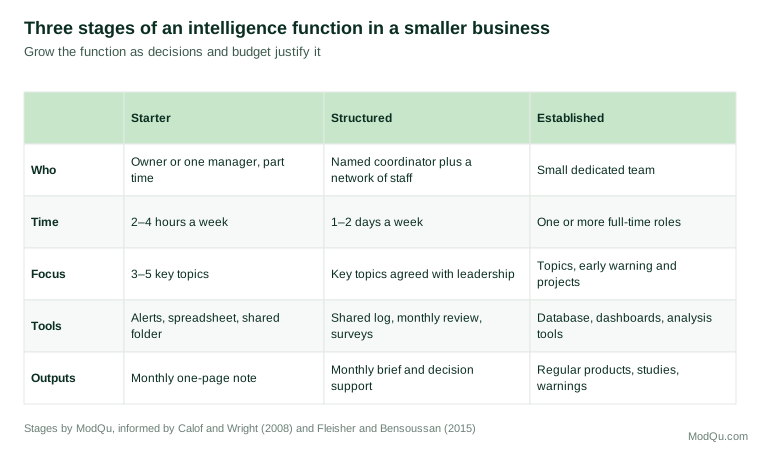
At the starter stage, the owner or one manager spends a few hours a week on the key topics, using free alerts, a simple spreadsheet log and conversations. At the structured stage, a named coordinator collects observations from a network of staff, holds a short monthly review and produces a brief for leadership. At the established stage, which only larger medium-sized firms usually reach, a small team supports strategy and provides early warning.
A monthly routine
The core of a small intelligence function is a regular, light routine. Figure 2 shows one that many firms can sustain.
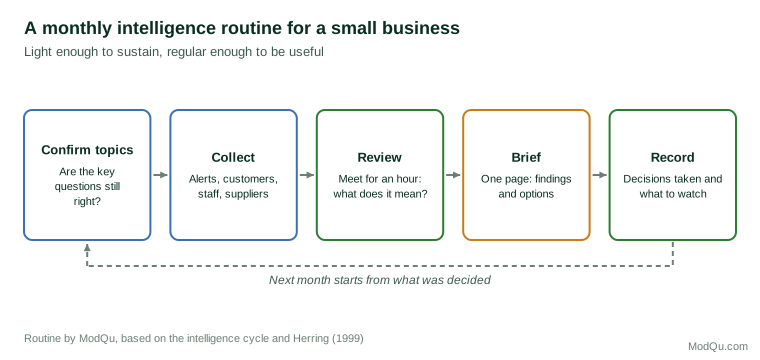
Each month, the coordinator confirms that the key topics are still the right ones, gathers what has been collected, and meets with two or three colleagues for an hour to discuss what it means. The result is a one-page brief for the owner or leadership team: what has changed, what it might mean, and what options the business has. Decisions and points to watch are recorded, so that the next month starts from them.
Choo (1996) emphasised that intelligence is valuable only when it shapes how an organisation makes sense of its environment and decides. The routine's purpose is not the brief itself but the conversation it supports.
Early warning
Gilad (2004) argues that the most valuable contribution of intelligence is early warning: detecting signs of risk or opportunity before they become obvious. Day and Schoemaker (2006) describe the need for peripheral vision, attention to weak signals at the edges of a business's usual focus. For a small business, a simple early-warning practice is to list, for each key topic, two or three signs that would indicate a significant change, such as a competitor recruiting sales staff in your region or a key customer appointing a new purchasing director, and to check for them each month.
Low-cost tools
A smaller business can run an effective intelligence function with very modest tools:
- A shared log. A spreadsheet or shared document with columns for date, source, key topic, observation and reliability. Every entry is short and dated.
- Automated alerts. Free news and web alerts on competitors, customers, products and regulations, filtered to the key topics.
- A contact list. A record of who in the business talks to which customers, suppliers and industry contacts, so that questions can be routed to the right person.
- Short customer surveys. A few questions sent after a sale or a lost bid can reveal why customers choose or reject the business.
- A brief template. A one-page format with fixed headings: what has changed, what it may mean, how confident we are, and what we could do.
The tools matter less than the habit of using them every week.
Making the case internally
In a small business, the owner's support is essential. The best way to secure it is to show results quickly. Start with one topic that matters to a current decision, deliver a useful brief within a month, and record what difference it made. Garcia-Alsina et al. (2013) found that visible links between intelligence and decisions were among the strongest enablers of sustained practice.
Common mistakes
- Collecting without a question. Alerts and reports pile up unread unless tied to a key topic.
- Relying on one person's memory. Knowledge held only by the owner is lost when they are busy or leave. Keep a simple shared log.
- Ignoring internal sources. Staff often know more than any published report.
- Producing long reports. A one-page brief that is read beats a long report that is not.
- Never revisiting topics. Business priorities change; key topics should be reviewed at least quarterly.
An illustration
A family-owned manufacturer of commercial kitchen equipment, with sixty employees, sets up a starter intelligence function. The operations director spends three hours a week on four key topics: the plans of two main competitors, trends in restaurant openings, changes in energy-efficiency regulations, and the purchasing intentions of the three largest distributors. Sales staff are asked to send a short note whenever they hear something relevant. After four months, a note from a sales representative reveals that a large distributor is testing a competitor's lower-cost range. The monthly brief flags the risk, and the company arranges a meeting with the distributor, learns its concerns about delivery times, and agrees on a revised service arrangement. The distributor stays. The owner, who had been sceptical, asks for the routine to be extended to cover export markets.
Conclusion
A smaller business does not need an intelligence department to be well informed. It needs a short list of the questions that matter most, a habit of collecting what its own people and customers already know, a regular routine for making sense of it, and a direct link to the decisions it supports. Started small and grown as it proves its value, an intelligence function can give a smaller business earlier warning and better decisions than its size would suggest.
References
Aguilar, F. J. (1967). Scanning the business environment. Macmillan.
Calof, J. L., & Wright, S. (2008). Competitive intelligence: A practitioner, academic and inter-disciplinary perspective. European Journal of Marketing, 42(7/8), 717–730. https://doi.org/10.1108/03090560810877114
Choo, C. W. (1996). The knowing organization: How organizations use information to construct meaning, create knowledge and make decisions. International Journal of Information Management, 16(5), 329–340. https://doi.org/10.1016/0268-4012(96)00020-5
Crane, A. (2005). In the company of spies: When competitive intelligence gathering becomes industrial espionage. Business Horizons, 48(3), 233–240. https://doi.org/10.1016/j.bushor.2004.11.005
Day, G. S., & Schoemaker, P. J. H. (2006). Peripheral vision: Detecting the weak signals that will make or break your company. Harvard Business School Press.
Fleisher, C. S., & Bensoussan, B. E. (2015). Business and competitive analysis: Effective application of new and classic methods (2nd ed.). Pearson Education.
Garcia-Alsina, M., Ortoll, E., & Cobarsí-Morales, J. (2013). Enabler and inhibitor factors influencing competitive intelligence practices. Aslib Proceedings, 65(3), 262–288. https://doi.org/10.1108/00012531311330647
Gilad, B. (2004). Early warning: Using competitive intelligence to anticipate market shifts, control risk, and create powerful strategies. AMACOM.
Herring, J. P. (1999). Key intelligence topics: A process to identify and define intelligence needs. Competitive Intelligence Review, 10(2), 4–14.
Jaworski, B. J., & Kohli, A. K. (1993). Market orientation: Antecedents and consequences. Journal of Marketing, 57(3), 53–70. https://doi.org/10.1177/002224299305700304
Kahaner, L. (1996). Competitive intelligence: How to gather, analyze, and use information to move your business to the top. Simon & Schuster.
Kohli, A. K., & Jaworski, B. J. (1990). Market orientation: The construct, research propositions, and managerial implications. Journal of Marketing, 54(2), 1–18. https://doi.org/10.1177/002224299005400201
Porter, M. E. (1980). Competitive strategy: Techniques for analyzing industries and competitors. Free Press.
Rockart, J. F. (1979). Chief executives define their own data needs. Harvard Business Review, 57(2), 81–93.
Smith, J. R., Wright, S., & Pickton, D. (2010). Competitive intelligence programmes for SMEs in France: Evidence of changing attitudes. Journal of Strategic Marketing, 18(7), 523–536.
Storey, D. J. (1994). Understanding the small business sector. Routledge.
Wilensky, H. L. (1967). Organizational intelligence: Knowledge and policy in government and industry. Basic Books.
Wright, S., Eid, E. R., & Fleisher, C. S. (2009). Competitive intelligence in practice: Empirical evidence from the UK retail banking sector. Journal of Marketing Management, 25(9–10), 941–964. https://doi.org/10.1362/026725709X479318