
Intelligence · Artificial and collective intelligence
Artificial Intelligence in Intelligence Analysis
Artificial intelligence can read, sort and summarise far more material than any team of analysts. This article explains where AI genuinely helps intelligence analysis, where it does not, and how to combine machine speed with human judgement.
Intelligence work has always been limited by attention. There is more material to read than analysts can read, more signals than they can watch and more questions than they can answer. Artificial intelligence (AI) changes that limit. Software can now translate, transcribe, classify and summarise text, images and audio at a scale no human team could match. The question for any intelligence function, in government or business, is not whether to use AI but where it adds value and where it introduces new risks.
What AI is, in practical terms
Russell and Norvig (2021) define AI broadly as the study of agents that perceive their environment and act to achieve goals. Most of what is useful in intelligence work today is a narrower subset: machine learning, in which systems learn patterns from examples rather than following hand-written rules. Jordan and Mitchell (2015) describe the main forms: supervised learning, which predicts a known label such as "relevant" or "not relevant"; unsupervised learning, which groups similar items without labels; and newer language models that generate and summarise text.
Agrawal, Gans and Goldfarb (2018) offer a helpful economic view. AI, they argue, makes prediction cheap. Prediction here means filling in missing information: which document is relevant, what a sentence in another language says, which transaction looks unusual. When prediction becomes cheap, the scarce and valuable input becomes judgement: deciding what matters, what the prediction means and what to do about it. That division maps closely onto the work of intelligence.
Where AI helps
Zegart (2022) argues that the volume of open-source information now available has transformed intelligence, and that machines are essential to exploit it. A study by the Royal United Services Institute for the British government found the strongest near-term benefits in three areas: automating routine administrative and processing tasks, filtering and triaging large volumes of data, and supporting analysts in spotting patterns (Babuta et al., 2020).
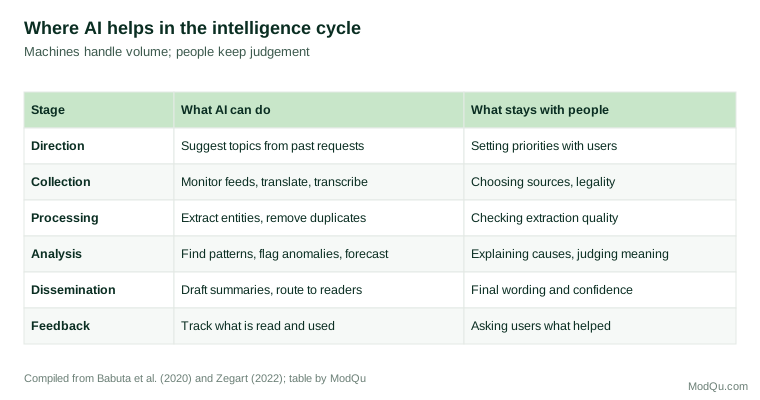
In a business setting, the same applies. A market intelligence team can use AI to monitor thousands of news sources, product reviews and regulatory filings, translate foreign-language material, extract company and product names, and flag changes that deserve attention. Figure 1 shows how these tasks fit the stages of the intelligence cycle.
Machine predictions can also outperform human judgement on narrow, well-defined tasks. Kleinberg et al. (2018) showed that an algorithm predicting whether defendants would fail to appear in court made fewer errors than the judges whose decisions it was trained on. Similar gains are possible in intelligence wherever the outcome is clear, past data are plentiful and the future resembles the past.
Where AI does not help, or harms
The same conditions mark the limits. Many intelligence questions concern rare events, deliberate deception or situations with no precedent. Models trained on past data will miss them or, worse, produce confident answers that are wrong. Language models can generate fluent text that contains invented facts. Systems trained on biased data reproduce those biases at scale.
There is also a human risk. Parasuraman and Riley (1997) described how people misuse automation by trusting it too much, and disuse it by ignoring it after it makes visible errors. Analysts who accept machine output without checking may stop noticing the anomalies that matter. Heuer (1999) warned that analysts already tend to see what they expect; a tool that presents a ranked list or a confident summary can strengthen that tendency rather than correct it.
Principles for responsible use
The Office of the Director of National Intelligence (2020) published principles for the use of AI in American intelligence. They include respecting law and human rights, being transparent about how systems work, keeping humans accountable for decisions, and testing systems for bias and reliability. These principles are a sound starting point for any organisation:
- Use AI to widen attention, not replace judgement. Let machines sort and surface; let analysts decide what it means.
- Know the error rates. Test tools on your own material before relying on them, and record how often they miss or mislabel.
- Keep the source visible. Every machine-generated summary should link back to the documents it came from.
- Watch for drift. A model that worked last year may fail when the world, or the data, changes.
- Make a person accountable. Every product should have a named analyst who has checked it.
A business illustration
A consumer goods company receives thousands of customer comments each week from reviews, call centres and social media. An AI tool groups them by topic and flags sudden increases. One week it flags a rise in complaints about packaging leaks in one region. The analyst checks a sample of the comments, confirms the pattern, finds that it began after a supplier change, and briefs the operations team. The machine found the signal in the volume; the analyst established that it was real and explained why it mattered.
Conclusion
AI makes intelligence functions faster and broader by taking on the work of reading, sorting and spotting patterns. It does not remove the need for analysts. It changes what they spend their time on: less on searching and more on checking, interpreting and advising. Organisations that treat AI as an assistant to human judgement, with clear rules on testing and accountability, gain its benefits while limiting its risks.
References
Agrawal, A., Gans, J., & Goldfarb, A. (2018). Prediction machines: The simple economics of artificial intelligence. Harvard Business Review Press.
Babuta, A., Oswald, M., & Janjeva, A. (2020). Artificial intelligence and UK national security: Policy considerations (Occasional Paper). Royal United Services Institute.
Heuer, R. J., Jr. (1999). Psychology of intelligence analysis. Center for the Study of Intelligence, Central Intelligence Agency.
Jordan, M. I., & Mitchell, T. M. (2015). Machine learning: Trends, perspectives, and prospects. Science, 349(6245), 255–260. https://doi.org/10.1126/science.aaa8415
Kleinberg, J., Lakkaraju, H., Leskovec, J., Ludwig, J., & Mullainathan, S. (2018). Human decisions and machine predictions. Quarterly Journal of Economics, 133(1), 237–293. https://doi.org/10.1093/qje/qjx032
Office of the Director of National Intelligence. (2020). Principles of artificial intelligence ethics for the intelligence community.
Parasuraman, R., & Riley, V. (1997). Humans and automation: Use, misuse, disuse, abuse. Human Factors, 39(2), 230–253. https://doi.org/10.1518/001872097778543886
Russell, S., & Norvig, P. (2021). Artificial intelligence: A modern approach (4th ed.). Pearson.
Zegart, A. B. (2022). Spies, lies, and algorithms: The history and future of American intelligence. Princeton University Press.