
Intelligence · Organisational intelligence
After-Action Reviews and Lessons-Learned Processes in Intelligence Organizations
After-action reviews are short, structured discussions held after a task to learn what happened and why. This article explains where the method came from, what research says about its effectiveness, and how intelligence teams can use reviews and lessons-learned processes to improve their work.
Intelligence teams often move from one task to the next without pausing to ask what went well, what went badly and what they would do differently. Mistakes are repeated, good practices are not spread and knowledge stays with the individuals who happened to be involved. An after-action review is a simple remedy: a short, structured discussion held after a task, project or event, in which the people involved examine what happened and agree what to change.
Origins of the after-action review
The after-action review was developed by the United States Army in the 1970s, initially for training exercises at its combat training centres. Morrison and Meliza (1999) trace its development from lengthy expert critiques, delivered to soldiers by observers, to discussions led by the units themselves. The change mattered: people learn more from analysing their own performance than from being told what they did wrong. The army later extended the method to real operations.
Garvin (2000), in a study of learning organisations, described the army's after-action reviews as one of the most effective organisational learning practices Garvin had observed in any sector. Darling et al. (2005) showed how the method could be adapted for business, stressing that its value lies in applying lessons quickly to the next action, not in producing reports.
The four questions
A typical after-action review asks four questions:
- What did we intend to happen?
- What actually happened?
- Why was there a difference?
- What will we do differently next time?
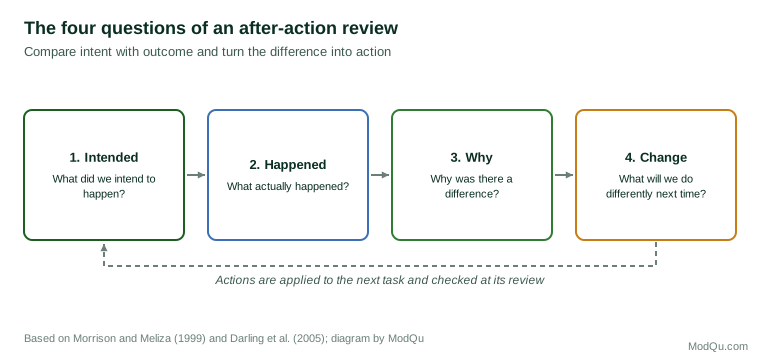
The first question is often skipped, yet it is essential. Without a clear statement of intent, it is impossible to judge whether the outcome was a success. The third question requires honesty about causes, including the team's own decisions. The fourth turns the discussion into action.
Does it work?
Research supports the method. Tannenbaum and Cerasoli (2013), in a meta-analysis of studies of team and individual debriefs, found that well-conducted debriefs improved performance by around 20 to 25 per cent on average. Keiser and Arthur (2021), in a later meta-analysis of after-action reviews specifically, also found substantial positive effects, which were larger when reviews were facilitated and structured.
Ellis and Davidi (2005) studied soldiers in navigation exercises and found that reviewing both successes and failures led to better learning than reviewing failures alone. Analysing success helps people understand what worked and why, so they can repeat it deliberately rather than by luck.
Why reviews work
Kolb (1984) described learning as a cycle: concrete experience, reflection, forming general ideas and testing them in new situations. After-action reviews build the reflection step into routine work. Argyris and Schön (1978) distinguished single-loop learning, which corrects actions within existing assumptions, from double-loop learning, which questions the assumptions themselves. A good review asks both whether the team did the task well and whether it was doing the right task.
Reviews depend on candour. Edmondson (1999) showed that teams learn more when members feel psychologically safe to admit mistakes and raise concerns. If reviews are used to assign blame, people will hide problems. The army's practice of leaving rank at the door during reviews, and of not using what is said for individual assessment, addresses this risk.
Who should lead a review
A review works best when it is led by someone who can keep the discussion focused and fair. In a small team this may be the team leader, but there is a risk that people defer to the person who assigns their work. A colleague from another team, or a rotating facilitator, can help. The facilitator's job is to keep to the four questions, make sure quieter members speak, and move the discussion from description to action.
Using reviews in intelligence
Intelligence work offers many occasions for review: after a major assessment, a crisis, a surprise, a forecast that turned out right or wrong, or a project for a new consumer. Marrin (2012) argues that intelligence analysis lacks a strong evidence base about which practices work; systematic reviews are one way to build it. Lowenthal (2022) notes that intelligence organisations tend to examine their performance only after major failures, often through external inquiries. Regular, small-scale internal reviews are more useful because they catch problems early and reinforce good practice.
Useful practices include:
- Hold reviews promptly, while memories are fresh, and keep them short.
- Include everyone involved, including consumers where possible.
- Review successes as well as failures.
- Compare judgements with outcomes, using the probabilities recorded at the time.
- Record a small number of specific actions, each with an owner.
- Check later whether the actions were carried out.
From reviews to lessons learned
A single review helps the team involved. A lessons-learned process spreads the benefit across the organisation. Senge (1990) describes the learning organisation as one that continually expands its capacity by learning collectively. In practice this means collecting the actions and insights from reviews, looking for recurring themes and changing procedures, training or tools in response.
The common failure is the "lessons filed" problem: lessons are recorded in a database but never acted on. Lessons are only learned when something changes. Each lesson should therefore lead to a specific change, with an owner and a date, and the organisation should check that recurring problems decline.
Common mistakes
- Blame. Reviews that seek culprits stop people speaking honestly.
- Skipping intent. Without a clear statement of what was intended, there is nothing to compare the outcome with.
- Reviewing only failures. Successes contain lessons too.
- Long reports, no action. Short reviews with a few specific actions are more useful.
A business illustration
A consumer electronics company's intelligence team forecast that a competitor would launch a rival product in the spring; it launched in January. In a thirty-minute review, the team compares its forecast with what happened and finds that it had discounted a supplier's hiring announcement as noise. It agrees to add supplier activity to its list of indicators and to revisit forecasts whenever an indicator changes. It also reviews a successful forecast from the same quarter and notes that close contact with the sales team had provided early warning. Both lessons are added to the team's procedures, and the next quarterly review checks whether they have been applied.
Conclusion
After-action reviews are a simple, well-tested method for learning from experience. By asking what was intended, what happened, why the two differed and what will change, intelligence teams can improve their work steadily. Combined with a lessons-learned process that turns insights into changes, reviews help an intelligence organisation learn collectively rather than repeat its mistakes.
References
Argyris, C., & Schön, D. A. (1978). Organizational learning: A theory of action perspective. Addison-Wesley.
Darling, M., Parry, C., & Moore, J. (2005). Learning in the thick of it. Harvard Business Review, 83(7), 84–92.
Edmondson, A. (1999). Psychological safety and learning behavior in work teams. Administrative Science Quarterly, 44(2), 350–383. https://doi.org/10.2307/2666999
Ellis, S., & Davidi, I. (2005). After-event reviews: Drawing lessons from successful and failed experience. Journal of Applied Psychology, 90(5), 857–871. https://doi.org/10.1037/0021-9010.90.5.857
Garvin, D. A. (2000). Learning in action: A guide to putting the learning organization to work. Harvard Business School Press.
Keiser, N. L., & Arthur, W., Jr. (2021). A meta-analysis of the effectiveness of the after-action review (or debrief) and factors that influence its effectiveness. Journal of Applied Psychology, 106(7), 1007–1032. https://doi.org/10.1037/apl0000821
Kolb, D. A. (1984). Experiential learning: Experience as the source of learning and development. Prentice Hall.
Lowenthal, M. M. (2022). Intelligence: From secrets to policy (9th ed.). CQ Press.
Marrin, S. (2012). Improving intelligence analysis: Bridging the gap between scholarship and practice. Routledge.
Morrison, J. E., & Meliza, L. L. (1999). Foundations of the after action review process (Special Report 42). U.S. Army Research Institute for the Behavioral and Social Sciences.
Senge, P. M. (1990). The fifth discipline: The art and practice of the learning organization. Doubleday.
Tannenbaum, S. I., & Cerasoli, C. P. (2013). Do team and individual debriefs enhance performance? A meta-analysis. Human Factors, 55(1), 231–245. https://doi.org/10.1177/0018720812448394