
Insights · Generating insight
The Role of Constraints and Framing in Focusing Insight Search
How constraints and problem framing shape the search for insight, covering research on creativity under constraints, fixation, problem finding and reframing, with practical techniques for setting useful constraints and testing alternative frames.
A common view holds that insight needs freedom: remove the limits and new ideas will flow. Research suggests a more complicated picture. Constraints, such as limits on budget, time, materials or the form of a solution, can focus search and push people beyond obvious answers. The way a problem is framed, meanwhile, determines which solutions people consider at all. Both can help or hinder. This article explains how constraints and framing shape the search for insight and how analysts can use them deliberately.
Why constraints can help
Without constraints, people tend to take the path of least resistance. Ward (1994) asked people to imagine animals living on another planet. Most of the creatures they invented closely resembled animals on Earth, with eyes, legs and symmetrical bodies. People built new ideas from the most accessible examples in memory, which made them more conventional than intended.
Constraints can block these easy paths. Stokes (2005) argued that creative breakthroughs often follow from constraints that preclude familiar solutions and direct search towards unfamiliar ones. Moreau and Dahl (2005) asked consumers to design products under different conditions and found that constraints on the inputs they could use led to more creative designs, because they prevented people from relying on the most familiar approach. Goldenberg et al. (1999) found that successful new products often followed a small number of recurring patterns, or templates, and that training people to apply these templates, which act as structured constraints, improved the quality of their ideas.
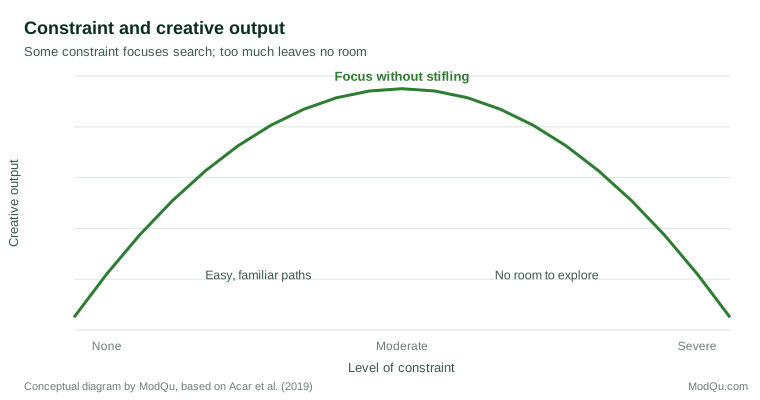
There are limits. Acar et al. (2019) reviewed research across several disciplines and concluded that the relationship between constraints and creativity is often shaped like an inverted U. Some constraint helps, by providing focus and motivation, but too much constraint leaves no room to explore.
When constraints get in the way
Some constraints are imposed by the situation; others are imposed, often without awareness, by the person solving the problem. Duncker (1945) showed that people struggled to use an object in an unfamiliar way, such as using a box that held tacks as a shelf, an effect known as functional fixedness. Knoblich et al. (1999) found that insight problems became hard when they required people to relax assumptions that the problem had never stated. Jansson and Smith (1991) found that designers shown an example solution reproduced its features in their own designs, even its flaws, a pattern they called design fixation.
For analysts, unstated constraints are common: assumptions that the answer must come from existing data, that the customer segment is fixed or that the current product must stay. Making these assumptions explicit is often the first step to a new insight.
Framing the problem
How a problem is stated determines where people look. Tversky and Kahneman (1981) showed that logically equivalent descriptions of a choice, such as describing outcomes in terms of lives saved or lives lost, led to different decisions. The frame changed how people saw the options.
Framing also matters before any options exist. Getzels and Csikszentmihalyi (1976) studied art students and found that those who spent more time exploring materials and deciding what to draw, before starting, produced work judged more original and were more successful years later. They called this problem finding. Reiter-Palmon and Robinson (2009) reviewed research on problem construction and concluded that how people define a problem has a significant effect on the quality and originality of their solutions.
Simon (1973) observed that many real problems are ill-structured: their goals, options and criteria are not fully defined. Much of the work of solving them lies in giving them structure. Dorst (2011) described how expert designers create new frames, such as treating a problem of crime in a nightlife district as a problem of hosting a large party, which opens up solutions that the original frame excluded.
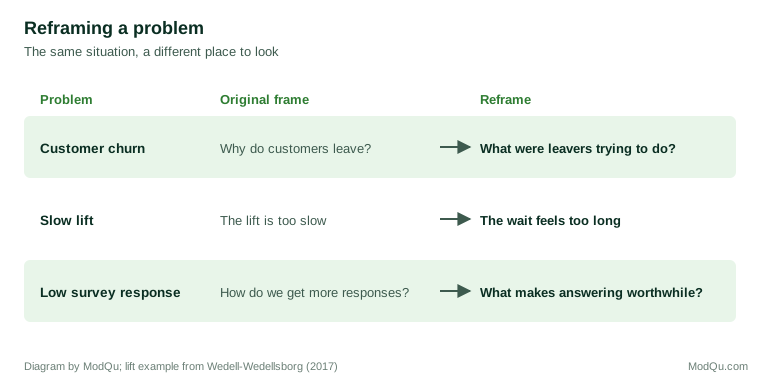
Reframing does not mean abandoning the original question. It means stepping back to the goal behind it and asking whether there are other routes to that goal. Wedell-Wedellsborg (2017) gave a well-known example: tenants complained that a lift was too slow. Framed as a speed problem, the solutions were expensive. Reframed as a problem of waiting being tedious, a cheap solution appeared: mirrors beside the lift, which gave people something to look at.
Using constraints and frames deliberately
Several practices follow from this research. Analysts can list the assumptions behind a question and ask which are real constraints and which are habits. They can add useful constraints on purpose, for example "find a solution that costs nothing" or "explain this result without using demographic data", to push past the first obvious answer. They can write the problem in several different ways before choosing one, and ask whose problem it is, what the goal behind it is and what would count as success. And they can review the frame again when progress stalls, because a stalled search often means the frame is wrong.
Constraints can also be applied to the analysis itself. An analyst who is asked to explain a sales decline using only three variables must decide which ones matter most, which often produces a clearer account than a model with dozens of inputs. A team that must present its finding in a single sentence is forced to decide what the finding actually is. Time limits work in a similar way: a short, fixed period for exploring a question can prevent a team from collecting data indefinitely without deciding what it is looking for.
A further technique is to ask how someone from a different field would describe the problem. A logistics specialist, a psychologist and a finance manager will each frame a fall in repeat purchases differently, and each frame suggests different data to examine.
Common mistakes
Common mistakes include accepting the first statement of a problem as given, especially when it comes from a senior stakeholder; treating every constraint as fixed, without checking whether it is a real limit or a habit; and imposing so many constraints that no workable solution remains. Another mistake is changing the frame silently. When a team reframes a problem, it should explain the new frame to the people who asked the original question, because a good answer to a different question can look like a failure to answer theirs.
An example
An insurer asked its insights team why online quote requests were not turning into policies. The initial frame, "how do we improve the quote form", produced small design changes and little improvement. The team then imposed a constraint, "explain the drop-off without changing the form", which forced them to look elsewhere. They found that many people requested quotes to compare prices for a renewal with their existing insurer and never intended to switch. The problem was reframed as "how do we win customers at renewal time", which led to a different and more successful campaign.
Conclusion
Constraints and framing direct the search for insight. Moderate constraints block familiar paths and focus effort (Acar et al., 2019; Moreau & Dahl, 2005), while hidden constraints and fixation keep people stuck (Duncker, 1945; Jansson & Smith, 1991). Spending time on how a problem is framed, and testing alternative frames, is often the fastest way to an insight that the original question could not reach.
References
Acar, O. A., Tarakci, M., & van Knippenberg, D. (2019). Creativity and innovation under constraints: A cross-disciplinary integrative review. Journal of Management, 45(1), 96–121. https://doi.org/10.1177/0149206318805832
Dorst, K. (2011). The core of "design thinking" and its application. Design Studies, 32(6), 521–532. https://doi.org/10.1016/j.destud.2011.07.006
Duncker, K. (1945). On problem-solving. Psychological Monographs, 58(5), i–113. https://doi.org/10.1037/h0093599
Getzels, J. W., & Csikszentmihalyi, M. (1976). The creative vision: A longitudinal study of problem finding in art. Wiley.
Goldenberg, J., Mazursky, D., & Solomon, S. (1999). Toward identifying the inventive templates of new products: A channeled ideation approach. Journal of Marketing Research, 36(2), 200–210. https://doi.org/10.1177/002224379903600205
Jansson, D. G., & Smith, S. M. (1991). Design fixation. Design Studies, 12(1), 3–11. https://doi.org/10.1016/0142-694X(91)90003-F
Knoblich, G., Ohlsson, S., Haider, H., & Rhenius, D. (1999). Constraint relaxation and chunk decomposition in insight problem solving. Journal of Experimental Psychology: Learning, Memory, and Cognition, 25(6), 1534–1555. https://doi.org/10.1037/0278-7393.25.6.1534
Moreau, C. P., & Dahl, D. W. (2005). Designing the solution: The impact of constraints on consumers' creativity. Journal of Consumer Research, 32(1), 13–22. https://doi.org/10.1086/429597
Reiter-Palmon, R., & Robinson, E. J. (2009). Problem identification and construction: What do we know, what is the future? Psychology of Aesthetics, Creativity, and the Arts, 3(1), 43–47. https://doi.org/10.1037/a0014629
Simon, H. A. (1973). The structure of ill structured problems. Artificial Intelligence, 4(3–4), 181–201. https://doi.org/10.1016/0004-3702(73)90011-8
Stokes, P. D. (2005). Creativity from constraints: The psychology of breakthrough. Springer.
Tversky, A., & Kahneman, D. (1981). The framing of decisions and the psychology of choice. Science, 211(4481), 453–458. https://doi.org/10.1126/science.7455683
Ward, T. B. (1994). Structured imagination: The role of category structure in exemplar generation. Cognitive Psychology, 27(1), 1–40. https://doi.org/10.1006/cogp.1994.1010
Wedell-Wedellsborg, T. (2017). Are you solving the right problems? Harvard Business Review, 95(1), 76–84.