
Insights · Generating insight
Cognitive Offloading Tools That Support Insight Discovery
Notes, sketches, sticky-note walls and spreadsheets let analysts move thinking out of their heads. Used well, these tools make insight more likely; used carelessly, they hide errors and weaken understanding.
Working memory is small. An analyst reading forty interview transcripts or a cross-tabulation with twelve banners cannot hold every pattern in mind at once. People cope by putting part of the work into the world: they write notes, draw diagrams, sort cards and build spreadsheets. Psychologists call this cognitive offloading, the use of physical action to reduce the mental demands of a task (Risko & Gilbert, 2016). For insight work, offloading is not a convenience. It is often the condition that makes a new pattern visible at all.
Why external aids help
Kirsh and Maglio (1994) showed that expert players of the game Tetris rotate pieces on screen before they need to, not to place them but to see the options faster. They named these moves epistemic actions: actions taken to make thinking easier rather than to change the world. Larkin and Simon (1987) made a similar point about diagrams. A good diagram puts related information next to each other, so the reader can see a relationship instead of searching for it and working it out. Clark and Chalmers (1998) went further, arguing that a notebook used reliably can become part of the thinking system itself.
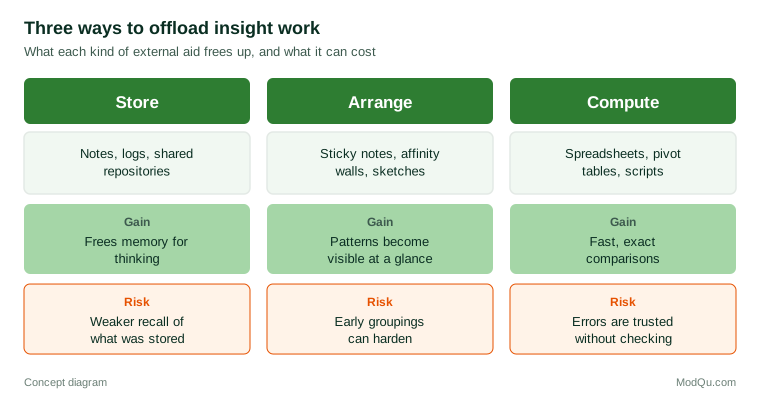
In research teams the same logic applies. A wall of sticky notes lets several people rearrange findings until a grouping makes sense. A pivot table lets an analyst compare segments without recalculating anything mentally. A running research log keeps early hunches available when later data confirms or contradicts them.
An example
Consider a hypothetical team analysing 300 open-ended answers about why customers cancelled a subscription. Reading the answers one by one, each analyst forms a vague impression that price is the main complaint. When the team copies short quotes onto cards and sorts them on a wall, a different picture appears: many "price" comments are really about paying for features the customer never learned to use. The wall did not create that insight, but it put related comments side by side long enough for someone to notice the connection. A quick count in a spreadsheet then shows how large the group is, and the team has an insight it can test: better onboarding might reduce cancellations more than a discount would.
The costs
Offloading changes what people remember. In a series of experiments, Sparrow et al. (2011) found that people who expected to be able to look information up later remembered the information itself less well, but remembered where to find it. For an insights team, this means that a well-organised repository can substitute for memory, while a poorly organised one leaves nobody holding the knowledge.
Two further risks matter in practice. First, physical arrangements tend to persist: once sticky notes are clustered, the clusters can feel settled even when new evidence points elsewhere. Second, computed outputs carry authority. A wrong formula in a spreadsheet is trusted because nobody is re-doing the arithmetic in their head, which was the point of offloading in the first place.
Practical guidance
- Offload early and visibly. Put findings on a shared surface before anyone tries to summarise them, so the group sees the same material.
- Rearrange on purpose. Schedule a second sort of the evidence with different headings, to test whether the first grouping still holds.
- Check what the tools compute. Spot-check a sample of calculated figures against the raw data before an insight is reported.
- Keep the trail. Store notes with dates and sources, so later readers can trace an insight back to its evidence.
Key takeaways
Cognitive offloading moves memory, arrangement and calculation out of the head and into notes, walls and software. That shift frees capacity for the interpretive work where insights form. The same tools can weaken recall, freeze early ideas and hide errors, so teams should use them deliberately and check what they produce.
References
Clark, A., & Chalmers, D. (1998). The extended mind. Analysis, 58(1), 7–19. https://doi.org/10.1093/analys/58.1.7
Kirsh, D., & Maglio, P. (1994). On distinguishing epistemic from pragmatic action. Cognitive Science, 18(4), 513–549. https://doi.org/10.1207/s15516709cog1804_1
Larkin, J. H., & Simon, H. A. (1987). Why a diagram is (sometimes) worth ten thousand words. Cognitive Science, 11(1), 65–100. https://doi.org/10.1111/j.1551-6708.1987.tb00863.x
Risko, E. F., & Gilbert, S. J. (2016). Cognitive offloading. Trends in Cognitive Sciences, 20(9), 676–688. https://doi.org/10.1016/j.tics.2016.07.002
Sparrow, B., Liu, J., & Wegner, D. M. (2011). Google effects on memory: Cognitive consequences of having information at our fingertips. Science, 333(6043), 776–778. https://doi.org/10.1126/science.1207745