
Insights · What an insight is
The Distinction Between Incremental Insights and Disruptive Knowledge Shifts
Most insights refine what an organisation already knows, while a few overturn it. This article explains the difference, draws on innovation research to show why established organisations handle the two so differently, and suggests how research teams can recognise and present each kind.
Not all insights are equal. Most refine an existing understanding: a segment is a little larger than thought, a message works better with one group than another, a feature matters more than expected. A few overturn the understanding altogether, showing that the organisation has misread its customers, its market or its own role. The first kind can be called incremental insight; the second, a disruptive knowledge shift. Both are valuable, but they behave differently, meet different kinds of resistance and need to be handled differently.
Two kinds of change in understanding
The distinction has a long history in the study of science. Kuhn (1962) described most scientific work as "normal science": puzzle-solving within an accepted framework, which extends and refines knowledge without questioning its foundations. Occasionally, anomalies accumulate that the framework cannot explain, and a scientific revolution replaces the framework with a new one. After the change, the same observations are seen differently.
Insight research describes a similar contrast at the level of individual problem-solving. Knoblich, Ohlsson, Haider and Rhenius (1999) showed that some problems can be solved by relaxing minor assumptions, while others require people to abandon fundamental ones. The deeper the assumption that must be dropped, the harder the problem and the rarer the solution.
In organisations, an incremental insight fits within the existing view of the market and suggests improvements to existing products, messages or processes. A disruptive knowledge shift changes the view itself, for example by revealing that customers buy a product for a different reason than the company believed, or that the real competitor is in another industry.
Lessons from innovation research
Innovation research has studied the same distinction in products and technologies, and its findings apply closely to insight.
Tushman and Anderson (1986) distinguished between technological changes that enhance the existing competence of established firms and those that destroy it. Competence-enhancing changes tended to strengthen incumbents; competence-destroying changes often opened the way for new entrants. Henderson and Clark (1990) added a further distinction. Some innovations change the core components of a product, while others leave the components alone but change how they are linked together. They called the second kind architectural innovation and showed, in a study of the photolithographic equipment industry, that established firms repeatedly failed to recognise it, because their knowledge was organised around the old architecture.
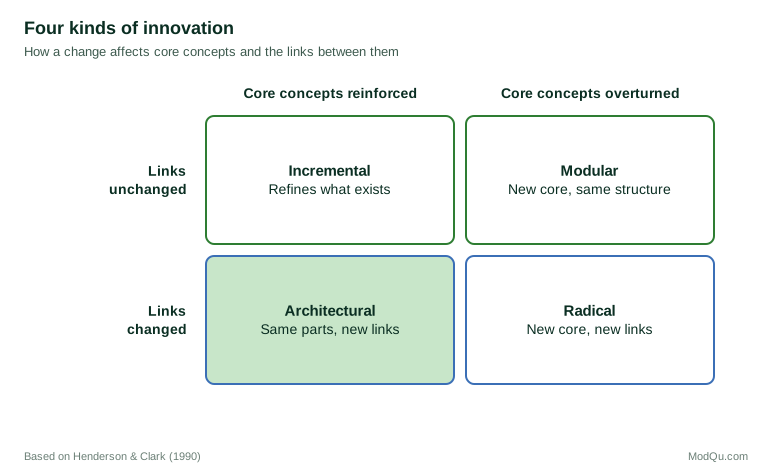
The parallel with insight is direct. An organisation's understanding of its customers is organised around a set of core concepts (who the customer is, what they want, who the competitors are) and a set of assumed links between them. Incremental insight refines the concepts within the existing structure. A disruptive shift either replaces a core concept or, like architectural innovation, changes how the familiar pieces fit together.
March (1991) explained why organisations favour the incremental. March distinguished between exploitation, refining what is already known, and exploration, searching for new possibilities. Exploitation produces quicker, more certain returns, so organisations tend to drift towards it at the expense of exploration. Research functions are subject to the same pressure: studies that track and refine existing measures are easier to justify than studies that question the organisation's basic assumptions.
Christensen's (1997) theory of disruptive innovation adds that established firms often listen closely to their best customers, which leads them to improve products for those customers while missing new markets at the low end or among non-customers. Christensen, Raynor and McDonald (2015) later warned that the term "disruptive" is widely misused for any large change. King and Baatartogtokh (2015) tested the theory against the cases used to support it and found that relatively few fitted all of its elements, a reminder that dramatic labels should be applied with care.
How the two kinds are received
Incremental insights are easy to accept. They fit existing beliefs, can be acted on by existing teams and carry little political risk. Disruptive shifts are harder. They imply that past decisions were based on a mistaken view, and they may threaten the expertise and status of people who built that view.
Organisational capacity matters. Cohen and Levinthal (1990) argued that an organisation's ability to recognise and use new external knowledge, its absorptive capacity, depends on its existing related knowledge. Organisations with little knowledge close to the new idea may not see its value. Dewar and Dutton (1986) found that firms with deeper technical knowledge were more likely to adopt radical innovations, whereas incremental innovations were adopted more widely. Ettlie, Bridges and O'Keefe (1984) found that radical innovation was associated with different strategies and structures from incremental innovation, including a more aggressive technology policy.
Research methods also shape which kind of insight is found. Norman and Verganti (2014) argued that research focused on current users tends to produce incremental improvements, while radical change usually comes from new technologies or from a change in the meaning of a product. Asking customers to evaluate existing offers rarely reveals that the whole category could be understood differently.
Practical implications for research teams
- Label the kind of insight. Telling decision-makers whether an insight refines or challenges current understanding helps them judge how much evidence to demand and how much change to expect.
- Demand more evidence for disruptive claims. A finding that overturns established understanding may be right, but it may also be an artefact of a small sample or a flawed measure. Replication with different data before presenting it as established protects both the organisation and the research team's credibility.
- Look beyond current customers. Disruptive shifts are more likely to be found among non-customers, lapsed customers, adjacent markets and unexpected uses.
- Protect some exploratory research. A portfolio that is entirely tracking and optimisation will produce only incremental insight. Setting aside some capacity for open-ended exploration follows March's (1991) advice.
- Plan the reception. Disruptive insights need more time, more discussion and earlier involvement of senior stakeholders than incremental ones.
Key takeaways
Incremental insights refine an organisation's existing understanding; disruptive knowledge shifts replace it. Innovation research shows that established organisations handle incremental change well but often fail to recognise changes that destroy existing competence or alter how familiar elements fit together. The same pressures affect insight: organisations favour exploitation over exploration, absorb most easily what fits their existing knowledge and design research that refines rather than questions. Research teams can respond by labelling the kind of insight they deliver, testing disruptive claims thoroughly, looking beyond current customers and preparing the organisation for findings that challenge it.
References
Christensen, C. M. (1997). The innovator's dilemma: When new technologies cause great firms to fail. Harvard Business School Press.
Christensen, C. M., Raynor, M. E., & McDonald, R. (2015). What is disruptive innovation? Harvard Business Review, 93(12), 44–53.
Cohen, W. M., & Levinthal, D. A. (1990). Absorptive capacity: A new perspective on learning and innovation. Administrative Science Quarterly, 35(1), 128–152. https://doi.org/10.2307/2393553
Dewar, R. D., & Dutton, J. E. (1986). The adoption of radical and incremental innovations: An empirical analysis. Management Science, 32(11), 1422–1433. https://doi.org/10.1287/mnsc.32.11.1422
Ettlie, J. E., Bridges, W. P., & O'Keefe, R. D. (1984). Organization strategy and structural differences for radical versus incremental innovation. Management Science, 30(6), 682–695. https://doi.org/10.1287/mnsc.30.6.682
Henderson, R. M., & Clark, K. B. (1990). Architectural innovation: The reconfiguration of existing product technologies and the failure of established firms. Administrative Science Quarterly, 35(1), 9–30. https://doi.org/10.2307/2393549
King, A. A., & Baatartogtokh, B. (2015). How useful is the theory of disruptive innovation? MIT Sloan Management Review, 57(1), 77–90.
Knoblich, G., Ohlsson, S., Haider, H., & Rhenius, D. (1999). Constraint relaxation and chunk decomposition in insight problem solving. Journal of Experimental Psychology: Learning, Memory, and Cognition, 25(6), 1534–1555. https://doi.org/10.1037/0278-7393.25.6.1534
Kuhn, T. S. (1962). The structure of scientific revolutions. University of Chicago Press.
March, J. G. (1991). Exploration and exploitation in organizational learning. Organization Science, 2(1), 71–87. https://doi.org/10.1287/orsc.2.1.71
Norman, D. A., & Verganti, R. (2014). Incremental and radical innovation: Design research vs. technology and meaning change. Design Issues, 30(1), 78–96. https://doi.org/10.1162/DESI_a_00250
Tushman, M. L., & Anderson, P. (1986). Technological discontinuities and organizational environments. Administrative Science Quarterly, 31(3), 439–465. https://doi.org/10.2307/2392832