
Insights · Customer and market insight
Social Media Insight: Reading Public Conversation
What social media listening can and cannot reveal about customers and markets, why online conversation is not a representative sample of opinion, and how to read it carefully.
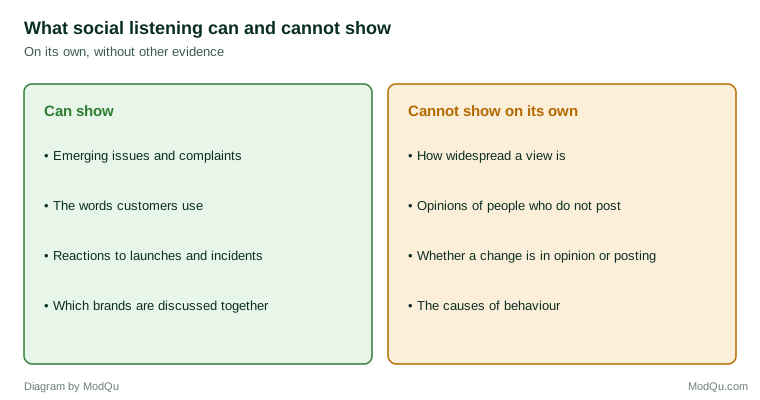
Every day, people post millions of comments, reviews, photos and videos about products, brands and services. Social media listening, the systematic collection and analysis of this public conversation, offers organisations an unprompted view of what people say about them, in their own words and in real time. It can reveal emerging issues, the language customers use and how a brand is discussed alongside competitors. It is also easy to misread, because the people who post are not a cross-section of customers, and what they post is shaped by the platform and the audience.
What listening can reveal
Social media is useful for spotting new issues early, for understanding how people talk about a category, and for following reactions to launches, campaigns and incidents as they unfold. Tirunillai and Tellis (2014) analysed large volumes of online product reviews and identified the dimensions of quality that consumers discussed, showing how these differed between brands and changed over time.
Why online conversation is not opinion
The people who post are not typical. Mellon and Prosser (2017) compared users of major social media platforms in Britain with the general population and found that they differed in age, education and political attitudes, so that conclusions drawn from their posts could not be generalised. Ruths and Pfeffer (2014) warned that studies using social media data often overlook such biases, as well as the effects of platform design, automated accounts and the way data are filtered by the platform before researchers see them.
What people post also depends on where and when they post. Moe and Schweidel (2012) studied online product ratings and found that the decision to post and the rating given were influenced by the ratings already posted by others, so that the opinions visible online reflected social dynamics as well as product experience. Schweidel and Moe (2014) found that the sentiment of brand-related posts differed systematically between venues such as blogs, forums and microblogs, so that a change in where people post can look like a change in sentiment. Hu et al. (2009) showed that product reviews tend to cluster at the extremes, because people with very positive or very negative experiences are the most likely to write.
Reading the conversation well
Several practices help. Treat social media as a source of questions and language rather than as a measure of prevalence, and check important findings with surveys or behavioural data. Compare sentiment within the same platform over time, not across platforms. Read samples of posts rather than relying only on automated sentiment scores. Watch for automated accounts and coordinated campaigns. And remember that silence online does not mean satisfaction: most customers never post at all. Finally, record how the data were collected, including platforms, search terms and date ranges, because results can change substantially when any of these change.
An example
Consider a hypothetical snack brand that sees a sudden surge of negative posts about a new recipe. The volume looks alarming, and some managers want to withdraw the product. The insight team reads a sample of several hundred posts and finds that most come from a small number of accounts and repeat the same few phrases, many shared after a single popular video. Sales data show that repeat purchase of the new recipe is in line with the old one, and a quick survey of recent buyers finds that most prefer it or notice no difference.
The team does find one genuine issue in the posts: several people mention that the new packaging is hard to reseal. The survey confirms that this is a common complaint among buyers who never post. The brand keeps the recipe and fixes the packaging. Listening was valuable, but only because its findings were checked against evidence from customers who do not post.
Key takeaways
Social media listening gives organisations an unprompted, real-time view of public conversation about their brands and categories. It is valuable for spotting issues, understanding language and following reactions. But the people who post are not representative, and what they post is shaped by platforms, audiences and the posts of others. Insight from social media is most reliable when it is used to generate questions that are then tested with other evidence.
References
Hu, N., Zhang, J., & Pavlou, P. A. (2009). Overcoming the J-shaped distribution of product reviews. Communications of the ACM, 52(10), 144–147. https://doi.org/10.1145/1562764.1562800
Mellon, J., & Prosser, C. (2017). Twitter and Facebook are not representative of the general population: Political attitudes and demographics of British social media users. Research & Politics, 4(3). https://doi.org/10.1177/2053168017720008
Moe, W. W., & Schweidel, D. A. (2012). Online product opinions: Incidence, evaluation, and evolution. Marketing Science, 31(3), 372–386. https://doi.org/10.1287/mksc.1110.0662
Ruths, D., & Pfeffer, J. (2014). Social media for large studies of behavior. Science, 346(6213), 1063–1064. https://doi.org/10.1126/science.346.6213.1063
Schweidel, D. A., & Moe, W. W. (2014). Listening in on social media: A joint model of sentiment and venue format choice. Journal of Marketing Research, 51(4), 387–402. https://doi.org/10.1509/jmr.12.0424
Tirunillai, S., & Tellis, G. J. (2014). Mining marketing meaning from online chatter: Strategic brand analysis of big data using latent Dirichlet allocation. Journal of Marketing Research, 51(4), 463–479. https://doi.org/10.1509/jmr.12.0106