
Insights · Customer and market insight
Shopper Insight Versus Consumer Insight
The difference between understanding people as consumers, who use products, and as shoppers, who buy them, why the two can diverge, what research shows about decisions made at the point of purchase, and how to combine both kinds of insight.
The person who buys a product is not always the person who uses it, and even when they are the same person, they think differently in the two roles. A parent choosing breakfast cereal in a supermarket is acting as a shopper, balancing price, children's preferences, the shopping list and time pressure. The same parent eating the cereal at home is a consumer, judging taste and satisfaction. Consumer insight seeks to understand people as users of products: their needs, motivations and experiences. Shopper insight seeks to understand people in the act of buying: how they plan, where they shop, what they notice and how they choose at the point of purchase. Both are needed, and confusing them leads to mistakes.
Why the distinction matters
Shankar et al. (2011) described shopper marketing as the planning and execution of marketing activities that influence shoppers along the path to purchase, from the moment a need is recognised through purchase, consumption and repurchase. They argued that it had become a major area of investment for manufacturers and retailers because many decisions are shaped by what happens during shopping, not only by attitudes formed beforehand.
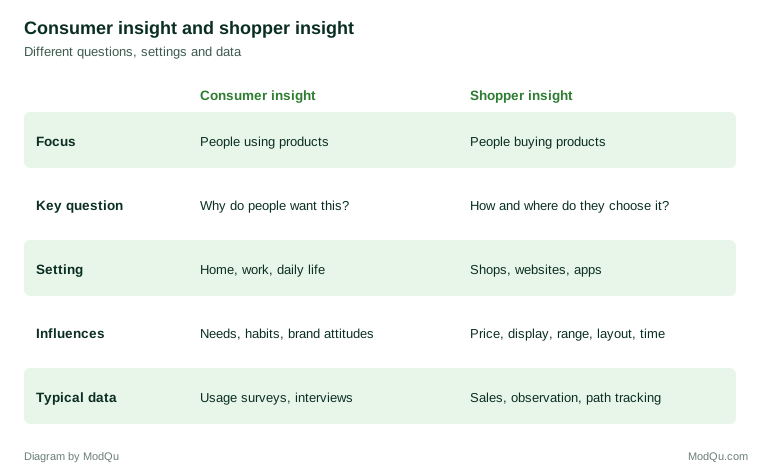
The two can diverge. A consumer may prefer a particular brand but, as a shopper, buy whichever is on promotion. A product may be loved by those who use it but rarely bought because it is hard to find on the shelf. And the shopper may not be the consumer at all, as with parents buying for children, or people buying gifts.
Decisions at the point of purchase
Research has long found that many purchases are not fully planned. Kollat and Willett (1967) interviewed shoppers before and after supermarket trips and found that a large share of the items they bought had not been mentioned as planned purchases when they entered the store. Inman et al. (2009) analysed a large dataset of shopping trips and found that unplanned buying was more likely for some categories and shoppers than others: for example, it was higher for categories that were displayed prominently and for shoppers who did not use a shopping list. Bell et al. (2011) found that factors before the shopping trip, such as the purpose of the trip and the choice of store, influenced how much unplanned buying occurred, so that the path to purchase begins before the shopper enters the store.
Shoppers often know less than marketers assume. Dickson and Sawyer (1990) interviewed supermarket shoppers moments after they had chosen an item and found that many could not accurately recall its price, and that many spent only a few seconds choosing. Decisions made so quickly depend heavily on what catches attention at the shelf.
What happens in the store
In-store factors influence attention and choice. Chandon et al. (2009) used eye tracking to study how shoppers look at shelves and found that the number of facings a brand had on the shelf strongly affected whether shoppers noticed it and, in turn, whether they chose it, while shelf position had smaller effects. They also found that in-store attention was most valuable for brands that shoppers already knew and liked, suggesting that shopper and consumer factors work together.
Larson et al. (2005) tracked the paths of shoppers' carts through a supermarket and found that most shoppers visited only part of the store and followed common patterns, rather than walking every aisle. Hui et al. (2013) found that increasing the distance shoppers travelled through a store increased unplanned spending, and that mobile promotions designed to extend shoppers' paths could increase it further.
The store environment matters too. North et al. (1999) played French or German music on alternate days in a supermarket wine section and found that French wine outsold German wine when French music was played, and the reverse when German music was played, although few shoppers said the music had influenced them.
The range of choice also affects shoppers. Iyengar and Lepper (2000) found that shoppers who saw a display of 24 jams were more likely to stop than those who saw 6, but less likely to buy. Later research suggests the effect is not universal: Scheibehenne et al. (2010) conducted a meta-analysis of choice overload studies and found that the average effect was close to zero, with large variation between studies, indicating that too much choice discourages buying only under certain conditions.
Methods for shopper insight
Shopper insight draws on methods suited to studying behaviour in context. Sales and loyalty-card data show what was bought, where and with what else. Observation, both in person and through video, shows how shoppers move and what they look at; Underhill (1999) described how systematic observation of shoppers revealed problems such as narrow aisles that caused shoppers to abandon displays. Eye tracking measures attention at the shelf. Accompanied shops and interviews at the point of purchase capture shoppers' reasoning while it is fresh. And in-store experiments test changes to display, range, price and promotion.
Promotions deserve particular care. Ailawadi et al. (2009) reviewed research on retail communication and promotion and noted that promotions often shift purchases in time or between brands rather than increasing total category sales, so their effects should be measured carefully.
Combining shopper and consumer insight
The most useful understanding combines both perspectives. Consumer insight explains why people want a product and what they value in it; shopper insight explains whether they find it, notice it and choose it when buying. A brand with strong consumer appeal may lose sales because it is poorly displayed; a brand with weak consumer appeal may sell well because it is always on promotion, but struggle to keep customers. Grewal et al. (2017) argued that technology, such as mobile devices and in-store data, is blurring the boundary between the two by connecting what people do at home with what they do in shops.
A practical approach is to map both journeys, the consumer's experience of using the product and the shopper's path to buying it, and to identify where they connect: where usage experience creates the need to buy again, and where the shopping experience shapes what people consume.
An example
Consider a hypothetical maker of premium dog food. Its consumer research is encouraging: owners who have tried the product rate it highly, their dogs eat it readily, and repeat purchase among triers is strong. Yet sales growth has stalled.
Shopper research tells a different story. Observation in pet stores and supermarkets shows that the product is stocked on a bottom shelf, with a single facing, next to several larger brands with bright packaging. Eye tracking with a sample of shoppers finds that fewer than one in five even look at it during a typical visit to the aisle. Interviews at the shelf reveal that many shoppers buy the same food every time and spend only seconds in the aisle, picking up their usual bag without looking at alternatives. Those who do consider switching mostly do so when their usual brand is out of stock or when a promotion catches their eye.
The company changes its approach. It negotiates more facings at eye level in key stores, redesigns its packaging to stand out on the shelf, and focuses its promotions on encouraging trial among shoppers who buy competing premium brands. It measures the effects with a test in a matched set of stores. Sales in the test stores grow substantially, while the product itself is unchanged. The consumer insight had shown that the product deserved to succeed; the shopper insight showed why it was not being bought.
Key takeaways
Consumers use products; shoppers buy them. The two roles involve different needs, settings and influences, and the same person can think differently in each. Many purchases are shaped at the point of purchase, by display, layout, range and the purpose of the trip, often in seconds and with little conscious deliberation. Shopper insight uses sales data, observation, eye tracking and in-store experiments to understand these influences. Combining shopper and consumer insight gives a fuller picture of why products succeed or fail.
References
Ailawadi, K. L., Beauchamp, J. P., Donthu, N., Gauri, D. K., & Shankar, V. (2009). Communication and promotion decisions in retailing: A review and directions for future research. Journal of Retailing, 85(1), 42–55. https://doi.org/10.1016/j.jretai.2008.11.002
Bell, D. R., Corsten, D., & Knox, G. (2011). From point of purchase to path to purchase: How preshopping factors drive unplanned buying. Journal of Marketing, 75(1), 31–45. https://doi.org/10.1509/jm.75.1.31
Chandon, P., Hutchinson, J. W., Bradlow, E. T., & Young, S. H. (2009). Does in-store marketing work? Effects of the number and position of shelf facings on brand attention and evaluation at the point of purchase. Journal of Marketing, 73(6), 1–17. https://doi.org/10.1509/jmkg.73.6.1
Dickson, P. R., & Sawyer, A. G. (1990). The price knowledge and search of supermarket shoppers. Journal of Marketing, 54(3), 42–53. https://doi.org/10.1177/002224299005400304
Grewal, D., Roggeveen, A. L., & Nordfält, J. (2017). The future of retailing. Journal of Retailing, 93(1), 1–6. https://doi.org/10.1016/j.jretai.2016.12.008
Hui, S. K., Inman, J. J., Huang, Y., & Suher, J. (2013). The effect of in-store travel distance on unplanned spending: Applications to mobile promotion strategies. Journal of Marketing, 77(2), 1–16. https://doi.org/10.1509/jm.11.0436
Inman, J. J., Winer, R. S., & Ferraro, R. (2009). The interplay among category characteristics, customer characteristics, and customer activities on in-store decision making. Journal of Marketing, 73(5), 19–29. https://doi.org/10.1509/jmkg.73.5.19
Iyengar, S. S., & Lepper, M. R. (2000). When choice is demotivating: Can one desire too much of a good thing? Journal of Personality and Social Psychology, 79(6), 995–1006. https://doi.org/10.1037/0022-3514.79.6.995
Kollat, D. T., & Willett, R. P. (1967). Customer impulse purchasing behavior. Journal of Marketing Research, 4(1), 21–31. https://doi.org/10.1177/002224376700400102
Larson, J. S., Bradlow, E. T., & Fader, P. S. (2005). An exploratory look at supermarket shopping paths. International Journal of Research in Marketing, 22(4), 395–414. https://doi.org/10.1016/j.ijresmar.2005.09.005
North, A. C., Hargreaves, D. J., & McKendrick, J. (1999). The influence of in-store music on wine selections. Journal of Applied Psychology, 84(2), 271–276. https://doi.org/10.1037/0021-9010.84.2.271
Scheibehenne, B., Greifeneder, R., & Todd, P. M. (2010). Can there ever be too many options? A meta-analytic review of choice overload. Journal of Consumer Research, 37(3), 409–425. https://doi.org/10.1086/651235
Shankar, V., Inman, J. J., Mantrala, M., Kelley, E., & Rizley, R. (2011). Innovations in shopper marketing: Current insights and future research issues. Journal of Retailing, 87(S1), S29–S42. https://doi.org/10.1016/j.jretai.2011.04.007
Underhill, P. (1999). Why we buy: The science of shopping. Simon & Schuster.