
Insights · Generating insight
Integrating Historical Analogues for Contemporary Insight Generation
How analysts can use historical analogues to understand present situations and forecast outcomes, covering research on analogical reasoning, the outside view, structured analogies and reference classes, and the risks of choosing analogies by surface similarity.
When a situation is new, people look for something similar from the past. A company entering a new market asks how earlier entrants fared. A team forecasting demand for a new product looks at the adoption of comparable products. A manager facing a crisis recalls a previous one. Historical analogues can be a rich source of insight, because the past contains a vast record of how similar situations unfolded. They can also mislead, when the chosen analogy resembles the present on the surface but differs in the features that matter. This article reviews research on using historical analogues and sets out a disciplined way to use them.
How analogy works
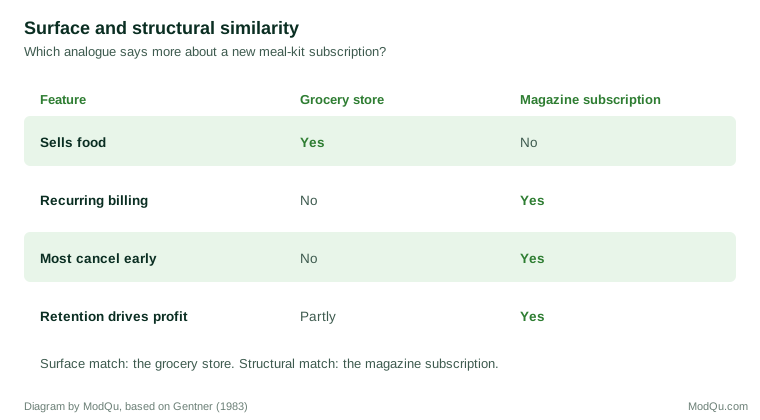
Gentner (1983) described analogy as a mapping of relational structure from a familiar situation, the source, to a new one, the target. A good analogy matches the relationships between elements, such as cause and effect, rather than the surface features of the elements themselves. Gick and Holyoak (1983) found that people often failed to apply a relevant analogy unless they were prompted, but that comparing two analogous cases helped them extract the underlying principle and apply it to new problems. Holyoak and Thagard (1995) argued that analogies are constrained by similarity, structure and purpose: a useful analogy fits the goal of the person using it as well as the facts.
Analogies in strategy and policy
Neustadt and May (1986) studied how American policymakers used history in decisions and found that they often reached for a single vivid analogy without examining it. They proposed simple disciplines, such as listing the ways the present situation was like and unlike the analogue, and tracing the history of the issue itself rather than borrowing a story from elsewhere. Khong (1992) analysed decisions about the Vietnam War and showed how analogies to earlier events, such as Korea and Munich, shaped how policymakers defined the problem and which options they considered.
Gavetti et al. (2005) argued that analogy is central to strategy making in novel and complex environments, where managers cannot calculate the best choice. They found that analogies helped managers frame new situations, but that the quality of the result depended on whether the analogy captured the right causal features. Gavetti and Rivkin (2005) gave examples of companies that drew successful strategies from other industries, and others that were misled by analogies based on superficial resemblance.
The outside view
Historical analogues are especially useful for forecasting. Kahneman and Lovallo (1993) distinguished between an inside view, which forecasts by thinking through the details of the case at hand, and an outside view, which forecasts from the outcomes of a class of similar cases. The inside view tends to produce optimistic forecasts, because people imagine how their plan will succeed and overlook the many ways it might be delayed or fail. The outside view corrects this by asking how similar projects have actually turned out.
Flyvbjerg (2006) applied this idea in reference class forecasting, in which planners estimate the cost and duration of a project from the distribution of outcomes for a reference class of comparable past projects. Lovallo et al. (2012) tested case-based forecasting with private equity investors and found that forecasts based on a set of similar past cases were more accurate than forecasts based on the single most similar case, which in turn were less biased than forecasts made without reference to past cases.
Structured analogies
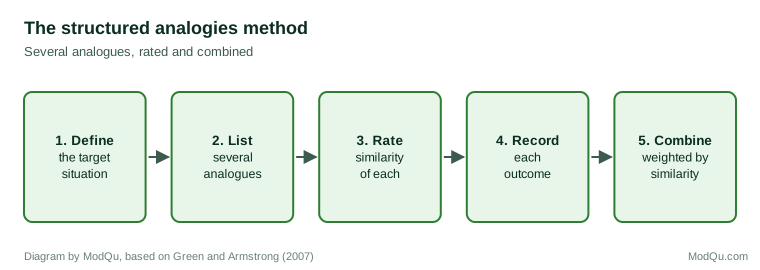
Green and Armstrong (2007) developed a structured method for using analogies in forecasting. Experts were asked to describe analogous situations, rate how similar each was to the target situation and state the outcome of each. The forecasts were then derived from the outcomes of the most similar analogues. In tests on conflict situations, structured analogies produced more accurate forecasts than unaided expert judgement, especially when experts could identify two or more analogies.
The structured approach addresses several weaknesses of informal analogy. It encourages people to consider several analogues rather than one. It makes the basis for similarity explicit. And it separates the identification of analogues from the forecast, which reduces the temptation to choose analogies that support a preferred conclusion.
Analogues in market insight
In market research, historical analogues are often used to forecast the adoption of new products. Bass (1969) modelled the diffusion of new consumer durables, and forecasters commonly estimate the parameters of the model for a new product from the observed diffusion of analogous products. The choice of analogue matters: a product that resembles the new one in price, purchase frequency and the role of word of mouth will usually provide a better guide than one that resembles it only in category.
Financial history provides another example. Reinhart and Rogoff (2009) assembled data on financial crises across many countries and several centuries and found that they followed recurring patterns, despite the common belief before each crisis that "this time is different". The long record of past cases gave a clearer view of likely outcomes than analysis of the current situation alone.
Risks and safeguards
The main risk of analogy is choosing a source by surface similarity or by vividness. Memorable cases come to mind easily, and they may be unrepresentative. A second risk is hindsight: the outcome of a historical case can seem inevitable once known, which hides how uncertain it looked at the time (Fischhoff, 1975). A third is selective use: people may adopt an analogy because it supports a conclusion they already favour.
Several safeguards help. Use several analogues, not one. List the ways each analogue is similar to and different from the present case, focusing on causal features. Look up what actually happened, rather than relying on memory. Treat the analogue as a source of questions and base rates rather than a prediction.
Finding good analogues
Good analogues are rarely the first ones that come to mind. Analysts can widen the search by asking several people from different backgrounds to suggest cases independently, by searching outside the organisation's own industry and by describing the target situation in abstract terms before looking for matches. A description such as "a recurring purchase where most customers decide whether to stay within the first three months" opens up analogues in publishing, fitness, software and utilities that a description such as "a new meal-kit service" would not. Tetlock and Gardner (2015) found that the most accurate forecasters routinely started from base rates for a class of similar events before adjusting for the specifics of the case, which is the same discipline in another form.
The search should also include cases that failed. Analogues drawn only from well-known successes give a distorted picture of likely outcomes, because the many similar ventures that did not succeed are less visible and less often written about.
Common mistakes
Common mistakes include relying on a single famous case, especially a dramatic success; choosing an analogue because it supports a conclusion the team already favours; and ignoring important differences between the analogue and the present situation, such as changes in technology, regulation or customer expectations. Another mistake is treating an analogue as a prediction rather than as evidence. An analogue suggests what might happen and what to watch for, but the present case may still turn out differently.
An example
A software company planned to introduce a subscription version of a product that customers had previously bought outright. Managers initially compared the change with a well-known competitor's successful switch. The insights team assembled six analogues from different industries and rated each on its similarity in customer type, price level and switching costs. The two most similar cases showed a temporary fall in revenue lasting about two years before subscriptions overtook the old model, and significant losses among small customers. The company adjusted its forecast, prepared for the transition period and introduced a lower-priced plan for small customers.
Conclusion
Historical analogues give analysts access to a large body of experience about how situations similar to the present one have unfolded. Used carefully, they correct optimistic inside-view forecasts and suggest questions that might otherwise be missed (Kahneman & Lovallo, 1993; Lovallo et al., 2012). Used carelessly, they can import the wrong lessons. The research points to a clear discipline: look for structural rather than surface similarity, use several analogues and treat them as evidence to weigh rather than stories to follow.
References
Bass, F. M. (1969). A new product growth for model consumer durables. Management Science, 15(5), 215–227. https://doi.org/10.1287/mnsc.15.5.215
Fischhoff, B. (1975). Hindsight is not equal to foresight: The effect of outcome knowledge on judgment under uncertainty. Journal of Experimental Psychology: Human Perception and Performance, 1(3), 288–299. https://doi.org/10.1037/0096-1523.1.3.288
Flyvbjerg, B. (2006). From Nobel prize to project management: Getting risks right. Project Management Journal, 37(3), 5–15. https://doi.org/10.1177/875697280603700302
Gavetti, G., & Rivkin, J. W. (2005). How strategists really think: Tapping the power of analogy. Harvard Business Review, 83(4), 54–63.
Gavetti, G., Levinthal, D. A., & Rivkin, J. W. (2005). Strategy making in novel and complex worlds: The power of analogy. Strategic Management Journal, 26(8), 691–712. https://doi.org/10.1002/smj.475
Gentner, D. (1983). Structure-mapping: A theoretical framework for analogy. Cognitive Science, 7(2), 155–170. https://doi.org/10.1207/s15516709cog0702_3
Gick, M. L., & Holyoak, K. J. (1983). Schema induction and analogical transfer. Cognitive Psychology, 15(1), 1–38. https://doi.org/10.1016/0010-0285(83)90002-6
Green, K. C., & Armstrong, J. S. (2007). Structured analogies for forecasting. International Journal of Forecasting, 23(3), 365–376. https://doi.org/10.1016/j.ijforecast.2007.05.005
Holyoak, K. J., & Thagard, P. (1995). Mental leaps: Analogy in creative thought. MIT Press.
Kahneman, D., & Lovallo, D. (1993). Timid choices and bold forecasts: A cognitive perspective on risk taking. Management Science, 39(1), 17–31. https://doi.org/10.1287/mnsc.39.1.17
Khong, Y. F. (1992). Analogies at war: Korea, Munich, Dien Bien Phu, and the Vietnam decisions of 1965. Princeton University Press.
Lovallo, D., Clarke, C., & Camerer, C. (2012). Robust analogizing and the outside view: Two empirical tests of case-based decision making. Strategic Management Journal, 33(5), 496–512. https://doi.org/10.1002/smj.962
Neustadt, R. E., & May, E. R. (1986). Thinking in time: The uses of history for decision makers. Free Press.
Reinhart, C. M., & Rogoff, K. S. (2009). This time is different: Eight centuries of financial folly. Princeton University Press.
Tetlock, P. E., & Gardner, D. (2015). Superforecasting: The art and science of prediction. Crown.