
Insights · The insight function
Insight-Driven Organisations: Characteristics and Evidence
What distinguishes organisations that consistently turn customer and market understanding into better decisions, and what research on market orientation and data-driven decision making says about the performance benefits.
Many organisations describe themselves as insight-driven, customer-led or data-driven. Far fewer behave that way consistently. The difference is not usually the amount of data held or the size of the research budget. It lies in how the organisation is led, how people treat evidence, how insight is connected to decisions, and what happens when evidence contradicts a preferred plan.
This article describes the characteristics that research associates with insight-driven organisations and summarises the evidence on whether being insight-driven improves performance. It draws on two bodies of work: research on market orientation, which dates from the 1990s, and more recent research on data-driven decision making and analytics capability.
What "insight-driven" means
An insight-driven organisation is one in which decisions at all levels are routinely informed by an understanding of customers, markets and the organisation's own operations, and in which that understanding is generated, shared and acted upon as a normal part of work. The definition has three parts, and each matters. Insight must be generated, it must be shared with the people who make decisions, and it must change what they do.
This mirrors the definition of market orientation offered by Kohli and Jaworski in the early 1990s: the organisation-wide generation of market intelligence, its dissemination across departments, and the organisation-wide responsiveness to it (Jaworski & Kohli, 1993). Narver and Slater (1990) described market orientation in terms of customer orientation, competitor orientation and coordination across functions. Both definitions treat customer understanding as a property of the whole organisation rather than of a single department. Said et al. (2015) found the same emphasis among practitioners: managers valued insight because it was new, shared and acted upon, not simply because it was accurate.
Characteristics of insight-driven organisations
Research and practice point to six recurring characteristics.
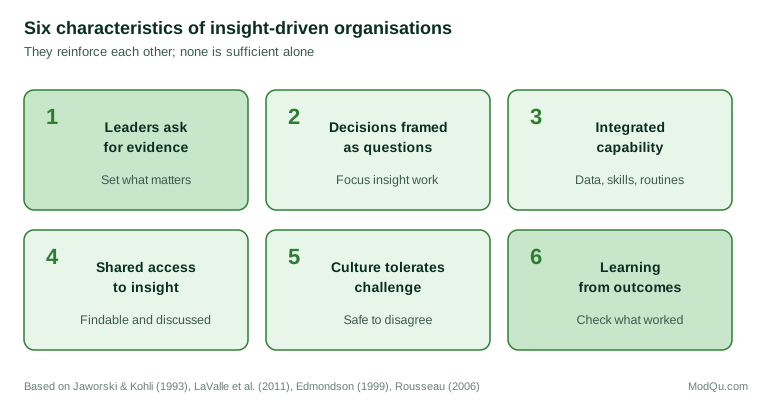
1. Leaders who ask for evidence
Leadership is the characteristic most often identified as decisive. In a large survey of executives, LaValle et al. (2011) found that the main barriers to using analytics were managerial and cultural rather than technical; the most commonly cited obstacle was a lack of understanding of how to use analytics to improve the business. McAfee and Brynjolfsson (2012) argued that the shift to data-driven decision making is above all a management challenge, requiring leaders who are willing to ask "what do the data say?" and to change course when the answer is inconvenient. When senior leaders consistently ask what evidence supports a proposal, the rest of the organisation learns that evidence matters.
2. Decisions framed as questions
Insight-driven organisations start from decisions rather than data. Before commissioning research or analysis, they state the decision to be made and what would need to be true for each option to be the right one. This keeps insight work focused and makes it easier to tell whether it was useful. Provost and Fawcett (2013) described data-driven decision making as the practice of basing decisions on the analysis of data rather than purely on intuition, and noted that its benefits depend on the decisions being ones where better information can change the outcome.
3. An integrated insight capability
These organisations combine several kinds of evidence, such as surveys, behavioural data, qualitative research, operational data and external sources, rather than relying on one. Research on analytics capability shows that integration is a capability built from several resources: data, technology, skilled people, and organisational routines for using what they produce (Gupta & George, 2016). Technology alone does not create the capability.
4. Shared access to insight
Insight is available to the people who need it, in a form they can use. Market orientation research gave intelligence dissemination equal weight with generation: knowledge held in one department does little for decisions made in another (Jaworski & Kohli, 1993). In practice, this means repositories that make past findings easy to find, regular forums where insight is discussed, and insight specialists who work alongside decision makers.
5. A culture that tolerates challenge
Evidence is only useful if people can raise it when it contradicts a plan. Edmondson (1999) showed that teams with higher psychological safety, a shared belief that it is safe to take interpersonal risks, engaged more in learning behaviours such as asking questions, seeking feedback and discussing errors. In insight-driven organisations, analysts and researchers can say "the evidence does not support this" without penalty, and leaders treat such statements as useful rather than disloyal.
6. Learning from outcomes
Finally, insight-driven organisations check whether their decisions worked and what the evidence did or did not predict. Rousseau (2006) argued that evidence-based management requires not only using the best available evidence but also learning systematically from the results of decisions. Without this feedback, an organisation cannot tell which kinds of insight are reliable.
What the evidence says about performance
The claim that insight-driven organisations perform better has been tested in several ways.
Market orientation and performance
The largest body of evidence concerns market orientation. Narver and Slater (1990) found a substantial positive relationship between market orientation and profitability in a sample of business units. Jaworski and Kohli (1993) found that market orientation was related to overall business performance and to employee commitment and esprit de corps. Kirca et al. (2005) pooled results from many such studies in a meta-analysis and concluded that market orientation is positively associated with overall business performance, and that the effect operates partly through innovation, customer quality and customer loyalty. They also found that the relationship was stronger in some settings than others, including manufacturing compared with service firms and in low power distance and uncertainty avoidance cultures.
Data-driven decision making and analytics
A newer body of research examines data-driven decision making directly. Brynjolfsson et al. (2011) studied large publicly traded firms and found that those that reported greater use of data and analytics in decision making had output and productivity about 5% to 6% higher than would be expected given their other investments. Germann et al. (2013) surveyed senior managers and found that deploying marketing analytics was associated with better firm performance, and that the association was stronger in more competitive industries and where customer preferences changed rapidly. Müller et al. (2018) used firm-level panel data and found that adopting big data and analytics was associated with an average productivity gain of roughly 3% to 7%, with the effect concentrated in information technology intensive and highly competitive industries.
How the benefits arise
Research also suggests why such benefits occur. Wamba et al. (2017) found that analytics capability improved firm performance both directly and through dynamic capabilities, the organisation's ability to sense change and reconfigure its resources. Mikalef et al. (2019) found that analytics capability supported innovation through similar dynamic capabilities, with stronger effects in more dynamic environments. Ghasemaghaei et al. (2017) found that analytics improved firm agility when the tools, data and people's skills fitted the tasks at hand. The common thread is that insight improves performance mainly by helping organisations notice and respond to change sooner and more accurately.
Interpreting the evidence with care
Several cautions apply. Most studies are observational, so it is difficult to separate the effect of being insight-driven from other qualities of well-managed firms. Many rely on managers' own reports of how they use information, which may be optimistic. Effects vary considerably across industries and conditions, so the average benefit says little about a particular organisation. And the strongest evidence links performance to the use of insight, not to the possession of data or technology. Organisations that invest in data without changing how decisions are made should not expect the benefits these studies report.
Reverse causation is a particular concern. Firms that are already successful may have more money to spend on research and analytics, and may report greater use of evidence because they have more time to reflect on their decisions. Studies that follow firms over time, such as the panel analysis of Müller et al. (2018), reduce this problem but do not remove it. The most defensible conclusion is that the use of insight and analytics is reliably associated with better performance, that plausible mechanisms explain the association, and that the size of the benefit depends heavily on the setting.
Becoming more insight-driven
For organisations that want to move in this direction, the research points to a small number of priorities. Start with leadership behaviour, because it shapes what everyone else does. Link insight work explicitly to major decisions. Build the integration of data, skills and routines rather than buying technology alone. Make insight easy to find and discuss. Protect people who bring unwelcome evidence. And review decisions after the fact to learn what worked. None of these steps requires a large budget, but all of them require persistence, because they change habits rather than tools.
A simple diagnostic can help an organisation see where it stands. Executives can ask: For our five most important recent decisions, what evidence did we use, and would we have chosen differently without it? Who outside the insight team can find and read our last ten studies? When was a plan last changed because the evidence did not support it? Clear answers to these questions indicate an insight-driven organisation more reliably than any statement of values.
Key takeaways
An insight-driven organisation generates understanding of its customers and markets, shares it, and acts on it as a normal part of work. Six characteristics recur: leaders who ask for evidence, decisions framed as questions, an integrated insight capability, shared access to insight, a culture that tolerates challenge, and learning from outcomes. Research on market orientation and data-driven decision making consistently finds positive associations with performance, although effects vary by context and causal claims require caution. The benefits come from using insight in decisions, not from holding data.
References
Brynjolfsson, E., Hitt, L. M., & Kim, H. H. (2011). Strength in numbers: How does data-driven decisionmaking affect firm performance? (SSRN Working Paper). https://doi.org/10.2139/ssrn.1819486
Edmondson, A. (1999). Psychological safety and learning behavior in work teams. Administrative Science Quarterly, 44(2), 350–383. https://doi.org/10.2307/2666999
Germann, F., Lilien, G. L., & Rangaswamy, A. (2013). Performance implications of deploying marketing analytics. International Journal of Research in Marketing, 30(2), 114–128. https://doi.org/10.1016/j.ijresmar.2012.10.001
Ghasemaghaei, M., Hassanein, K., & Turel, O. (2017). Increasing firm agility through the use of data analytics: The role of fit. Decision Support Systems, 101, 95–105. https://doi.org/10.1016/j.dss.2017.06.004
Gupta, M., & George, J. F. (2016). Toward the development of a big data analytics capability. Information & Management, 53(8), 1049–1064. https://doi.org/10.1016/j.im.2016.07.004
Jaworski, B. J., & Kohli, A. K. (1993). Market orientation: Antecedents and consequences. Journal of Marketing, 57(3), 53–70. https://doi.org/10.1177/002224299305700304
Kirca, A. H., Jayachandran, S., & Bearden, W. O. (2005). Market orientation: A meta-analytic review and assessment of its antecedents and impact on performance. Journal of Marketing, 69(2), 24–41. https://doi.org/10.1509/jmkg.69.2.24.60761
LaValle, S., Lesser, E., Shockley, R., Hopkins, M. S., & Kruschwitz, N. (2011). Big data, analytics and the path from insights to value. MIT Sloan Management Review, 52(2), 21–31.
McAfee, A., & Brynjolfsson, E. (2012). Big data: The management revolution. Harvard Business Review, 90(10), 60–68.
Mikalef, P., Boura, M., Lekakos, G., & Krogstie, J. (2019). Big data analytics capabilities and innovation: The mediating role of dynamic capabilities and moderating effect of the environment. British Journal of Management, 30(2), 272–298. https://doi.org/10.1111/1467-8551.12343
Müller, O., Fay, M., & vom Brocke, J. (2018). The effect of big data and analytics on firm performance: An econometric analysis considering industry characteristics. Journal of Management Information Systems, 35(2), 488–509. https://doi.org/10.1080/07421222.2018.1451955
Narver, J. C., & Slater, S. F. (1990). The effect of a market orientation on business profitability. Journal of Marketing, 54(4), 20–35. https://doi.org/10.1177/002224299005400403
Provost, F., & Fawcett, T. (2013). Data science and its relationship to big data and data-driven decision making. Big Data, 1(1), 51–59. https://doi.org/10.1089/big.2013.1508
Rousseau, D. M. (2006). Is there such a thing as "evidence-based management"? Academy of Management Review, 31(2), 256–269. https://doi.org/10.5465/amr.2006.20208679
Said, E., Macdonald, E. K., Wilson, H. N., & Marcos, J. (2015). How organisations generate and use customer insight. Journal of Marketing Management, 31(9–10), 1158–1179. https://doi.org/10.1080/0267257X.2015.1037785
Wamba, S. F., Gunasekaran, A., Akter, S., Ren, S. J., Dubey, R., & Childe, S. J. (2017). Big data analytics and firm performance: Effects of dynamic capabilities. Journal of Business Research, 70, 356–365. https://doi.org/10.1016/j.jbusres.2016.08.009