
Insights · The insight function
The Chief Insights Officer: Role and Responsibilities
What a chief insights officer does, how the role differs from those of the chief marketing, data and analytics officers, what research on senior functional leaders suggests about its value, and the capabilities that make the role effective.
As customer understanding has moved from a technical support activity to a source of strategic advantage, some organisations have created a senior executive role to lead it. The title varies: chief insights officer, chief customer insight officer, vice-president of consumer insights, or head of customer intelligence. The responsibilities vary too. But the underlying idea is consistent: someone at senior level should be accountable for ensuring that the organisation understands its customers and markets and uses that understanding in its most important decisions.
This article describes what the role involves, how it relates to neighbouring executive roles, what research on senior functional leaders says about when such roles add value, and what capabilities make a chief insights officer effective. There is relatively little academic research on the chief insights officer specifically, so the article draws on broader research on market orientation, marketing leadership, information use and analytics.
Why a senior insights role?
The case for a senior insights leader rests on three findings from research.
First, market intelligence creates value when it is generated, spread across the organisation and acted upon (Kohli & Jaworski, 1990). These processes cut across departments: marketing, product, sales, service and operations all generate and need customer information. Someone must coordinate them, and coordination across departments usually requires seniority.
Second, research is used more when researchers are close to decision-makers. Deshpandé and Zaltman (1982) found that the interaction between researchers and managers was one of the strongest influences on whether research was used. Menon and Varadarajan (1992) emphasised that both direct use in decisions and broader changes in managers' understanding depend on such relationships. An insights leader who sits with the senior team can ensure that insight reaches decisions at the moment it can make a difference.
Third, the information environment has become more complex. Wedel and Kannan (2016) describe how firms now combine research, transaction data, digital behaviour and external sources. Integrating these sources, and judging the strengths and weaknesses of each, is a strategic task as much as a technical one.
Upper echelons theory provides a further rationale. Hambrick and Mason (1984) argued that organisations reflect the values, experiences and cognitive frames of their top managers. If the senior team includes someone whose role is to represent the customer's perspective and the evidence about it, that perspective is more likely to shape strategy.
Core responsibilities
Although job descriptions differ, the role typically spans five areas of responsibility.
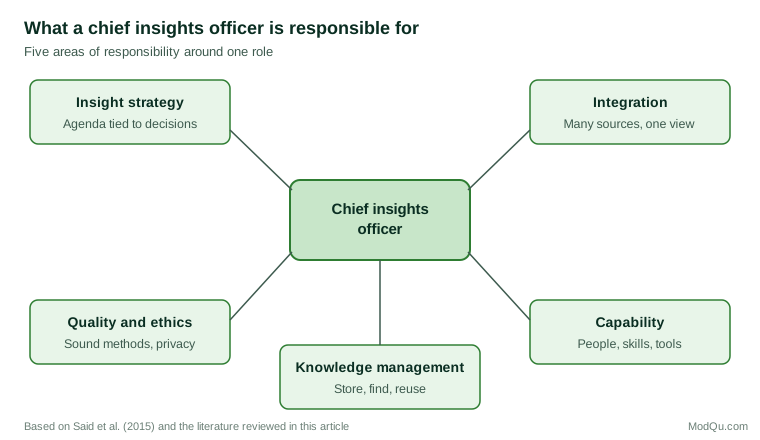
1. Insight strategy
The chief insights officer sets the agenda for customer understanding. This means identifying the organisation's most important decisions and uncertainties, determining what needs to be learned to address them, and allocating research and analytics resources accordingly. Decision analysis provides a useful principle: information has value only to the extent that it can change a decision (Howard, 1966). An insight strategy built on this principle invests most where uncertainty is high and the stakes are large.
2. Integration of sources
The insights leader is responsible for bringing together research, behavioural data, operational data and external information into a coherent view of customers. This usually requires partnership with data, analytics and IT functions, and agreement about who owns which data and how it can be combined.
3. Quality, ethics and independence
The leader is accountable for the quality of the evidence behind insights: sound methods, appropriate samples, honest statements of uncertainty. Increasingly, this also includes the ethical use of customer data, including privacy, consent and fairness. A further and often overlooked responsibility is protecting the independence of insight. When findings are unwelcome, someone senior must ensure that they are heard rather than softened or suppressed.
4. Knowledge management
Organisations repeatedly lose what they have learned about customers when projects end and people move on. The insights leader is responsible for organisational memory: systems and habits that make past insights available and connect new findings with old ones. Sinkula (1994) described organisational memory as a core part of how firms process market information. Szulanski (1996) showed that knowledge does not transfer easily within firms, even when people want to share it, so memory requires active management.
5. Capability
Finally, the leader builds the people, tools and partnerships that make insight possible: hiring and developing researchers and analysts, choosing technology, and managing relationships with research agencies and data providers. Research on analytics capability shows that technology alone is not enough; skilled people and supportive organisational routines matter as much (Gupta & George, 2016).
Relationship with other senior roles
The chief insights officer works alongside several other executives whose roles overlap.
Chief marketing officer. In many organisations, insights sit within marketing, and the insights leader reports to the chief marketing officer. This keeps insight close to brand and communication decisions but can limit its reach into product, operations and strategy. Where the insights leader reports to the chief executive or the strategy function, insight may influence a wider range of decisions but lose some closeness to marketing practice.
Chief data officer and chief analytics officer. These roles focus on data infrastructure, governance and advanced analytics. Their overlap with insights is substantial. In practice, the distinction is usually that data and analytics leaders focus on the systems and models that produce information, while the insights leader focuses on understanding customers and turning evidence into decisions. Provost and Fawcett (2013) describe data science as the set of principles that support data-driven decision-making; the insights role sits at the point where those principles meet business judgement.
Chief customer officer and customer experience leaders. These roles focus on improving the customer's experience across touchpoints. They are major users of insight and often run their own feedback programmes. Close coordination prevents duplication and conflicting measures.
The precise boundaries matter less than clarity. Overlapping roles without agreed boundaries lead to competing versions of the customer and duplicated research.
What research says about senior functional leaders
There is little direct evidence on whether chief insights officers improve company performance. Research on chief marketing officers offers a useful parallel. Nath and Mahajan (2008) studied large United States firms and found no significant relationship between the presence of a chief marketing officer in the top management team and firm performance. Germann, Ebbes and Grewal (2015) revisited the question using a larger data set and methods designed to address how firms choose to appoint such officers, and found a positive association between having a chief marketing officer and firm performance. The contrasting results suggest that the value of a senior functional leader depends on the role, the person and the context, not simply on the title.
Research on marketing influence points in the same direction. Verhoef and Leeflang (2009) found that marketing departments gained influence within firms when they were accountable for financial outcomes and innovative, and that greater influence was associated with stronger market orientation. Moorman and Rust (1999) found that the marketing function contributed most when it connected customers with products, service delivery and financial accountability. By analogy, an insights leader is likely to add most value when they can link insight to specific decisions and outcomes, not merely produce it.
Studies of analytics point to the importance of culture and leadership. LaValle, Lesser, Shockley, Hopkins and Kruschwitz (2011), in a survey of nearly 3,000 executives, found that the leading obstacles to using analytics were managerial and cultural rather than technical. Germann, Lilien and Rangaswamy (2013) found that the performance benefits of marketing analytics depended on its deployment across the firm, which required top management support. Brynjolfsson, Hitt and Kim (2011) found that firms that based decisions on data were more productive than expected. These findings suggest that a senior insights leader's most important contribution may be cultural: making evidence a normal part of how decisions are made.
Capabilities of an effective chief insights officer
Drawing these strands together, an effective insights leader needs a distinctive combination of capabilities.
Business judgement. The leader must understand the organisation's strategy, economics and decisions well enough to know which questions matter. Insight that is technically excellent but strategically irrelevant has little value.
Methodological credibility. The leader need not be the best statistician in the team, but must be able to judge the quality of evidence, recognise weak inferences and defend methods when findings are challenged. Without this, the role becomes advocacy rather than insight.
Integrative thinking. The leader must combine evidence from sources with different strengths and biases into a coherent view, and recognise when sources conflict.
Influence without authority. Most of the decisions that insights inform are made by others. The leader must persuade, build relationships and help others reach conclusions. Weiss (1979) showed that research often influences organisations by gradually changing how problems are understood, which requires patience and persistent engagement.
Courage and independence. The leader must be willing to bring unwelcome findings to senior colleagues. Edmondson (1999) found that psychological safety supports learning in teams. The insights leader both depends on and helps to create such an environment.
Commitment to evidence-based management. Rousseau (2006) described evidence-based management as making decisions informed by the best available evidence, combined with judgement and attention to stakeholders. The insights leader is in effect the organisation's advocate for this approach.
Common pitfalls
Several patterns undermine the role.
- Title without access. A senior title without a seat in key decision forums leaves the leader producing insight that arrives too late.
- Technology first. Investing heavily in platforms and dashboards before clarifying which decisions they should serve produces data, not insight.
- Advocacy over evidence. Leaders under pressure to show influence may present insights more confidently than the evidence supports, eroding trust when the insights fail.
- Turf wars. Unclear boundaries with data, analytics and customer experience leaders lead to duplication and competing measures.
- Neglecting memory. Without knowledge management, each new leader and each new project starts again from the beginning.
Measuring the role's contribution
Because insight influences decisions indirectly, measuring the contribution of an insights leader is difficult. Useful measures include the share of major decisions informed by insight, documented cases where insight changed a decision and the results that followed, stakeholder assessments of the usefulness and credibility of insight, the speed with which important questions are answered, and reductions in duplicated research. No single measure is sufficient, but together they show whether the function is shaping decisions or merely supplying information.
A practical approach is to keep a decision log. For each major decision on the insight agenda, the log records the question asked, the evidence provided, the option chosen, whether the evidence changed the choice, and the outcome observed later. Over time, the log gives the leader and the executive team a concrete record of where insight helped, where it was ignored, and where it was wrong. It also supports learning, because reviewing past decisions shows which kinds of evidence proved reliable and which did not. Information value theory offers a further discipline: before a study is commissioned, the team can ask how much the decision would be worth improving and how likely the study is to change it (Howard, 1966). Studies that cannot plausibly change a decision are hard to justify, however interesting their subject. Finally, the leader should be wary of measures that reward activity rather than influence, such as the number of studies completed or reports delivered, because these can grow while the function's effect on decisions stays flat.
An illustration: the first year in the role
Consider a hypothetical consumer goods company that appoints its first chief insights officer after several years in which research was commissioned separately by each brand team. The example is invented, but each step reflects the responsibilities described above.
In the first three months, the new leader concentrates on listening and mapping. They meet the executive team and ask a simple question: which decisions over the next eighteen months matter most, and what would you need to know to make them well? The answers become a short insight agenda of perhaps eight to ten priority questions. At the same time, the leader takes stock of existing assets: past studies, customer databases, sales data, social listening feeds and agency contracts. Such audits commonly find that the organisation already holds partial answers to several priority questions, scattered across teams that do not know of each other's work.
In months four to six, the focus moves to integration and quality. The leader brings brand-level research budgets under shared standards, agrees common definitions for key measures such as brand awareness and customer satisfaction, and sets minimum methodological requirements for any study the company commissions. A simple repository is created so that each completed study is stored with a short summary, its sample, its date and its main limitations. Nonaka (1994) argued that organisational knowledge is created when individual and tacit understanding is converted into shared, explicit forms that others can build on; a repository with short summaries is a modest but practical version of that conversion.
In the second half of the year, the leader tests whether the function influences decisions. They attach insight leads to two or three of the most important decisions on the agenda, such as a pricing change or a new product launch, and ask those leads to stay involved from framing the question to reviewing the outcome. At the end of the year, the leader can point to specific decisions that changed because of evidence, to money saved by reusing existing studies, and to a clearer understanding among executives of what the evidence does and does not support.
This illustration also shows why context matters. Boyd et al. (2010) found that the effect of chief marketing officers on firm value depended on the role's managerial discretion and on how much power customers held in the industry. The same is likely to be true of insights leaders: a leader with a real mandate, in a market where understanding customers is decisive, has more room to add value than one appointed in name only.
Key takeaways
The chief insights officer is responsible for ensuring that an organisation understands its customers and markets and uses that understanding in its most important decisions. The role typically covers insight strategy, integration of sources, quality and ethics, knowledge management and capability building, and must be coordinated with marketing, data, analytics and customer experience leaders. Research on chief marketing officers suggests that the value of such roles depends on context and execution rather than title, and research on analytics suggests that culture and leadership matter more than technology. Effective insights leaders combine business judgement, methodological credibility, integrative thinking, influence and the independence to bring unwelcome evidence to the table.
References
Boyd, D. E., Chandy, R. K., & Cunha, M., Jr. (2010). When do chief marketing officers affect firm value? A customer power explanation. Journal of Marketing Research, 47(6), 1162–1176. https://doi.org/10.1509/jmkr.47.6.1162
Brynjolfsson, E., Hitt, L. M., & Kim, H. H. (2011). Strength in numbers: How does data-driven decisionmaking affect firm performance? (SSRN Working Paper). https://doi.org/10.2139/ssrn.1819486
Deshpandé, R., & Zaltman, G. (1982). Factors affecting the use of market research information: A path analysis. Journal of Marketing Research, 19(1), 14–31. https://doi.org/10.1177/002224378201900102
Edmondson, A. (1999). Psychological safety and learning behavior in work teams. Administrative Science Quarterly, 44(2), 350–383. https://doi.org/10.2307/2666999
Germann, F., Ebbes, P., & Grewal, R. (2015). The chief marketing officer matters! Journal of Marketing, 79(3), 1–22. https://doi.org/10.1509/jm.14.0244
Germann, F., Lilien, G. L., & Rangaswamy, A. (2013). Performance implications of deploying marketing analytics. International Journal of Research in Marketing, 30(2), 114–128. https://doi.org/10.1016/j.ijresmar.2012.10.001
Gupta, M., & George, J. F. (2016). Toward the development of a big data analytics capability. Information & Management, 53(8), 1049–1064. https://doi.org/10.1016/j.im.2016.07.004
Hambrick, D. C., & Mason, P. A. (1984). Upper echelons: The organization as a reflection of its top managers. Academy of Management Review, 9(2), 193–206. https://doi.org/10.5465/amr.1984.4277628
Howard, R. A. (1966). Information value theory. IEEE Transactions on Systems Science and Cybernetics, 2(1), 22–26. https://doi.org/10.1109/TSSC.1966.300074
Kohli, A. K., & Jaworski, B. J. (1990). Market orientation: The construct, research propositions, and managerial implications. Journal of Marketing, 54(2), 1–18. https://doi.org/10.1177/002224299005400201
LaValle, S., Lesser, E., Shockley, R., Hopkins, M. S., & Kruschwitz, N. (2011). Big data, analytics and the path from insights to value. MIT Sloan Management Review, 52(2), 21–31.
Menon, A., & Varadarajan, P. R. (1992). A model of marketing knowledge use within firms. Journal of Marketing, 56(4), 53–71. https://doi.org/10.1177/002224299205600405
Moorman, C., & Rust, R. T. (1999). The role of marketing. Journal of Marketing, 63(Special Issue), 180–197. https://doi.org/10.1177/00222429990634s117
Nath, P., & Mahajan, V. (2008). Chief marketing officers: A study of their presence in firms' top management teams. Journal of Marketing, 72(1), 65–81. https://doi.org/10.1509/jmkg.72.1.065
Nonaka, I. (1994). A dynamic theory of organizational knowledge creation. Organization Science, 5(1), 14–37. https://doi.org/10.1287/orsc.5.1.14
Provost, F., & Fawcett, T. (2013). Data science and its relationship to big data and data-driven decision making. Big Data, 1(1), 51–59. https://doi.org/10.1089/big.2013.1508
Rousseau, D. M. (2006). Is there such a thing as "evidence-based management"? Academy of Management Review, 31(2), 256–269. https://doi.org/10.5465/amr.2006.20208679
Sinkula, J. M. (1994). Market information processing and organizational learning. Journal of Marketing, 58(1), 35–45. https://doi.org/10.1177/002224299405800103
Szulanski, G. (1996). Exploring internal stickiness: Impediments to the transfer of best practice within the firm. Strategic Management Journal, 17(S2), 27–43. https://doi.org/10.1002/smj.4250171105
Verhoef, P. C., & Leeflang, P. S. H. (2009). Understanding the marketing department's influence within the firm. Journal of Marketing, 73(2), 14–37. https://doi.org/10.1509/jmkg.73.2.14
Wedel, M., & Kannan, P. K. (2016). Marketing analytics for data-rich environments. Journal of Marketing, 80(6), 97–121. https://doi.org/10.1509/jm.15.0413
Weiss, C. H. (1979). The many meanings of research utilization. Public Administration Review, 39(5), 426–431. https://doi.org/10.2307/3109916