
Insights · The insight function
Customer-Centricity and the Role of Insight
What customer-centricity means, how it differs from product-centric management, why it depends on insight, and what research says about its link with customer and financial outcomes.
Customer-centricity is one of the most widely claimed and least consistently practised ideas in management. Most organisations say they put the customer first. Fewer organise their structures, measures and decisions around customers rather than around products, channels or internal functions. Insight sits at the centre of the difference, because an organisation cannot centre itself on customers it does not understand.
This article explains what customer-centricity means, how it differs from a product-centric approach, why it depends on insight, and what research says about whether it pays.
What customer-centricity means
A customer-centric organisation designs its activities around the needs, value and experience of its customers. Shah et al. (2006) contrasted this with the product-centric approach that dominated twentieth-century management. In a product-centric firm, the basic question is how many customers can be found for a given product; the organisation is structured around product lines, and success is measured by product profitability and market share. In a customer-centric firm, the question is how many products and services can be offered to meet a given customer's needs; the organisation is structured around customer segments, and success is measured by customer satisfaction, retention and the value of customer relationships over time.
Fader (2012) added an important refinement. Customer-centricity does not mean treating every customer as equally important or doing whatever customers ask. It means recognising that customers differ greatly in their current and future value, and aligning the organisation's effort with the customers who matter most to its long-term success. This requires measuring that value, which is itself an insight task.
Customer-centricity builds on the earlier idea of market orientation. Kohli and Jaworski (1990) defined market orientation as the generation, dissemination and use of market intelligence across the organisation, and Narver and Slater (1990) identified customer orientation as one of its core components. Day (1994) argued that market-driven organisations are distinguished by superior capabilities for sensing the market and linking with customers. Customer-centricity can be seen as a stronger form of the same idea, in which the customer becomes the organising principle for structure and measurement rather than one input among several.
The stages of customer focus
Organisations rarely become customer-centric in one step. Gulati and Oldroyd (2005) described the journey as four stages of increasingly close coordination around customer information.
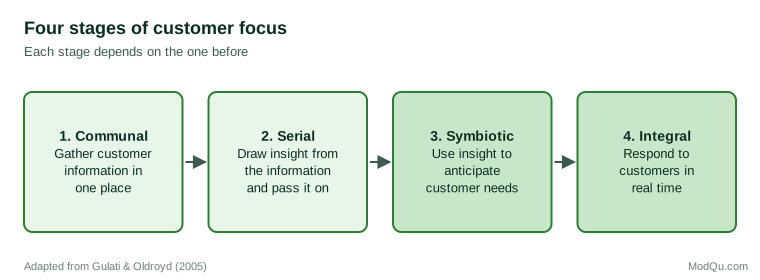
In the first stage, communal coordination, the organisation gathers customer information held in separate units into one place. In the second, serial coordination, it draws insight from that information and passes it to the units that interact with customers. In the third, symbiotic coordination, units work together to use insight to anticipate customer needs. In the fourth, integral coordination, the organisation responds to individual customers in real time using everything it knows about them. Each stage requires the one before. An organisation that has not yet pooled its customer information cannot act on an integrated view of the customer.
The framework makes clear that customer-centricity is largely a matter of how insight is gathered, combined and used. Each stage is defined by what the organisation does with customer information.
Why customer-centricity depends on insight
Insight contributes to customer-centricity in at least four ways.
First, it reveals what customers need, including needs they do not state directly. Research of this kind helps the organisation design offers around customer problems rather than around existing products.
Second, it measures customer value. Gupta et al. (2004) showed that the value of a firm's customer base, estimated from data on acquisition, retention and margins, can provide a reasonable approximation of firm value for some companies. They also found that improving customer retention had a much larger effect on customer value than comparable changes in acquisition cost or the discount rate. Such analysis is the foundation of the approach Fader (2012) describes.
Third, it maps the customer experience. Lemon and Verhoef (2016) described the customer experience as a journey across many touchpoints before, during and after purchase, only some of which the firm controls. Understanding this journey requires combining several kinds of evidence, including surveys, behavioural data and qualitative research. Homburg et al. (2017) argued that managing customer experience requires cultural mindsets, strategic directions and firm capabilities that together keep the organisation focused on the experience as customers perceive it.
Fourth, it tracks whether customer-centric actions work. Measures such as satisfaction, retention and recommendation tell an organisation whether its customer relationships are getting stronger. Choosing the right measures is itself a question for insight. Reichheld (2003) proposed that a single question about willingness to recommend was the best predictor of growth. Keiningham et al. (2007) tested this claim using longitudinal data from Norwegian firms and found that the net promoter measure did not predict revenue growth better than other customer satisfaction measures. The lesson is that customer metrics should be chosen on evidence, not on popularity.
Does customer-centricity pay?
The evidence suggests that it does, although the size of the effect varies. Anderson et al. (2004) found that firms with higher customer satisfaction scores in the American Customer Satisfaction Index tended to have higher shareholder value, measured by Tobin's q. Meta-analytic research on market orientation found positive associations with overall business performance, operating partly through customer loyalty and quality (Kirca et al., 2005). Kumar and Reinartz (2016) reviewed research on customer value and argued that firms create lasting value for shareholders by first creating value for customers and then capturing a fair share of that value through retention, growth and profitable relationships.
These findings come mostly from observational studies, so they show association rather than proof of cause. But the mechanism is plausible and consistent across studies: organisations that understand and serve their customers well tend to keep them longer and earn more from them.
Barriers to customer-centricity
If customer-centricity pays, why is it rare? Shah et al. (2006) identified four groups of barriers. Organisational culture may value products and technical excellence above customer understanding. Structures organised by product make it hard to see the whole customer. Processes such as planning and budgeting are often built around products. And financial metrics typically report product profitability rather than customer profitability. Each barrier has an insight dimension. Without integrated customer data, the organisation cannot report customer profitability; without insight that reaches decision makers, structures and processes remain product-based by default.
Said et al. (2015) found a related pattern in their study of how large organisations generate and use customer insight. Managers distinguished between information, which was plentiful, and insight, which was scarce and was valued because it was new, shared across the organisation and acted upon. Insight that stays inside a research team does little to change product-based structures and habits.
An illustration
Consider a hypothetical insurer organised by product: motor, home and travel. Each product team runs its own surveys and reports its own satisfaction score, and each believes its customers are loyal. When the insights team combines policy, claims and complaint data for the first time, it finds that customers holding two or more products are far more likely to renew, and that a poor claims experience in one product often leads customers to cancel all of their policies. Neither finding was visible from inside any single product team. The result is a shift in measurement, from product satisfaction to the value and loyalty of the whole customer relationship, which is the shift Shah et al. (2006) described.
Practical steps
For an insights team seeking to support customer-centricity, the research suggests several practical steps. Build an integrated view of the customer by combining data that sits in separate systems. Estimate customer value so that effort can be directed where it matters. Map the customer journey across touchpoints and identify the moments that most affect loyalty. Choose customer metrics that have been shown to predict outcomes in the organisation's own context. And bring customer evidence into planning, budgeting and product decisions, where the product-centric habits are strongest.
Key takeaways
Customer-centricity means organising around the needs and value of customers rather than around products. It depends on insight at every step: understanding needs, measuring customer value, mapping the experience, and tracking results. Organisations typically move through stages, from pooling customer information to responding to customers in real time. Research links customer satisfaction and market orientation with better financial performance, while also showing that the choice of customer metrics should rest on evidence. The main barriers are cultural, structural and procedural, and insight that is integrated into decisions is one of the most effective ways to overcome them.
References
Anderson, E. W., Fornell, C., & Mazvancheryl, S. K. (2004). Customer satisfaction and shareholder value. Journal of Marketing, 68(4), 172–185. https://doi.org/10.1509/jmkg.68.4.172.42723
Day, G. S. (1994). The capabilities of market-driven organizations. Journal of Marketing, 58(4), 37–52. https://doi.org/10.1177/002224299405800404
Fader, P. (2012). Customer centricity: Focus on the right customers for strategic advantage (2nd ed.). Wharton Digital Press.
Gulati, R., & Oldroyd, J. B. (2005). The quest for customer focus. Harvard Business Review, 83(4), 92–101.
Gupta, S., Lehmann, D. R., & Stuart, J. A. (2004). Valuing customers. Journal of Marketing Research, 41(1), 7–18. https://doi.org/10.1509/jmkr.41.1.7.25084
Homburg, C., Jozić, D., & Kuehnl, C. (2017). Customer experience management: Toward implementing an evolving marketing concept. Journal of the Academy of Marketing Science, 45(3), 377–401. https://doi.org/10.1007/s11747-015-0460-7
Keiningham, T. L., Cooil, B., Andreassen, T. W., & Aksoy, L. (2007). A longitudinal examination of net promoter and firm revenue growth. Journal of Marketing, 71(3), 39–51. https://doi.org/10.1509/jmkg.71.3.039
Kirca, A. H., Jayachandran, S., & Bearden, W. O. (2005). Market orientation: A meta-analytic review and assessment of its antecedents and impact on performance. Journal of Marketing, 69(2), 24–41. https://doi.org/10.1509/jmkg.69.2.24.60761
Kohli, A. K., & Jaworski, B. J. (1990). Market orientation: The construct, research propositions, and managerial implications. Journal of Marketing, 54(2), 1–18. https://doi.org/10.1177/002224299005400201
Kumar, V., & Reinartz, W. (2016). Creating enduring customer value. Journal of Marketing, 80(6), 36–68. https://doi.org/10.1509/jm.15.0414
Lemon, K. N., & Verhoef, P. C. (2016). Understanding customer experience throughout the customer journey. Journal of Marketing, 80(6), 69–96. https://doi.org/10.1509/jm.15.0420
Narver, J. C., & Slater, S. F. (1990). The effect of a market orientation on business profitability. Journal of Marketing, 54(4), 20–35. https://doi.org/10.1177/002224299005400403
Reichheld, F. F. (2003). The one number you need to grow. Harvard Business Review, 81(12), 46–54.
Said, E., Macdonald, E. K., Wilson, H. N., & Marcos, J. (2015). How organisations generate and use customer insight. Journal of Marketing Management, 31(9–10), 1158–1179. https://doi.org/10.1080/0267257X.2015.1037785
Shah, D., Rust, R. T., Parasuraman, A., Staelin, R., & Day, G. S. (2006). The path to customer centricity. Journal of Service Research, 9(2), 113–124. https://doi.org/10.1177/1094670506294666