
Inquiry · Ethics and limits
Uncertainty, Ignorance and Unknown Unknowns
Not all ignorance is alike. This article distinguishes risk, uncertainty, ambiguity and ignorance, explains the "unknown unknowns" that catch organisations by surprise, reviews the research on overconfidence, and sets out practical ways to surface and manage what is not known.
Every inquiry begins from ignorance, but ignorance comes in different forms. Sometimes we know exactly what we do not know, and can estimate the odds. Sometimes we know there is something important we cannot estimate. And sometimes we do not know what we do not know: the factor that matters most has not occurred to anyone. Distinguishing these situations is one of the most practical skills in inquiry, because each calls for a different response.
Kinds of not knowing
Economists in the early twentieth century drew a basic distinction. Frank Knight (1921) separated risk, in which the possible outcomes and their probabilities are known or can be estimated, from uncertainty, in which they cannot. A roulette wheel involves risk; the success of an untried product in a new market involves uncertainty. John Maynard Keynes (1921) similarly argued that many probabilities cannot be expressed as precise numbers, because the evidence bearing on them is incomplete or of uncertain weight.
Daniel Ellsberg (1961) showed that people treat these situations differently. Given a choice between betting on an urn containing a known mixture of coloured balls and an urn with an unknown mixture, most people prefer the known urn, even when the bets are logically equivalent. This ambiguity aversion shows that people care not only about probabilities but about how well they know them.
Michael Smithson (1989) went further, proposing a taxonomy of ignorance that includes not only uncertainty but also incompleteness, irrelevance, distortion and taboo: matters that people choose not to ask about. Robert Proctor and Londa Schiebinger (2008) introduced the study of agnotology, the ways in which ignorance is produced and maintained, sometimes deliberately, as when an industry funds research designed to cast doubt on evidence of harm from its products.
Known and unknown unknowns
In a 2002 news briefing, the United States Secretary of Defense, Donald Rumsfeld (2002), distinguished "known knowns", "known unknowns" and "unknown unknowns". The phrasing was widely mocked, but the distinction is useful and older than the remark. Joseph Luft and Harrington Ingham (1955) had used a similar grid, the Johari window, to describe what a person knows about themselves compared with what others know. Figure 1 applies the idea to an organisation's knowledge.
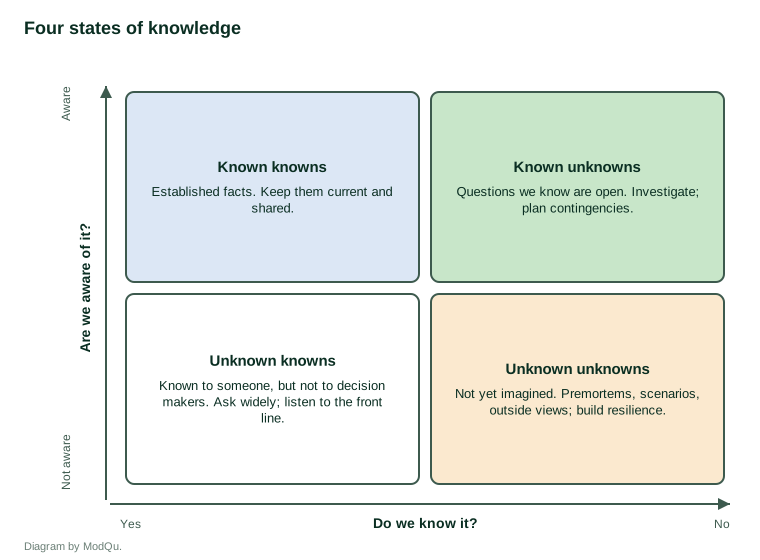
Known knowns are facts the organisation has established. Known unknowns are questions it knows it cannot yet answer, which can be investigated or managed with contingency plans. Unknown knowns are things someone in the organisation knows but that have not reached the people who need them, or that people know but prefer not to acknowledge. Unknown unknowns are the factors no one has thought of. Nassim Nicholas Taleb (2007) argued that rare, high-impact events of this last kind, which he called black swans, shape history far more than forecasts allow, and that people construct explanations for them only after the fact.
Why we underestimate what we do not know
People are systematically overconfident about the completeness of their knowledge. Marc Alpert and Howard Raiffa (1982) asked people to give ranges for uncertain quantities that they were 98% sure would contain the true value. The true values fell outside the ranges far more often than the 2% that good calibration would require. Don Moore and Paul Healy (2008) reviewed research on overconfidence and distinguished three forms: overestimating one's own performance, overplacing oneself relative to others, and overprecision, excessive certainty about the accuracy of one's beliefs. Overprecision was the most persistent.
Justin Kruger and David Dunning (1999) found that people who performed worst on tests of logic, grammar and humour tended to overestimate their performance most, partly because the skills needed to perform well are the same skills needed to recognise poor performance. Ignorance, in other words, can conceal itself.
Scientists and policymakers face the same problem at a larger scale. Brian Wynne (1992) argued that scientific assessments of risk often present uncertainty as if it were measurable risk, while overlooking forms of ignorance and indeterminacy that do not fit models. Silvio Funtowicz and Jerome Ravetz (1990) proposed that scientific information for policy should be accompanied by an assessment of its quality, including the reliability of its sources and the kinds of uncertainty involved, so that decision makers could see how much weight it could bear.
Ignorance by choice
Some ignorance is chosen. Smithson's (1989) category of taboo covers questions that a group prefers not to ask, because the answers might be uncomfortable, costly or threatening to someone's position. Organisations develop such taboos too. A company may avoid measuring customer satisfaction with a flagship product that senior leaders championed, or may not ask why experienced staff are leaving. Not asking can feel safer than asking, because a question that is never asked produces no bad news.
The cost of chosen ignorance usually arrives later and is larger. Problems that are not measured cannot be managed, and they tend to surface at the worst possible moment, in a crisis, a complaint made public or a sudden loss of customers. Proctor and Schiebinger (2008) showed how ignorance can be actively produced by those who benefit from it. Within an organisation, the same dynamic can operate more quietly, through incentives that reward good news and through meetings in which awkward questions are not welcome. A practical test is to list the questions that nobody in the organisation is currently asking, and to ask why.
Surfacing what is not known
Several methods help bring hidden ignorance to light.
Imagining failure. Mitchell et al. (1989) found that people generated more reasons for an outcome when they imagined it had already happened than when they imagined it might happen, a technique called prospective hindsight. Gary Klein (2007) built on this in the premortem: before a project begins, the team imagines that it has failed and writes down why. The exercise brings concerns into the open that people might otherwise keep to themselves.
Scenario planning. Paul Schoemaker (1995) described scenario planning as a way to explore several plausible futures rather than predicting one. By constructing distinct stories about how key uncertainties might unfold, organisations can test their strategies against conditions they had not considered.
Tracking calibration. Philip Tetlock and Dan Gardner (2015) described forecasters who made unusually accurate predictions about world events. They broke questions into parts, started from base rates, updated their estimates in small steps as new evidence arrived, and kept score of their accuracy. Calibration improves when people record their confidence and later compare it with what happened.
Asking outside the circle. Unknown knowns are often held by people outside the decision-making group: front-line staff, customers, suppliers or critics. Deliberately seeking their views is one of the cheapest ways to reduce ignorance.
Communicating uncertainty
Once uncertainty has been recognised, it must be communicated honestly. David Spiegelhalter (2017) reviewed research on communicating risk and uncertainty and recommended stating uncertainty explicitly, using ranges and frequencies rather than single figures where possible, distinguishing uncertainty about numbers from deeper uncertainty about the underlying evidence, and acknowledging what is not known. Audiences generally cope better with honest uncertainty than communicators fear, and trust is damaged more by false certainty that later proves wrong.
An example
The following example is hypothetical. A company plans to launch a subscription service. Its known knowns include the cost of delivery and the price of competing services. Its known unknowns include how many customers will subscribe, which it addresses with a survey and a limited trial. A premortem uncovers an unknown known: customer service staff have heard many complaints from existing customers about the cancellation process for a similar service, a concern that had not reached the planning team. The team simplifies cancellation before launch. Scenario planning also prompts the question of what would happen if a large retailer launched a rival service at a lower price, a possibility no one had seriously considered. The company cannot eliminate that unknown, but it can prepare a response. It agrees in advance which early signals would suggest a rival is coming and what it would do if they appeared.
Conclusion
Ignorance is not a single condition but a family of them. Risk can be estimated; uncertainty can be explored; ambiguity can be acknowledged; and unknown unknowns can be reduced, though never eliminated, by deliberate efforts to imagine failure, consider alternative futures and listen to people outside the usual circle. Since people tend to overestimate what they know, the most useful habit in inquiry may be to ask regularly: what might we be missing?
References
Alpert, M., & Raiffa, H. (1982). A progress report on the training of probability assessors. In D. Kahneman, P. Slovic, & A. Tversky (Eds.), Judgment under uncertainty: Heuristics and biases (pp. 294–305). Cambridge University Press.
Ellsberg, D. (1961). Risk, ambiguity, and the Savage axioms. The Quarterly Journal of Economics, 75(4), 643–669. https://doi.org/10.2307/1884324
Funtowicz, S. O., & Ravetz, J. R. (1990). Uncertainty and quality in science for policy. Kluwer Academic. https://doi.org/10.1007/978-94-009-0621-1
Keynes, J. M. (1921). A treatise on probability. Macmillan.
Klein, G. (2007). Performing a project premortem. Harvard Business Review, 85(9), 18–19.
Knight, F. H. (1921). Risk, uncertainty and profit. Houghton Mifflin.
Kruger, J., & Dunning, D. (1999). Unskilled and unaware of it: How difficulties in recognizing one's own incompetence lead to inflated self-assessments. Journal of Personality and Social Psychology, 77(6), 1121–1134. https://doi.org/10.1037/0022-3514.77.6.1121
Luft, J., & Ingham, H. (1955). The Johari window, a graphic model of interpersonal awareness. In Proceedings of the Western Training Laboratory in Group Development. University of California, Los Angeles.
Mitchell, D. J., Russo, J. E., & Pennington, N. (1989). Back to the future: Temporal perspective in the explanation of events. Journal of Behavioral Decision Making, 2(1), 25–38. https://doi.org/10.1002/bdm.3960020103
Moore, D. A., & Healy, P. J. (2008). The trouble with overconfidence. Psychological Review, 115(2), 502–517. https://doi.org/10.1037/0033-295X.115.2.502
Proctor, R. N., & Schiebinger, L. (Eds.). (2008). Agnotology: The making and unmaking of ignorance. Stanford University Press.
Rumsfeld, D. H. (2002, February 12). DoD news briefing: Secretary Rumsfeld and Gen. Myers [Transcript]. U.S. Department of Defense.
Schoemaker, P. J. H. (1995). Scenario planning: A tool for strategic thinking. Sloan Management Review, 36(2), 25–40.
Smithson, M. (1989). Ignorance and uncertainty: Emerging paradigms. Springer. https://doi.org/10.1007/978-1-4612-3628-3
Spiegelhalter, D. (2017). Risk and uncertainty communication. Annual Review of Statistics and Its Application, 4, 31–60. https://doi.org/10.1146/annurev-statistics-010814-020148
Taleb, N. N. (2007). The black swan: The impact of the highly improbable. Random House.
Tetlock, P. E., & Gardner, D. (2015). Superforecasting: The art and science of prediction. Crown.
Wynne, B. (1992). Uncertainty and environmental learning: Reconceiving science and policy in the preventive paradigm. Global Environmental Change, 2(2), 111–127. https://doi.org/10.1016/0959-3780(92)90017-2