
Inquiry · Inquiry in organisations
The Use of Provocations and Boundary Objects to Stimulate Inquiry
A rough prototype, a shared diagram or a deliberately provocative statement can draw out knowledge that direct questions miss. This article explains boundary objects and provocations, the research behind them, and how to use them to stimulate inquiry in teams and with customers.
Direct questions are not always the best way to find out what people know or think. Asked in the abstract how they would like a service to work, customers often struggle to answer. Asked whether two departments agree on a project's goals, managers usually say yes. Yet show the customers a rough prototype, or put a single shared plan in front of both departments, and disagreements, needs and assumptions quickly come to the surface. Objects and provocations of this kind are powerful tools of inquiry because they give people something concrete to react to.
Boundary objects
The sociologists Susan Leigh Star and James Griesemer (1989) introduced the term boundary object in a study of a natural history museum. Amateur collectors, professional scientists and administrators had very different goals, yet they cooperated through shared objects such as specimens, field notes and maps. These objects were flexible enough to be interpreted differently by each group, yet stable enough to maintain a common identity across them. Star (2010) later emphasised that boundary objects allow groups to work together without first reaching full agreement.
Paul Carlile (2002) studied product development in a manufacturing firm and found that boundary objects such as drawings, prototypes and shared spreadsheets helped engineers, designers and production staff identify where their knowledge differed and negotiate changes. He argued that the most useful boundary objects make the consequences of each group's knowledge visible to the others. Beth Bechky (2003) found that misunderstandings between engineers, technicians and assemblers were often resolved when they worked together around a physical machine rather than discussing drawings, because the machine grounded their different understandings in something they could all see. Boland and Tenkasi (1995) described how such shared representations support perspective taking, in which members of one community come to understand how another sees a problem.
As tools of inquiry, boundary objects work by making differences visible. When two groups look at the same customer journey map and describe it differently, the disagreement is itself a finding. Ewenstein and Whyte (2009) showed that visual representations in design work often act as epistemic objects: incomplete and open to development, they prompt further questions rather than simply recording answers.
Provocations
A provocation is a deliberately unfinished, unusual or extreme stimulus intended to draw out reactions. Edward de Bono (1992) proposed using statements known to be false or absurd as a way of escaping habitual thinking: the point is not whether the statement is right but where it leads. Charlan Nemeth (1986) found that exposure to dissenting views, even incorrect ones, stimulated more thorough and original thinking.
In design research, Gaver et al. (1999) developed cultural probes: packs of tasks such as disposable cameras, maps and postcards with provocative questions, given to participants to complete in their own time. The responses were not analysed as data in the usual sense but used to inspire design ideas. Tuuli Mattelmäki (2006) studied the use of probes in design practice and found that they helped participants reflect on and express aspects of their experience that interviews might not reach. Dunne and Raby (2013) used speculative design, imagined products from possible futures, to provoke debate about where technologies might lead. Michael Schrage (2000) argued that prototypes are valuable less as previews of finished products than as means of provoking conversations that reveal what people really want.
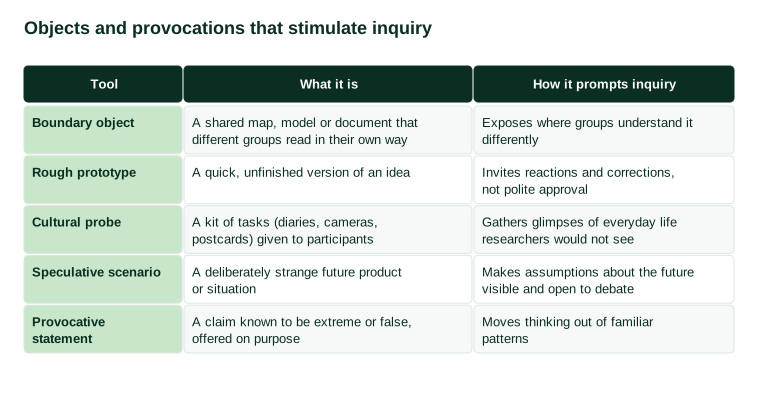
Figure 1 summarises these tools.
When to use them
Objects and provocations are most useful in three situations. The first is when people find it hard to describe their needs or practices in the abstract, as is common with new products and with routines so familiar that people no longer notice them. The second is when several groups must work together but may not share the same understanding of a problem, so that a shared object can expose differences before they cause costly mistakes. The third is when thinking has become stuck in familiar patterns, and a deliberately unusual stimulus can open up new possibilities.
They are less useful when the question is one of measurement, such as how many customers hold a view or how often a problem occurs. Reactions to a single prototype or probe come from a small number of people and are strongly shaped by the object itself. Their value lies in generating questions and revealing differences, which other methods can then examine more systematically.
Using them well
Rough is often better than polished. People are reluctant to criticise something that looks finished, and readily suggest changes to something that is clearly a draft. A provocation should also be framed honestly: participants should know that it is a stimulus for discussion, not a commitment. The responses need careful interpretation, because reactions to an object reveal what people notice and care about, not necessarily what they would do. Findings from provocations are best treated as leads to follow up with more systematic research.
A hypothetical example shows how this works. A utility company asks its billing, customer service and IT teams whether they agree on the main problems with its bills. All say they do. The researcher then prints a real bill on a large sheet and asks each team to mark what confuses customers. The marks barely overlap. Billing staff highlight tariff codes, service staff highlight payment dates and IT staff highlight a layout problem that only appears on mobile screens. The shared object revealed three different problems that the direct question had hidden.
Conclusion
People often know more than they can say in answer to a direct question. Boundary objects and provocations help bring that knowledge into the open by giving people something concrete to interpret, correct or argue with. Used early in an inquiry, they reveal differences in understanding and needs that would otherwise surface only later, when they are harder to address.
References
Bechky, B. A. (2003). Sharing meaning across occupational communities: The transformation of understanding on a production floor. Organization Science, 14(3), 312–330. https://doi.org/10.1287/orsc.14.3.312.15162
Boland, R. J., Jr., & Tenkasi, R. V. (1995). Perspective making and perspective taking in communities of knowing. Organization Science, 6(4), 350–372. https://doi.org/10.1287/orsc.6.4.350
Carlile, P. R. (2002). A pragmatic view of knowledge and boundaries: Boundary objects in new product development. Organization Science, 13(4), 442–455. https://doi.org/10.1287/orsc.13.4.442.2953
de Bono, E. (1992). Serious creativity: Using the power of lateral thinking to create new ideas. HarperBusiness.
Dunne, A., & Raby, F. (2013). Speculative everything: Design, fiction, and social dreaming. MIT Press.
Ewenstein, B., & Whyte, J. (2009). Knowledge practices in design: The role of visual representations as 'epistemic objects'. Organization Studies, 30(1), 7–30. https://doi.org/10.1177/0170840608083014
Gaver, B., Dunne, T., & Pacenti, E. (1999). Design: Cultural probes. Interactions, 6(1), 21–29. https://doi.org/10.1145/291224.291235
Mattelmäki, T. (2006). Design probes. University of Art and Design Helsinki.
Nemeth, C. J. (1986). Differential contributions of majority and minority influence. Psychological Review, 93(1), 23–32. https://doi.org/10.1037/0033-295X.93.1.23
Schrage, M. (2000). Serious play: How the world's best companies simulate to innovate. Harvard Business School Press.
Star, S. L. (2010). This is not a boundary object: Reflections on the origin of a concept. Science, Technology, & Human Values, 35(5), 601–617. https://doi.org/10.1177/0162243910377624
Star, S. L., & Griesemer, J. R. (1989). Institutional ecology, 'translations' and boundary objects: Amateurs and professionals in Berkeley's Museum of Vertebrate Zoology, 1907–39. Social Studies of Science, 19(3), 387–420. https://doi.org/10.1177/030631289019003001