
Inquiry · Philosophy of inquiry
The Pragmatist Theory of Truth and Its Relevance to Research
Pragmatists defined truth in terms of inquiry: what would hold up under continued investigation. This article explains the pragmatist theory of truth, the objections to it and what it means for how researchers judge findings.
What does it mean to say that a research finding is true? The everyday answer is that it matches reality: the survey says 40% of customers are dissatisfied, and 40% really are. But this answer raises a practical difficulty. We never get to compare our findings directly with reality; we only ever compare them with more evidence. The American pragmatists of the late nineteenth and early twentieth centuries took this difficulty seriously and proposed that truth should be understood through the process of inquiry itself. Their theory is often misunderstood, but it offers researchers a useful way of thinking about what their conclusions can and cannot claim.
Three ways of thinking about truth
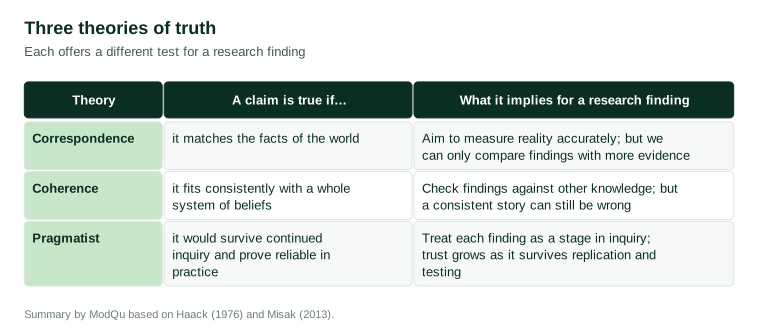
Philosophers have traditionally distinguished three broad theories of truth (Figure 1). The correspondence theory says a statement is true if it corresponds to the facts. The coherence theory says a statement is true if it fits consistently into a whole system of beliefs. The pragmatist theory says that truth is to be understood through its role in inquiry and practice: what would be agreed on by investigation, what proves reliable when acted upon, or what would survive all future testing. Susan Haack (1976) shows that the pragmatists did not speak with one voice, and that their accounts differ in important ways.
Peirce: truth as the end of inquiry
Charles Sanders Peirce applied his pragmatic maxim, that the meaning of a concept lies in its practical consequences, to the concept of truth itself. The result was a definition: "The opinion which is fated to be ultimately agreed to by all who investigate, is what we mean by the truth" (Peirce, 1878, p. 300). Truth, on this view, is not something beyond all possible evidence. It is the answer that inquiry would converge on if it were pursued long enough and well enough.
Cheryl Misak (1991, 2013) interprets Peirce as saying that a true belief is one that would never be overturned by further evidence and argument, however far inquiry went. This keeps the idea that truth is independent of what any particular person believes now, while explaining truth in terms of something inquirers can actually work towards.
James: truth as what works
William James gave pragmatism its popular reputation, and much of its notoriety. In Pragmatism (James, 1907), he wrote that "the true" is "only the expedient in the way of our thinking", and that true ideas are those "we can assimilate, validate, corroborate and verify". Ideas become true, he said, insofar as they help us get into satisfactory relations with other parts of our experience. James (1909) later defended and clarified these claims in The Meaning of Truth.
Critics pounced. Bertrand Russell (1910) argued that James had confused the criterion by which we judge whether a belief is true with the meaning of truth. A belief can be useful without being true, and true without being useful. Russell noted, for instance, that on James's account it might be "true" that a comforting religious belief is correct simply because believing it works well for the believer. Peirce himself disliked James's version so much that he renamed his own position "pragmaticism", a word he said was "ugly enough to be safe from kidnappers" (Peirce, 1905). The episode shows that "pragmatist theory of truth" names a family of views, and that its critics often attacked the most quotable version rather than the most careful one.
Dewey: warranted assertibility
John Dewey preferred to avoid the word "truth" in technical contexts. He spoke instead of warranted assertibility: the status of a conclusion reached by competent inquiry and confirmed by its consequences (Dewey, 1938). A warranted assertion is one we are entitled to rely on in further inquiry and action, while recognising that future inquiry might overturn it.
Later pragmatists
The debate did not end with the classical pragmatists. Richard Rorty (1979) argued that we should stop thinking of knowledge as a mirror of nature and treat truth as a compliment we pay to beliefs that have earned our trust in conversation. Hilary Putnam (1981) defended a related view, which he called internal realism, in which truth is idealised rational acceptability: what we would be justified in believing under ideal conditions of inquiry. Misak (2013) argues that Peirce's version, which keeps truth tied to evidence and to the possibility of error, is the strongest of these accounts.
Why it matters for research
The pragmatist theory has three practical implications for anyone who produces or uses research.
First, truth is approached through inquiry, not declared. No single study establishes a finding as true. A result becomes more trustworthy as it is replicated, tested in different ways and survives criticism. Large replication projects have shown how often published findings fail this test. The Open Science Collaboration (2015) repeated 100 psychology experiments and obtained statistically significant results in only about 36% of them, compared with 97% of the originals. Ioannidis (2005) argued that, under common conditions of small samples and flexible analysis, most published research findings may be false. A pragmatist would say that such findings were never established as true in the first place: they were early reports in an inquiry that had not yet converged.
Second, usefulness is evidence, not proof. James was right that ideas which keep working in practice deserve more confidence. A forecasting model that predicts well over many periods has earned trust. But Russell was right that usefulness is not the same as truth: a model can work for a time for the wrong reasons and then fail when conditions change. The statistician George Box (1976) captured the balance when he argued that all models are approximations and the scientist must be alert to what is importantly wrong with them.
Consider a customer survey showing that a new service feature is the main driver of satisfaction. A pragmatist reading asks what would happen if the finding were acted on and tested further. Does the relationship appear again in next quarter's survey, in a different region, or when measured with a different question? Does improving the feature actually raise satisfaction? Each test that the finding passes adds to its warrant; a failure is information about where the original inquiry went wrong.
Third, conclusions should be stated with their warrant. Dewey's language of warranted assertibility suggests a good reporting habit: say not only what was found but how strongly the evidence supports it, what methods produced it and what further evidence could change it. A report that does this treats its readers as fellow inquirers rather than recipients of final verdicts.
Conclusion
The pragmatist theory of truth is easy to caricature as "true means useful", a reading that even its founders disputed. Its more defensible form, found in Peirce and developed by Dewey and Misak, ties truth to the outcome of honest, continued inquiry. For researchers, that is a demanding standard. It means that every finding is a stage in an inquiry rather than its end, and that the best evidence of a claim's truth is that it keeps surviving the tests that could have refuted it.
References
Box, G. E. P. (1976). Science and statistics. Journal of the American Statistical Association, 71(356), 791–799. https://doi.org/10.1080/01621459.1976.10480949
Dewey, J. (1938). Logic: The theory of inquiry. Henry Holt.
Haack, S. (1976). The pragmatist theory of truth. The British Journal for the Philosophy of Science, 27(3), 231–249. https://doi.org/10.1093/bjps/27.3.231
Ioannidis, J. P. A. (2005). Why most published research findings are false. PLoS Medicine, 2(8), Article e124. https://doi.org/10.1371/journal.pmed.0020124
James, W. (1907). Pragmatism: A new name for some old ways of thinking. Longmans, Green.
James, W. (1909). The meaning of truth: A sequel to "Pragmatism". Longmans, Green.
Misak, C. (1991). Truth and the end of inquiry: A Peircean account of truth. Clarendon Press.
Misak, C. (2013). The American pragmatists. Oxford University Press.
Open Science Collaboration. (2015). Estimating the reproducibility of psychological science. Science, 349(6251), Article aac4716. https://doi.org/10.1126/science.aac4716
Peirce, C. S. (1878). How to make our ideas clear. Popular Science Monthly, 12, 286–302.
Peirce, C. S. (1905). What pragmatism is. The Monist, 15(2), 161–181.
Putnam, H. (1981). Reason, truth and history. Cambridge University Press. https://doi.org/10.1017/CBO9780511625398
Rorty, R. (1979). Philosophy and the mirror of nature. Princeton University Press.
Russell, B. (1910). Philosophical essays. Longmans, Green.