
Inquiry · Ethics and limits
The Ethics of Asking: Intrusion, Consent and Respect
Every question asked of another person makes a demand on them. This article explains the ethics of asking in research and business: why consent matters, what the principles of research ethics require, how questions can intrude, and how to ask in ways that respect the people who answer.
Asking a question seems harmless. Yet every question asked in research or business makes a claim on another person's time, attention and privacy, and some questions can cause distress, embarrassment or harm. The ethics of asking concerns how to seek knowledge from people while respecting them as people, not merely as sources of data. Its principles developed largely in response to research that went badly wrong, and they apply to every survey, interview and experiment, whether conducted in a university or a company.
Lessons from the past
Modern research ethics emerged after the Second World War, when the abuses of medical experiments made clear that scientific aims could not justify harm to participants. The World Medical Association's Declaration of Helsinki, first adopted in 1964 and revised several times since, set out principles for medical research, including that the well-being of the individual participant must take precedence over all other interests (World Medical Association, 2013).
Social research produced its own controversies. Stanley Milgram (1963) led participants to believe they were administering painful electric shocks to another person. Many showed signs of severe stress. Diana Baumrind (1964) criticised the study for deceiving participants and exposing them to distress without adequate protection. Laud Humphreys (1970) observed men in public toilets without revealing his purpose and later traced them to their homes, raising questions about covert research and privacy that are still debated. More recently, Kramer et al. (2014) reported an experiment in which a social networking platform altered the content shown to hundreds of thousands of users to study effects on their emotions, without asking for specific consent, which prompted widespread criticism.
Three principles
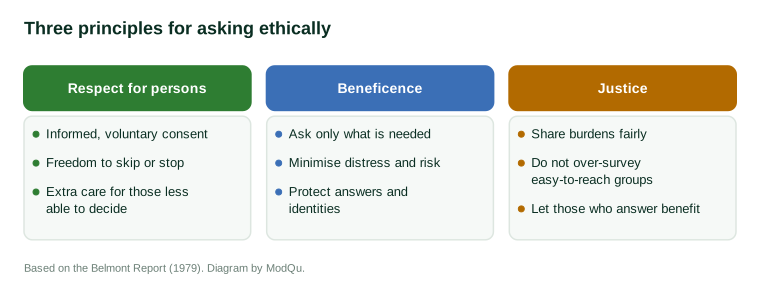
In the United States, the National Commission for the Protection of Human Subjects of Biomedical and Behavioral Research (1979) set out three principles in the Belmont Report, shown in Figure 1. Respect for persons requires treating people as autonomous agents and protecting those with reduced autonomy. Beneficence requires minimising harm and maximising benefit. Justice requires distributing the burdens and benefits of research fairly. In Canada, the Tri-Council Policy Statement expresses similar commitments through the core principles of respect for persons, concern for welfare and justice (Canadian Institutes of Health Research et al., 2022). Tom Beauchamp and James Childress (2019) developed related principles for biomedical ethics that are widely taught.
Consent
The practical expression of respect is informed consent. Ruth Faden and Tom Beauchamp (1986) argued that consent is genuine only when a person understands what they are agreeing to, agrees voluntarily and is competent to decide. For a survey or interview, this means explaining who is asking, why, what will be asked, how the answers will be used and stored, and that participation is voluntary and can be stopped at any time. Consent buried in lengthy terms and conditions, or obtained under pressure, does not meet this standard.
When questions intrude
Some questions are intrusive in themselves. Roger Tourangeau and Ting Yan (2007) reviewed research on sensitive questions, such as those about income, health, sexual behaviour or illegal acts. They found that such questions increase refusals and misreporting, particularly when asked by an interviewer, and that self-completed questionnaires reduce both. Asking sensitive questions is sometimes necessary, but each one should be justified by the purpose of the inquiry.
Helen Nissenbaum (2004) argued that privacy is best understood as contextual integrity: information flows appropriately when they respect the norms of the context in which the information was shared. Information given to a doctor, a researcher or a retailer carries different expectations. Using survey answers for a purpose the respondent did not anticipate, such as targeting them with sales calls, violates those expectations even if no law is broken.
Anonymity is also harder to guarantee than it appears. Latanya Sweeney (2000) showed that a large majority of people in the United States could be uniquely identified from just their postal code, sex and date of birth. Removing names from a data set does not necessarily make it anonymous.
Beyond the university
Formal ethics review is required for most research in universities and hospitals, but much questioning of people happens elsewhere: in companies, charities, public bodies and polling firms. The same principles apply. Professional associations in market and social research maintain codes of conduct that require researchers to be honest about who they are, to obtain consent, to keep research separate from selling, and to protect the identity of those who take part. Privacy law adds further obligations. In Canada, for example, private-sector organisations that collect personal information in the course of commercial activity must generally obtain meaningful consent and use the information only for the purposes for which it was collected.
A useful test for any organisation is whether the people being asked would be surprised or upset to learn how their answers were used. If they would, the inquiry needs to change, either in what it asks or in how clearly it explains itself.
Asking with respect
Respect also improves the quality of answers. Robert Groves, Eleanor Singer and Amy Corning (2000) proposed that people decide whether to take part in a survey by weighing features of the request that matter to them, such as the topic, the sponsor and any incentive, and that requests which are clear, relevant and considerate encourage participation. Singer et al. (1995) reviewed experiments on assurances of confidentiality and found that strong assurances improved responses to sensitive questions, although elaborate assurances for routine topics could raise suspicion.
Practical habits follow:
- Ask only what you need. Every question should serve the purpose of the inquiry.
- Explain clearly. Tell people who is asking, why, and how their answers will be used.
- Make refusal easy. Allow people to skip questions and stop at any time.
- Protect answers. Store data securely and report findings so that individuals cannot be identified.
- Use answers only as promised. Do not repurpose data without fresh consent.
Consider a hypothetical example. A company planning a customer survey drafts forty questions, including household income and health conditions. Reviewing the draft against its purpose, the team finds that neither is needed for the decisions the survey supports and removes them, shortening the survey and reducing intrusion. Those who answer are treated with respect, and the answers are likely to be more honest as a result.
References
Baumrind, D. (1964). Some thoughts on ethics of research: After reading Milgram's "Behavioral study of obedience." American Psychologist, 19(6), 421–423. https://doi.org/10.1037/h0040128
Beauchamp, T. L., & Childress, J. F. (2019). Principles of biomedical ethics (8th ed.). Oxford University Press.
Canadian Institutes of Health Research, Natural Sciences and Engineering Research Council of Canada, & Social Sciences and Humanities Research Council of Canada. (2022). Tri-Council policy statement: Ethical conduct for research involving humans – TCPS 2 (2022). Government of Canada.
Faden, R. R., & Beauchamp, T. L. (1986). A history and theory of informed consent. Oxford University Press.
Groves, R. M., Singer, E., & Corning, A. (2000). Leverage-saliency theory of survey participation: Description and an illustration. Public Opinion Quarterly, 64(3), 299–308. https://doi.org/10.1086/317990
Humphreys, L. (1970). Tearoom trade: Impersonal sex in public places. Aldine.
Kramer, A. D. I., Guillory, J. E., & Hancock, J. T. (2014). Experimental evidence of massive-scale emotional contagion through social networks. Proceedings of the National Academy of Sciences, 111(24), 8788–8790. https://doi.org/10.1073/pnas.1320040111
Milgram, S. (1963). Behavioral study of obedience. Journal of Abnormal and Social Psychology, 67(4), 371–378. https://doi.org/10.1037/h0040525
National Commission for the Protection of Human Subjects of Biomedical and Behavioral Research. (1979). The Belmont report: Ethical principles and guidelines for the protection of human subjects of research. U.S. Department of Health, Education, and Welfare.
Nissenbaum, H. (2004). Privacy as contextual integrity. Washington Law Review, 79(1), 119–157.
Singer, E., Von Thurn, D. R., & Miller, E. R. (1995). Confidentiality assurances and response: A quantitative review of the experimental literature. Public Opinion Quarterly, 59(1), 66–77. https://doi.org/10.1086/269458
Sweeney, L. (2000). Simple demographics often identify people uniquely (Data Privacy Working Paper 3). Carnegie Mellon University.
Tourangeau, R., & Yan, T. (2007). Sensitive questions in surveys. Psychological Bulletin, 133(5), 859–883. https://doi.org/10.1037/0033-2909.133.5.859
World Medical Association. (2013). World Medical Association Declaration of Helsinki: Ethical principles for medical research involving human subjects. JAMA, 310(20), 2191–2194. https://doi.org/10.1001/jama.2013.281053