
Inquiry · Inquiry in organisations
Strategic Questioning for Better Decisions
Decisions go wrong less often from poor answers than from questions that were never asked. This article explains what research on decision making shows about the most common errors, and how strategic questions at each stage of a decision help leaders frame problems, widen options, test assumptions and learn from results.
When important decisions go wrong, the post-mortem rarely finds that nobody had the relevant information. More often, the information was available but no one asked the question that would have brought it to the surface. Was this the right problem to solve? What other options were there? What would we expect to see if our plan were mistaken? Who disagreed, and why? Research on decision making shows that leaders and teams consistently fail to ask such questions, and that a modest number of well-chosen questions can substantially improve the quality of decisions. This article reviews the main sources of error, explains the functions that strategic questions perform and sets out questions for each stage of a decision.
Why decisions fail
Paul Nutt (1999) studied hundreds of decisions made in organisations and found that about half failed, in the sense that they were not fully adopted or were abandoned. Nutt identified several common features of failed decisions. Decision makers often adopted an idea early, frequently one that was presented to them as a ready-made solution, and then spent their efforts promoting it. They limited the search for alternatives, did not clarify what they were trying to achieve and relied on persuasion rather than participation to gain support. Nutt (2002) concluded that the tactics most likely to lead to failure were the ones most commonly used, because they appear quick and decisive.
Psychological research explains why. Hammond et al. (1998) described several "hidden traps" in decision making, including anchoring on initial information, the status quo trap, which favours alternatives that perpetuate the current situation, the sunk-cost trap, which leads people to justify past choices, and the confirming-evidence trap, which leads them to seek information that supports their existing view. Bazerman and Moore (2013) reviewed extensive evidence that managers are systematically overconfident, neglect base rates and are swayed by how options are framed.
Groups do not reliably correct these errors and can amplify them. Irving Janis (1982) described groupthink, in which a cohesive group's desire for agreement suppresses critical evaluation of alternatives. Stasser and Titus (1985) found that when group members held different pieces of information, discussions focused on what everyone already knew and neglected the information held by only one member, even when that information pointed to a better decision. Sunstein and Hastie (2015) reviewed research showing that groups often become more confident and more extreme in their views after discussion, without becoming more accurate.
Daniel Kahneman and colleagues (2021) also highlighted noise: unwanted variability in judgements that should be the same. Different managers presented with the same case often reach very different conclusions, and the same manager may decide differently on different days. Structured questions are one of the main ways of reducing noise, because they ensure that the same factors are considered each time.
The value of better process
The good news is that improving the process of decision making improves results. Lovallo and Sibony (2010) surveyed managers about more than 1,000 major business decisions and found that the quality of the decision process, such as whether uncertainties were explicitly discussed and dissenting views encouraged, was more strongly associated with good outcomes than the quality of the analysis behind the decision. Kahneman et al. (2011) proposed a checklist of questions that leaders can ask when reviewing a recommendation, designed to detect common biases in the team that produced it, such as whether the team fell in love with its proposal, whether credible alternatives were considered and whether the base case was overly optimistic.
Research on debiasing supports this approach. Richard Larrick (2004) reviewed techniques for reducing judgement errors and found that one of the most effective was simply prompting people to "consider the opposite": to ask what reasons there might be for the alternative view. Milkman et al. (2009) argued that because individual biases are hard to eliminate through awareness alone, the most promising improvements come from changing the decision environment and process, including the questions routinely asked.
What strategic questions do
Strategic questions serve three broad functions, shown in Figure 1. Some widen the decision, revealing alternative framings, objectives and options. Some test the decision, exposing assumptions and seeking evidence that might contradict the preferred view. And some help the group commit in a way that allows learning, by clarifying what has been decided and how its results will be reviewed.
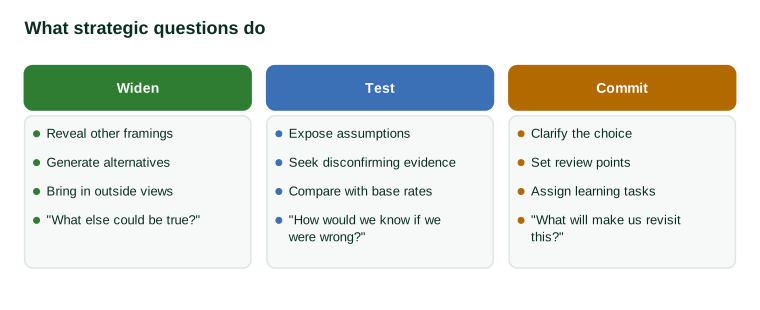
Chip and Dan Heath (2013) summarised much of the decision research in a similar framework. They recommended that decision makers widen their options, reality-test their assumptions, attain distance before deciding, to reduce the influence of short-term emotion, and prepare to be wrong. Each step is prompted by a particular kind of question.
Questions for each stage
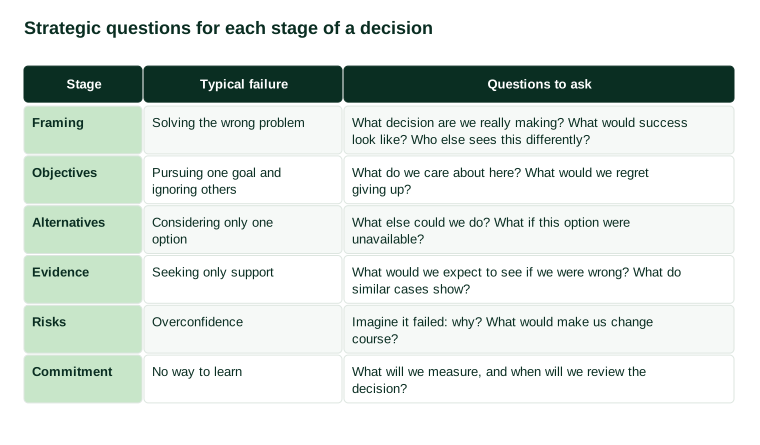
Figure 2 sets out questions for six stages of a decision, together with the typical failure each addresses.
Framing: what decision are we making?
The way a decision is framed determines which options are considered. A company that asks "should we cut prices?" has already narrowed its choices to price. One that asks "how can we win back the customers we have lost?" opens up many more possibilities. Nutt (2002) found that decisions framed around an explicit objective, rather than a proposed solution or a problem description, were more likely to succeed.
Useful framing questions include: What decision are we actually making, and why now? What would a good outcome look like in a year? Who else is affected, and how would they describe the problem? Are we treating a symptom as the problem?
Objectives: what do we care about?
Ralph Keeney (1992) argued that decisions should begin with values rather than alternatives. In value-focused thinking, decision makers first articulate what they care about in the situation, and only then generate alternatives designed to achieve those values. Starting with alternatives, by contrast, tends to limit thinking to the options that happen to be available. Asking "what are we trying to achieve?" and "what would we regret sacrificing?" often reveals objectives that were implicit or neglected.
Alternatives: what else could we do?
Nutt (1999) found that decisions in which more than one alternative was seriously considered were more likely to succeed than those in which a single option was evaluated. Heath and Heath (2013) observed that many organisational decisions are framed as a choice between doing something and not doing it, and that simply asking "what else could we do?" improves outcomes. A useful variant is the vanishing options question: if the current options were unavailable, what would we do? This forces the generation of new possibilities.
Kathleen Eisenhardt (1989) found that executives in fast-moving industries who considered several alternatives at the same time made decisions faster, not slower, than those who considered options one at a time. Having alternatives available reduced the commitment to any single option and made it easier to change course.
Evidence: how would we know if we were wrong?
The most powerful testing question asks what evidence would show that the preferred option is a mistake. This counters the confirming-evidence trap by directing attention to information that might otherwise be ignored. Other useful questions include: What do the outcomes of similar decisions elsewhere tell us? Which of our assumptions has the least support? What does the person who disagrees most know that we do not?
The last question matters because of the research on information pooling in groups. Stasser and Titus (1985) found that unique information is easily lost in discussion. Asking each person explicitly what they know that others may not, or what concerns they have not yet raised, brings that information into the open. Charlan Nemeth (1986) found that exposure to a dissenting minority view stimulated more thorough and original thinking in the majority, even when the minority view was wrong. Questions that invite dissent therefore improve the thinking of the whole group.
Risks: what could go wrong?
Gary Klein (2007) proposed the pre-mortem. Before a decision is finalised, the team imagines that it is a year later and the decision has turned out to be a disaster, and each person writes down why. Research by Mitchell et al. (1989) found that imagining an outcome as having already occurred increased the number of reasons people could generate for it. The pre-mortem uses this effect to bring risks to the surface and gives team members permission to voice doubts that social pressure might otherwise suppress.
Scenario questions extend this further. Paul Schoemaker (1995) described scenario planning, in which teams construct several plausible futures and ask how their decision would perform in each. The question "what would have to happen for this to fail?" becomes "in which of these futures does this decision work, and in which does it not?"
Commitment: how will we learn?
Decisions made under uncertainty will sometimes turn out badly even when the process was sound. The final set of questions prepares for this. What will we measure to know whether the decision is working? When will we review it? What result would lead us to change course? Setting these criteria in advance makes it easier to adjust, because the decision to change has in effect already been made. Tetlock and Gardner (2015) found that the most accurate forecasters expressed their judgements in precise, testable terms and updated them as evidence arrived; the same habit allows organisations to learn from their decisions.
The craft of questioning
Asking a good strategic question is a skill, and several writers have tried to describe it. Richard Paul and Linda Elder (2007), drawing on the Socratic tradition, classify questions according to what they probe: questions that clarify meaning ("what exactly do you mean by growth?"), questions that probe assumptions ("what are we taking for granted here?"), questions about evidence and reasons ("how do we know that?"), questions about viewpoints ("how would a competitor see this?") and questions about implications ("if that is true, what follows?"). A leader who can move between these types can examine a proposal thoroughly without needing to be an expert in its content.
Michael Marquardt (2014) studied leaders who make extensive use of questions and found that they used them to empower others, build shared understanding and surface problems early, rather than to test or trap their colleagues. The tone of a question matters as much as its content. "Why did you do that?" can be heard as an accusation; "what led you to that approach?" invites explanation. Questions asked with genuine curiosity are more likely to produce honest answers.
Warren Berger (2014) observed that many innovations began with a question that challenged a basic assumption of an industry, often asked by someone new to it. He described a sequence of questions moving from "why?", which challenges the existing situation, to "what if?", which imagines alternatives, to "how?", which turns an idea into action. The same sequence applies to strategic decisions: understand why the current situation is as it is, imagine what else might be possible and work out how to test the most promising option.
J. Edward Russo and Paul Schoemaker (1989) identified a set of decision traps that their research had found common among managers, including plunging in without thinking about the essence of the issue, failing to frame the question properly, being overconfident in one's judgement and failing to keep track of decision outcomes. They argued that each trap can be avoided by asking a specific question at the right time, such as "what is the real issue here?" before gathering information, and "what can we learn from this?" after the outcome is known.
Questions for research
Many important decisions draw on commissioned research, such as surveys, market studies or analyses of internal data. The questions asked at the start of a research project shape its usefulness as much as the questions asked during the decision itself. A research brief that asks "how satisfied are our customers?" will produce a number. One that asks "which aspects of our service most influence whether customers renew, and how do we compare with competitors on those aspects?" will produce information that bears directly on a decision.
Before commissioning research, decision makers can ask: What decision will this research inform? What result would change our decision, and what result would not? What do we already know, and what are we most uncertain about? If the answer to the first question is unclear, or if no plausible result would change the decision, the research may not be worth doing. Asking these questions also helps researchers design studies that test the assumptions that matter, rather than confirming what the organisation already believes.
Who asks the questions
Questions are only useful if they are asked, and in many organisations the social cost of asking is high. Edmondson (1999) found that people speak up and raise concerns more readily in teams with high psychological safety. In low-safety environments, the person who asks "what if we are wrong?" may be seen as disloyal or negative.
Several practices reduce this cost. Leaders can ask the questions themselves, signalling that they are legitimate. They can assign specific roles, such as a devil's advocate or a person responsible for arguing for an alternative. Schweiger et al. (1986) found that groups using structured approaches of this kind produced better strategic recommendations than groups seeking consensus. Leaders can also make questioning routine by using a standard checklist for major decisions, so that asking difficult questions is a matter of process rather than personal courage.
Leaders should also be careful about when they state their own views. A leader who announces a preference at the start of a discussion anchors the group, and subsequent questions tend to support the leader's view rather than test it. Asking others for their views first, and speaking last, allows more independent judgements to be heard.
Questions for reviewing a recommendation
Kahneman et al. (2011) suggested that leaders reviewing a recommendation from a team should ask questions about how the recommendation was produced, not only about its content. Drawing on their checklist and the research above, useful questions include:
- Is there any reason to suspect the team of motivated errors, such as a personal stake in the outcome?
- Has the team fallen in love with its proposal?
- Were there dissenting opinions within the team, and were they explored?
- Could the diagnosis have been overly influenced by a salient analogy or recent event?
- Have credible alternatives been considered?
- If this decision were made again in a year, what information would we want, and can we get it now?
- Is the base case overly optimistic? Has the team taken an outside view?
- Is the worst case bad enough?
These questions do not require the reviewer to be an expert in the subject. They focus on the quality of the reasoning, which any experienced leader can judge.
A hypothetical example
A retail chain's leadership team is asked to approve a proposal to open twenty new stores in a region where it has no presence. The proposal includes detailed financial projections and has strong support from the expansion team.
The chief executive works through a set of strategic questions. On framing, she asks what the company is trying to achieve: growth in revenue, or access to a new customer group? The answer is the latter, which opens the question of whether stores are the only way to reach them. On alternatives, she asks what else could achieve the same goal, and the team identifies two options not considered in the proposal: a partnership with an existing regional retailer and a pilot of five stores rather than twenty. On evidence, she asks what the outcomes of the company's previous regional expansions were. The answer is that they took twice as long to reach profitability as projected. On risks, she runs a pre-mortem, and a regional manager raises a concern about local competition that had not appeared in the proposal. On commitment, she asks what would lead the company to stop after the first stores open.
The decision that results is a pilot of five stores, with explicit criteria for expansion and a timetable for review, and a parallel exploration of the partnership option. The original proposal was not rejected; it was improved by questions that its authors had not been asked.
Building a questioning practice
- Ask framing questions first. Before evaluating options, check that the decision has been framed around objectives rather than a single solution.
- Always ask for alternatives. Treat a proposal with only one option as incomplete.
- Ask how you would know you were wrong. Make the search for disconfirming evidence explicit.
- Run a pre-mortem on major decisions.
- Invite dissent and unique information. Ask each person what they know or fear that has not been said.
- Speak last. Leaders should hear others' views before stating their own.
- Set review criteria in advance. Decide what will be measured and when the decision will be revisited.
- Use a standard checklist. Make the questions routine, so that asking them is expected.
Conclusion
The quality of a decision depends heavily on the questions asked before it is made. Research shows that organisations often fail by adopting the first solution offered, considering too few alternatives, seeking only confirming evidence and suppressing dissent. Each of these failures can be countered by a specific kind of question: questions that widen the frame and the set of options, questions that test assumptions against evidence and against the views of those who disagree, and questions that set up the decision so that its results can be learned from. None of these questions is complicated. What makes them strategic is asking them deliberately, at the right stage and in an environment where people feel able to answer honestly.
References
Bazerman, M. H., & Moore, D. A. (2013). Judgment in managerial decision making (8th ed.). Wiley.
Berger, W. (2014). A more beautiful question: The power of inquiry to spark breakthrough ideas. Bloomsbury.
Edmondson, A. (1999). Psychological safety and learning behavior in work teams. Administrative Science Quarterly, 44(2), 350–383. https://doi.org/10.2307/2666999
Eisenhardt, K. M. (1989). Making fast strategic decisions in high-velocity environments. Academy of Management Journal, 32(3), 543–576. https://doi.org/10.5465/256434
Hammond, J. S., Keeney, R. L., & Raiffa, H. (1998). The hidden traps in decision making. Harvard Business Review, 76(5), 47–58.
Heath, C., & Heath, D. (2013). Decisive: How to make better choices in life and work. Crown Business.
Janis, I. L. (1982). Groupthink: Psychological studies of policy decisions and fiascoes (2nd ed.). Houghton Mifflin.
Kahneman, D., Lovallo, D., & Sibony, O. (2011). Before you make that big decision. Harvard Business Review, 89(6), 50–60.
Kahneman, D., Sibony, O., & Sunstein, C. R. (2021). Noise: A flaw in human judgment. Little, Brown Spark.
Keeney, R. L. (1992). Value-focused thinking: A path to creative decisionmaking. Harvard University Press.
Klein, G. (2007). Performing a project premortem. Harvard Business Review, 85(9), 18–19.
Larrick, R. P. (2004). Debiasing. In D. J. Koehler & N. Harvey (Eds.), Blackwell handbook of judgment and decision making (pp. 316–338). Blackwell. https://doi.org/10.1002/9780470752937.ch16
Lovallo, D., & Sibony, O. (2010). The case for behavioral strategy. McKinsey Quarterly, (2), 30–43.
Marquardt, M. J. (2014). Leading with questions: How leaders find the right solutions by knowing what to ask (Rev. ed.). Jossey-Bass.
Milkman, K. L., Chugh, D., & Bazerman, M. H. (2009). How can decision making be improved? Perspectives on Psychological Science, 4(4), 379–383. https://doi.org/10.1111/j.1745-6924.2009.01142.x
Mitchell, D. J., Russo, J. E., & Pennington, N. (1989). Back to the future: Temporal perspective in the explanation of events. Journal of Behavioral Decision Making, 2(1), 25–38. https://doi.org/10.1002/bdm.3960020103
Nemeth, C. J. (1986). Differential contributions of majority and minority influence. Psychological Review, 93(1), 23–32. https://doi.org/10.1037/0033-295X.93.1.23
Nutt, P. C. (1999). Surprising but true: Half the decisions in organizations fail. Academy of Management Executive, 13(4), 75–90. https://doi.org/10.5465/ame.1999.2570556
Nutt, P. C. (2002). Why decisions fail: Avoiding the blunders and traps that lead to debacles. Berrett-Koehler.
Paul, R., & Elder, L. (2007). The thinker's guide to the art of Socratic questioning. Foundation for Critical Thinking.
Russo, J. E., & Schoemaker, P. J. H. (1989). Decision traps: Ten barriers to brilliant decision-making and how to overcome them. Doubleday.
Schoemaker, P. J. H. (1995). Scenario planning: A tool for strategic thinking. Sloan Management Review, 36(2), 25–40.
Schweiger, D. M., Sandberg, W. R., & Ragan, J. W. (1986). Group approaches for improving strategic decision making: A comparative analysis of dialectical inquiry, devil's advocacy, and consensus. Academy of Management Journal, 29(1), 51–71. https://doi.org/10.5465/255859
Stasser, G., & Titus, W. (1985). Pooling of unshared information in group decision making: Biased information sampling during discussion. Journal of Personality and Social Psychology, 48(6), 1467–1478. https://doi.org/10.1037/0022-3514.48.6.1467
Sunstein, C. R., & Hastie, R. (2015). Wiser: Getting beyond groupthink to make groups smarter. Harvard Business Review Press.
Tetlock, P. E., & Gardner, D. (2015). Superforecasting: The art and science of prediction. Crown.